
Short answer: Tweezing is cheap, precise and keeps upper lip and chin hair away for several weeks, which makes it a good choice for a few stray hairs. The downsides are time, discomfort and a risk of ingrown hairs, inflamed follicles, dark marks and, rarely, scarring. Tweezing does not make hair grow back thicker, but there is also no good evidence that it stops hair growing for good.
From our survey: 81% of the 269 women with hirsutism we surveyed had tried plucking their chin hair, but only 46% would recommend it. See the full results.
Most women with unwanted facial hair reach for tweezers at some point. They are inexpensive, you can use them anywhere, and they let you remove exactly the hair you want. But if you have more than a handful of chin or upper lip hairs, tweezing can take over your mornings. In a study of 88 women with suspected PCOS (now PMOS) and unwanted facial hair, participants spent an average of 104 minutes a week managing it, and 67% frequently checked their face in mirrors. [1]
Here is an honest look at the pros and cons of tweezing facial hair, how to do it with less irritation, and when another method might suit you better.
How tweezing works
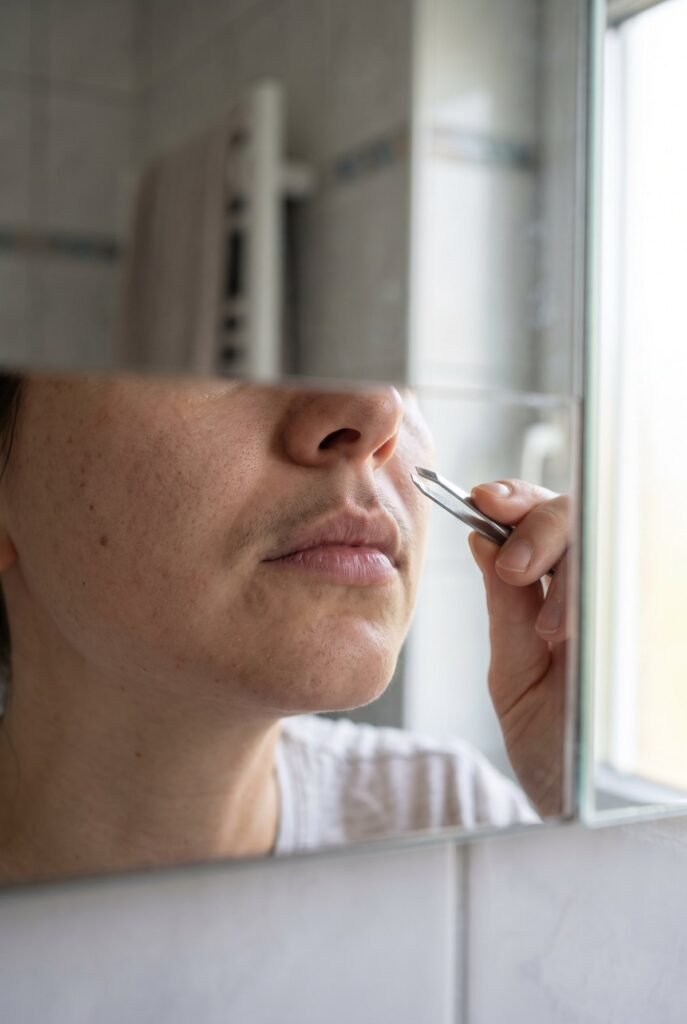
Evidence: Strong Tweezing, also called plucking, is a form of epilation. It pulls the whole hair out, including the bulb at its root, rather than cutting it at the surface. Results typically last around 6 weeks [2], and consumer health guidance gives a range of 3 to 8 weeks depending on the person and the hair. [3] The Endocrine Society guideline describes epilation methods like plucking and waxing as relatively safe and inexpensive, with some discomfort. [4]
The hair follicle itself stays in the skin, which is why the hair eventually grows back. We explain this in more detail in how many times you have to pluck a hair before it stops growing.
Pros and cons of tweezing at a glance
| Pros | Cons |
|---|---|
| Very low cost, and a good pair of tweezers lasts years | Slow if you have many hairs |
| Precise, so you remove only the hairs you choose | Painful, especially on the upper lip |
| Results last weeks rather than days | Can cause ingrown hairs, folliculitis and dark marks |
| No regrowth stubble across the whole area | Digging for short hairs can scar |
| Can be done at home at any time | Easy to overdo, and can become a habit |
The pros of tweezing chin and upper lip hair
It is cheap and always available
Tweezers are a one-time purchase. Unlike waxing, threading or laser, you don’t need an appointment, and you can deal with a stray chin hair the moment you notice it.
It is precise
Tweezers let you target a single coarse hair without touching the fine, light hair around it. That makes tweezing well suited to a few dark hairs on the chin or jaw. Hand-held tweezers are best for the occasional coarse hair or small groups of hairs. [5]
Results last longer than shaving
Because the root is removed, a tweezed hair stays gone for weeks, compared with 1 to 3 days for shaving. [3]
It won’t make hair thicker
The Endocrine Society guideline states that epilation methods such as plucking and waxing do not increase hair diameter. [4]
The cons of tweezing facial hair
Skin side effects
Pulling hairs out can irritate the follicle. Possible side effects include pain, folliculitis (inflamed, sometimes infected hair follicles that look like small pimples), ingrown hairs, scarring and post-inflammatory hyperpigmentation, meaning dark marks left after irritation. [5] The Endocrine Society notes that hyperpigmentation is particularly likely in women of color. [4] If a hair breaks off below the skin instead of coming out cleanly, it is more likely to become ingrown. [3]
It takes time
Tweezing one hair at a time works for a few hairs, but not for a whole upper lip or a dense patch on the chin and neck. If you are spending a lot of time on it each day, a method that treats the whole area at once will probably suit you better.
It hurts
Pulling a hair from the root hurts, particularly on the upper lip. Tweezing after a warm shower and pressing a cool compress on the skin afterward can make it more comfortable.
It can turn into a habit
Many women find themselves checking and plucking every day, sometimes for much longer than they meant to. If you feel unable to stop, or plucking is damaging your skin, you are not alone. Read about hirsutism and trichotillomania, a hair-pulling disorder that can overlap with facial hair removal.
How to tweeze facial hair safely
- Wash your face and hands. Clean the tips of your tweezers with rubbing alcohol before and after each use to reduce the chance of infection. [3]
- Use slanted tweezers with a sharp, well-aligned tip so they grip the hair, not the skin.
- Tweeze after a warm shower or after holding a warm, damp cloth on the area for a few minutes, when the skin is soft.
- Work in good, natural light, and use a magnifying mirror only if you need it. A magnifying mirror makes it easy to over-pluck.
- Hold the skin taut with one hand, grip the hair close to the root and pull in the direction it grows, with one smooth motion.
- Don’t dig into the skin for hairs that have not come through yet. Wait a day or two until you can grip them.
- Never pluck a hair that is trapped inside a bump. [6]
- Afterward, apply a cool compress and a gentle, fragrance-free moisturizer. Skip makeup on the area for a few hours if it is red.
If you notice repeated red bumps, pus or dark marks where you tweeze, take a break and let the skin heal. Our guide to razor bumps and ingrown hairs explains how to treat them.
Tweezing vs other facial hair removal methods
| Method | How long it lasts | Main downsides |
|---|---|---|
| Tweezing | About 3 to 8 weeks [3] | Slow, painful, ingrown hairs, dark marks |
| Shaving | 1 to 3 days [3] | Stubble, razor bumps, irritation [7] |
| Threading | Weeks (removes hair at the root) | Discomfort, but considered less painful than plucking or waxing [5] |
| Waxing | About 3 to 6 weeks [3] | Hair must be at least 6 mm long, irritation on the face [3], [7] |
| Eflornithine cream | Slows growth while used | Prescription only, stinging, acne; hair returns within about 8 weeks of stopping [8] |
| Laser | Months, with repeat sessions | Cost, works best on dark hair [4], [9] |
| Electrolysis | Potentially permanent | Cost, many sessions, results vary with the practitioner [2] |
Many women combine methods, for example tweezing a few chin hairs while shaving the upper lip, or using eflornithine cream alongside hair removal. If you want to compare shaving in more detail, read our guide to shaving your face as a woman. For longer-lasting options, see laser, IPL and electrolysis.
When to see a doctor
A few dark chin hairs are very common and usually nothing to worry about. Read what you can do about dark hairs on your chin for more. But see a doctor if:
- Facial hair appeared suddenly or is increasing quickly
- You notice a deeper voice, an enlarged clitoris or other signs of virilization. These can point to an androgen-secreting tumor, which is rare but needs prompt tests. [4]
- Your periods are irregular or have stopped
- Coarse hair is also growing on your chest, belly or back
Hormonal conditions such as PMOS, previously called polycystic ovary syndrome (PCOS), are often behind unwanted facial hair. The condition was renamed in 2026. [10] You can start with the hirsutism self-check.
Frequently asked questions
Is it bad to pluck chin hairs?
Not if you do it carefully. Tweezing is a safe, inexpensive option for a few hairs. [4] Problems come from digging into the skin, using dirty tweezers or plucking the same area repeatedly, which can cause folliculitis, ingrown hairs and dark marks. [5]
Does plucking make more hair grow back?
There is no evidence that plucking makes hairs thicker. [4]
Is it better to tweeze or shave the upper lip?
Shaving is faster and painless but lasts only 1 to 3 days. Tweezing lasts weeks but is slow and painful on a whole upper lip. [3] For more than a few hairs, many women find shaving, threading or waxing more practical.
How long does it take for tweezed hair to grow back?
Usually somewhere between 3 and 8 weeks, depending on the person and the area. [3]
Key takeaways
- Tweezing is cheap and precise and works well for a few stray chin or upper lip hairs.
- Results last weeks, but tweezing is slow and painful for larger areas.
- Ingrown hairs, folliculitis, dark marks and scarring are the main risks. Clean tweezers and gentle technique lower them.
- Tweezing does not make hair thicker, and there is no good evidence it stops hair growing permanently.
- Sudden or rapidly increasing facial hair needs a doctor’s assessment.

Free: The Hirsutism Action Plan
A 12-page guide: what’s causing your hair growth, which tests to ask your doctor for, and which treatments actually work, plus a printable doctor visit checklist.
You’ll also get our weekly email. Unsubscribe anytime.
Sources
- Lipton MG, Sherr L, Elford J, Rustin MHA, Clayton WJ. Women living with facial hair: the psychological and behavioral burden. J Psychosom Res. 2006;61(2):161-168. PubMed 16880018
- Gutierrez A, Coffel BN, Wong EB. Management of facial hair in women. Cutis. 2025;116(6):198-201. DOI 10.12788/cutis.1310
- Nemours KidsHealth. Hair Removal (medically reviewed August 2022). Accessed October 2026. Link
- Martin KA, Anderson RR, Chang RJ, et al. Evaluation and Treatment of Hirsutism in Premenopausal Women: An Endocrine Society Clinical Practice Guideline. J Clin Endocrinol Metab. 2018;103(4):1233-1257. PubMed 29522147
- DermNet. Epilation. Accessed October 2026. Link
- American Academy of Dermatology. Razor bump remedies for men with darker skin tones. Accessed October 2026. Link
- British Association of Dermatologists. Hirsutism (BAD Patient Hub). Accessed October 2026. Link
- US National Library of Medicine, DailyMed. Vaniqa (eflornithine hydrochloride) cream, 13.9%. Prescribing information. Accessed October 2026. Link
- Haedersdal M, Gøtzsche PC. Laser and photoepilation for unwanted hair growth. Cochrane Database Syst Rev. 2006;(4):CD004684. Cochrane summary
- Teede HJ, Bahri Khomami M, Morman R, et al. Polyendocrine metabolic ovarian syndrome, the new name for polycystic ovary syndrome: a multistep global consensus process. Lancet. 2026;407(10545):2329-2339. PubMed 42119588
This article is for education and is not medical advice. Talk to a doctor about diagnosis and treatment.