
Short answer: Electrolysis is the only method that destroys hair follicles one by one and is considered permanent, but it is slow and best for small areas or light hair. Laser hair removal gives long-lasting reduction rather than guaranteed permanence, and it has the strongest evidence, mainly for dark hair. IPL also works, but the evidence is weaker than for laser. If your hair growth is driven by hormones, as in PMOS (formerly PCOS), medical treatment alongside hair removal helps keep results.
Compare for your area: Our laser vs electrolysis calculator estimates sessions, time and cost based on your hair color, skin tone and whether hormones are involved.
From our survey: Only 25% of women had tried laser on their chin hair and 13% electrolysis, but electrolysis was the only method more women recommended than had tried. See the full results.
If you are tired of shaving, waxing or plucking every few days, permanent hair removal can sound like the answer. But the terms are confusing, the marketing is loud, and the right choice depends on your hair color, skin tone, the body area and the cause of your hair growth. This guide compares laser, intense pulsed light (IPL) and electrolysis, based on clinical guidelines and the best studies we could find.
Hair removal is a personal choice, not a necessity. If you do choose it, it helps to know what each method can and can’t do.
Laser vs IPL vs electrolysis at a glance
| Laser | IPL | Electrolysis | |
|---|---|---|---|
| How it works | Laser light heats pigment in the hair and damages the follicle | Flashes of light, not a laser, heat pigment in the hair | A fine probe in each follicle delivers an electric current that destroys it |
| Result | Long-lasting reduction, regrowth often finer | Reduction, generally less well studied than laser | Permanent removal of treated follicles |
| Best for | Dark hair, larger areas | Dark hair, larger areas | Any hair color, including blonde, gray and white; small areas |
| Typical course | 2 to 6 or more sessions, 4 to 8 weeks apart | Several sessions | Weekly or every other week, for up to about 18 months |
| Main downsides | Doesn’t work on light hair, risk of burns or pigment changes | Same as laser, weaker evidence | Slow, can be uncomfortable, needs a skilled electrologist |
| Evidence | Strong | Moderate | Moderate |
Sources for the table: [1][2][3][4][5][6][7]
Is any hair removal truly permanent?
Hairs grow in cycles. Laser and electrolysis work best on hairs in the active growth phase (anagen), and because hairs in one area are at different stages at any time, every method needs repeated sessions. [2][5]
Dermatology sources describe electrolysis as permanent once treatment is complete. [6][5] Laser is different. Most people stay hair-free for months or years, and any regrowth tends to be finer and lighter, but maintenance sessions may be needed. [1] Cleveland Clinic describes laser results as longer-lasting than shaving or waxing but not permanent. [2] The AAD notes that laser can be permanent after six or more treatments, except on a woman’s face. [6]
Long-term studies are limited. A 2006 Cochrane review of 11 randomized trials found that alexandrite and diode lasers reduced hair by about 50% for up to six months, but no trial had documented long-term removal. [3] A 2022 systematic review of five later trials found long-term reductions ranging from 27% to 84%, depending on the device and study, with no device clearly better than the others. [4]
Start here if you have hirsutism
Hirsutism means coarse, dark hair in a male pattern, such as on the chin, chest or stomach, and it is usually driven by androgens (hormones such as testosterone). The most common cause is PMOS, previously called polycystic ovary syndrome (PCOS). [7][8] If you aren’t sure whether your hair growth is in the normal range, try our hirsutism self-check and read what causes hirsutism.
This matters for hair removal. Hormones keep stimulating follicles, so new hairs can appear in treated areas. The Endocrine Society suggests that women with raised androgen levels who choose hair removal also take medication, such as the pill or an anti-androgen, to minimize regrowth. [7] The International PCOS Guideline adds that women with PCOS may need more laser sessions. [9] Read more in our guide to hirsutism medication.
Laser hair removal
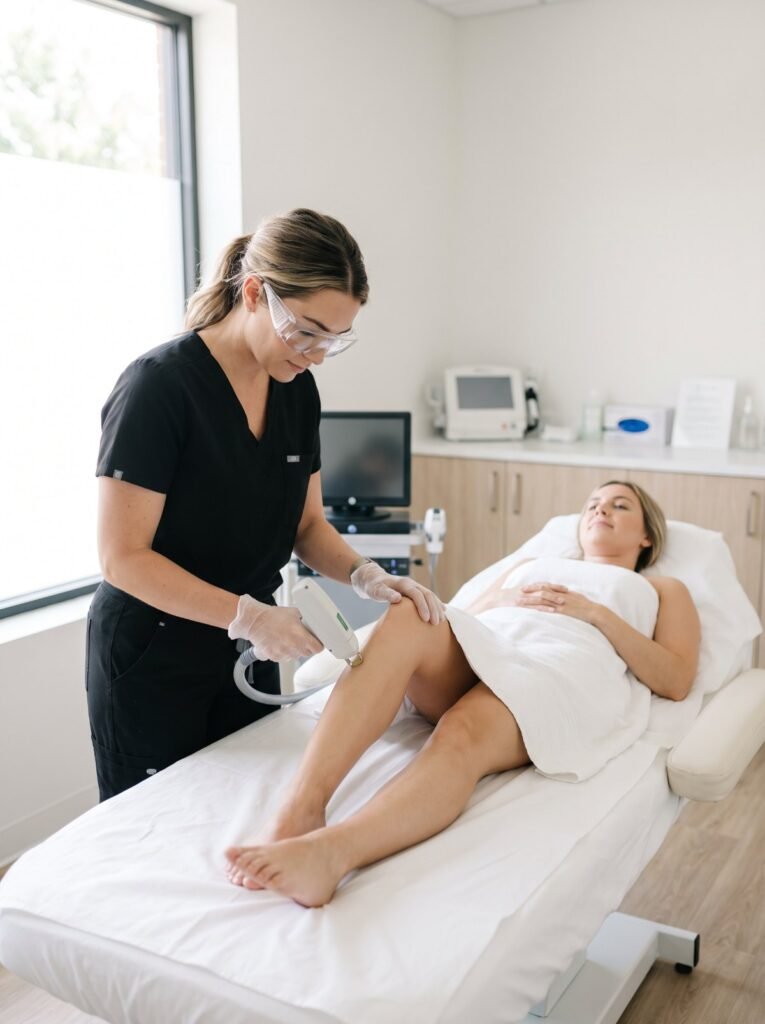
Evidence: Strong Laser hair removal uses a beam of light that is absorbed by the pigment in dark hair. The heat travels down the hair and damages the follicle. [2] The Endocrine Society suggests laser or other light-based hair removal (photoepilation) for women with auburn, brown or black hair, and the International PCOS Guideline recommends that laser and light therapies be considered for facial hirsutism. [7][9]
How well does laser work?
- After the first treatment, expect about a 10% to 25% reduction in hair. Most people need 2 to 6 treatments, usually 4 to 6 weeks apart, and some need maintenance sessions. [1] Cleveland Clinic says most people need about six to eight. [2]
- In the Cochrane review, alexandrite and diode lasers reduced hair by about 50% for up to six months after treatment. [3]
- A 2023 network meta-analysis of 13 randomized trials with 652 participants found no significant differences between laser types and concluded that lasers and IPL are safe and effective, while noting that long-term comparisons still need study. [10]
- In a small comparison in 12 people, alexandrite laser removed about 74% of underarm hair at six months, compared with about 35% for electrolysis on the other underarm. Laser was also faster and less painful. [11]
Laser for women with PMOS
One trial of women with PCOS (now PMOS) included in a 2022 review found that alexandrite laser reduced facial hair by 46% at six months, compared with 27% for IPL. [4] In an uncontrolled study of 88 women with facial hirsutism, quality-of-life scores improved steadily over five alexandrite laser sessions. [12] Because hormones keep driving hair growth, expect to need more sessions and possibly maintenance treatments. [9]
Laser on darker skin
Laser works best on dark hair and light skin, because the contrast lets the hair absorb the light rather than the surrounding skin. [1][2] It can also be used on darker skin, but this requires careful technique. [1] The Endocrine Society suggests a long-wavelength, long-pulse device, such as an Nd:YAG or diode laser with skin cooling, for women of color. [7] Ask any provider how much experience they have with your skin tone. [6]
Side effects and risks
Most people have redness, swelling and some discomfort that look like a mild sunburn and last 1 to 3 days. Less common risks include blisters, cold sore outbreaks, infection, scarring and lighter or darker patches of skin, which are usually temporary but can be permanent. The AAD warns that laser can be dangerous in inexperienced hands. [1]
A rare side effect is paradoxical hypertrichosis, where treated areas grow more hair. In one clinic’s records of 489 people treated with an alexandrite laser, it happened in 3 (0.6%). [13] The Endocrine Society warns that women of Mediterranean and Middle Eastern descent with facial hirsutism have a higher risk, and suggests topical treatment or electrolysis instead for them. [7]
Before and after laser
- Don’t tan, indoors or outdoors, and don’t use sunless tanners. Use a broad-spectrum SPF 30+ sunscreen daily. [14]
- Tell your dermatologist if you have taken isotretinoin, tend to scar or get keloids, or get cold sores. [14]
- Shave the area a few days before. Once treatment starts, don’t wax, tweeze or pluck the area, because laser needs the hair root in place. [2]
- If you are pregnant, talk to your provider first. [2]
IPL (intense pulsed light)
Evidence: Moderate IPL devices are not lasers. They use flashes of light to heat the pigment in hair, and like lasers they are grouped under “photoepilation.” [3][4] IPL is widely used, including in home devices, but it has been studied less rigorously than laser.
- The 2006 Cochrane review found little evidence of an effect for IPL at the time. [3]
- Later trials found long-term reductions of 27% to 53% with IPL, compared with 35% to 84% for alexandrite laser. One trial found IPL similar to a diode laser, while another, in women with PCOS, found it less effective than alexandrite laser. [4]
- The 2023 network meta-analysis concluded that both lasers and IPL are safe and effective. [10]
Guidelines note that laser and light-based treatments are relatively ineffective on blonde, gray or white hair. [9] Side effects are similar to laser: Redness, swelling and, less often, blisters or pigment changes. [3]
Electrolysis
Evidence: Moderate In electrolysis, a trained electrologist inserts a very fine probe into each hair follicle and uses an electric current to destroy the follicle. [5] There are three types: Galvanic (a chemical reaction), thermolysis (heat) and blend (both). No clinical trials have compared them, so claims that one type is better are based on anecdote. [15] The Endocrine Society suggests electrolysis for women with white or blonde hair, which laser can’t treat. [7]
How well does electrolysis work?
Electrolysis is described as permanent, with no maintenance needed once the hair is gone. [6] But results depend heavily on the electrologist’s skill, and not every hair is destroyed in one go. DermNet cites a common estimate that about 25% of treated hair does not regrow, so many hairs need more than one treatment. [15]
The research is old and mostly uncontrolled. In a 1986 report from one clinic, 281 women with facial and neck hirsutism received over 35,000 hours of electrolysis over four years. 93% improved, no scarring occurred, and the authors noted that results were best when excess androgens were also treated. [16] In the small underarm comparison mentioned above, electrolysis removed about 35% of hair at six months, compared with 74% for laser. [11]
What to expect
Sessions last 15 minutes to an hour and are usually weekly or every other week. The full course can take up to a year and a half, and coarse hair and larger areas need more sessions. [5] Each hair may sting, and a numbing cream can help. [6][15] For more detail, see how long electrolysis takes to show results.
Side effects and risks
Mild redness around treated follicles for a few days is common. Possible risks include scarring, lighter or darker marks, skin infection and flare-ups of cold sores. [15] People with darker skin may develop raised scars called keloids, and unsterile probes can cause infection. [6] Electrolysis should not be used if you have a pacemaker. [15] Home electrolysis kits don’t insert a probe into the follicle and are not the same thing. [6]
Which method is best for you?
- Dark hair, light to medium skin, larger areas such as legs, underarms or bikini line: Laser is usually the most efficient choice. [7][1]
- Dark hair and darker skin: Laser with a long-wavelength device such as Nd:YAG or diode, from a provider experienced with your skin tone. [7][6]
- Blonde, red, gray or white hair: Electrolysis, because laser and IPL can’t see the hair. [7][6]
- Small areas, stray hairs or hairs left after laser: Electrolysis. [5]
- Mediterranean or Middle Eastern background with facial hirsutism: Discuss the higher risk of paradoxical hair growth with laser, and consider electrolysis or a topical cream. [7]
- Raised androgen levels or PMOS: Combine hair removal with medical treatment to limit new growth. [7]

Can you combine laser with eflornithine cream?
Evidence: Moderate Eflornithine 11.5% cream (Vaniqa) is a prescription cream that slows facial hair growth. The Endocrine Society suggests adding it during laser treatment for faster results on the face. [7] In a randomized trial of 31 women, each woman used eflornithine on one side of the upper lip and an inactive cream on the other, with laser on both. 93.5% of the eflornithine sides had complete or near-complete hair removal, compared with 67.9% of the inactive cream sides. The study did not check whether the difference lasted beyond six months. [17] See our guide on how to stop hair growth on a woman’s face.
Are at-home laser and IPL devices worth it?
Evidence: Limited Home devices are cheaper and private, but the evidence is thin. A systematic review found no randomized trials, only seven small studies, most without a control group. Hair reduction ranged widely, from 6% to 72%, mostly measured 3 to 6 months after treatment. Redness was the most common side effect, and swelling, blistering, crusting and pigment changes were also reported. [18] Home devices need longer use and periodic maintenance, and the AAD advises talking to a dermatologist before buying one. [6] If you use one, follow the instructions closely and wear protective eyewear. [2]
What about facial hair?
Both laser and electrolysis are used on the face. The International PCOS Guideline specifically recommends considering laser and light therapies for facial hirsutism. [9] But facial hair driven by hormones often keeps coming back, which is why the AAD notes that laser is not permanent on a woman’s face, and why many women use electrolysis for the stray or light hairs that remain. [6][7] Everyone in the room should wear protective eyewear during laser treatment. [1]
Cost and choosing a provider
Prices vary so much by country, city, body area and number of sessions that we don’t quote figures. Both laser and electrolysis usually take many sessions, so ask for the total cost of a full course, not just a single session, and ask whether insurance or your health service covers treatment for medically diagnosed hirsutism. [5]
- For laser, the AAD recommends a board-certified dermatologist or someone they directly supervise. [1]
- For electrolysis, choose a board-certified dermatologist or a licensed or certified electrologist. [6][5]
- Ask how many people with your skin tone and hair type they have treated. [6]
- Check that probes and needles are sterile and disposable. [5]
When to see a doctor
Before you invest in permanent hair removal, see a doctor if your hair growth started suddenly or is getting worse within months, or if you also have irregular or missing periods, a deepening voice, an enlarged clitoris or increased muscle mass. These can be signs of a hormone problem that needs treatment, and rarely of a hormone-producing tumor. [7] Read more about virilization and which doctor to see.
Frequently asked questions
Is laser hair removal permanent?
Not fully. Most people are hair-free for months or years, and regrowth is usually finer and lighter, but maintenance sessions may be needed. [1] Results on a woman’s face are the least likely to be permanent. [6]
Which is more permanent, laser or electrolysis?
Electrolysis is the method considered permanent, because it destroys each treated follicle. [6][5] Laser clears hair faster and over larger areas, and in one small trial it removed more underarm hair at six months than electrolysis. [11]
Does laser hair removal work with PCOS (PMOS)?
Yes, but women with PCOS may need more sessions, and new hairs can keep appearing while hormone levels are high. [9] Combining laser with medication helps limit regrowth. [7]
Can laser hair removal make hair grow more?
Rarely. Paradoxical hair growth occurred in 0.6% of patients in one large clinic series. [13] The risk appears higher in women of Mediterranean and Middle Eastern descent with facial hirsutism. [7]
Is IPL as good as laser?
IPL can reduce hair, but it has been studied less rigorously. Some trials found it similar to diode laser, and one in women with PCOS found it less effective than alexandrite laser. [4]
Key takeaways
- Electrolysis is the method considered permanent, works on any hair color and suits small areas, but it is slow.
- Laser has the strongest evidence and gives long-lasting reduction, mainly for dark hair. It is not guaranteed to be permanent, especially on the face.
- IPL also reduces hair but is less well studied than laser, and home devices have only weak evidence.
- If you have PMOS or high androgen levels, combining hair removal with medical treatment gives better, longer-lasting results.
- Choose an experienced provider who has treated your skin tone and hair type, and protect your skin from the sun.

Free: The Hirsutism Action Plan
A 12-page guide: what’s causing your hair growth, which tests to ask your doctor for, and which treatments actually work, plus a printable doctor visit checklist.
You’ll also get our weekly email. Unsubscribe anytime.
Sources
- American Academy of Dermatology. Laser hair removal: FAQs. Accessed October 2026. Link
- Cleveland Clinic. Laser hair removal. Accessed October 2026. Link
- Haedersdal M, Gøtzsche PC. Laser and photoepilation for unwanted hair growth. Cochrane Database Syst Rev. 2006;(4):CD004684. doi:10.1002/14651858.CD004684.pub2
- Krasniqi A, McClurg DP, Gillespie KJ, Rajpara S. Efficacy of lasers and light sources in long-term hair reduction: a systematic review. J Cosmet Laser Ther. 2022;24(1-5):1-8. doi:10.1080/14764172.2022.2075899
- Cleveland Clinic. Electrolysis. Accessed October 2026. Link
- American Academy of Dermatology. 6 ways to remove unwanted hair. Accessed October 2026. Link
- Martin KA, Anderson RR, Chang RJ, et al. Evaluation and Treatment of Hirsutism in Premenopausal Women: An Endocrine Society Clinical Practice Guideline. J Clin Endocrinol Metab. 2018;103(4):1233-1257. PubMed 29522147
- Teede HJ, et al. Polyendocrine metabolic ovarian syndrome, the new name for polycystic ovary syndrome: a multistep global consensus process. Lancet. 2026;407(10545):2329-2339. Published online May 12, 2026. PubMed 42119588
- Teede HJ, Tay CT, Laven JJE, et al. Recommendations From the 2023 International Evidence-based Guideline for the Assessment and Management of Polycystic Ovary Syndrome. J Clin Endocrinol Metab. 2023;108(10):2447-2469. PubMed 37580314
- Kao YC, Lin DZ, Kang YN, Chang CJ, Chiu WK, Chen C. Efficacy of Laser in Hair Removal: A Network Meta-analysis. J Cosmet Laser Ther. 2023;25(1-4):7-19. doi:10.1080/14764172.2023.2221838
- Görgü M, Aslan G, Aköz T, Erdoğan B. Comparison of alexandrite laser and electrolysis for hair removal. Dermatol Surg. 2000;26(1):37-41. doi:10.1046/j.1524-4725.2000.99104.x
- Alizadeh N, Ayyoubi S, Naghipour M, et al. Can laser treatment improve quality of life of hirsute women? Int J Womens Health. 2017;9:777-780. doi:10.2147/IJWH.S137910
- Alajlan A, Shapiro J, Rivers JK, MacDonald N, Wiggin J, Lui H. Paradoxical hypertrichosis after laser epilation. J Am Acad Dermatol. 2005;53(1):85-88. doi:10.1016/j.jaad.2004.06.054
- American Academy of Dermatology. Laser hair removal: Preparation. Accessed October 2026. Link
- DermNet. Electrolysis. Accessed October 2026. Link
- Richards RN, McKenzie MA, Meharg GE. Electroepilation (electrolysis) in hirsutism: 35,000 hours’ experience on the face and neck. J Am Acad Dermatol. 1986;15(4 Pt 1):693-697. doi:10.1016/S0190-9622(86)70225-9
- Hamzavi I, Tan E, Shapiro J, Lui H. A randomized bilateral vehicle-controlled study of eflornithine cream combined with laser treatment versus laser treatment alone for facial hirsutism in women. J Am Acad Dermatol. 2007;57(1):54-59. doi:10.1016/j.jaad.2006.09.025
- Thaysen-Petersen D, Bjerring P, Dierickx C, Nash JF, Town G, Haedersdal M. A systematic review of light-based home-use devices for hair removal and considerations on human safety. J Eur Acad Dermatol Venereol. 2012;26(5):545-553. doi:10.1111/j.1468-3083.2011.04353.x
This article is for education and is not medical advice. Talk to a doctor about diagnosis and treatment.