

Short answer: The evidence that nut grass oil (Cyperus rotundus oil) reduces hair is very limited. It rests mainly on one small, open-label pilot study of underarm hair, written by a single author and not independently repeated[1]. There are no good trials on facial hair or hirsutism, and the claim that the oil is “anti-androgenic” has not been shown in people. We rate it as limited evidence and would not recommend it over proven options.
Nut grass essential oil, also sold as cyperus oil, has become a popular “natural laser” on social media. Sellers say it slows regrowth after shaving or waxing and, over time, stops hair from coming back. If you live with hirsutism, coarse male-pattern hair caused mostly by androgens (hormones such as testosterone), a cheap oil that does what laser does sounds very appealing.
We looked at the research behind these claims. This article explains what the studies found, what they don’t tell us, how to use the oil more safely if you decide to try it, and which options have stronger evidence.
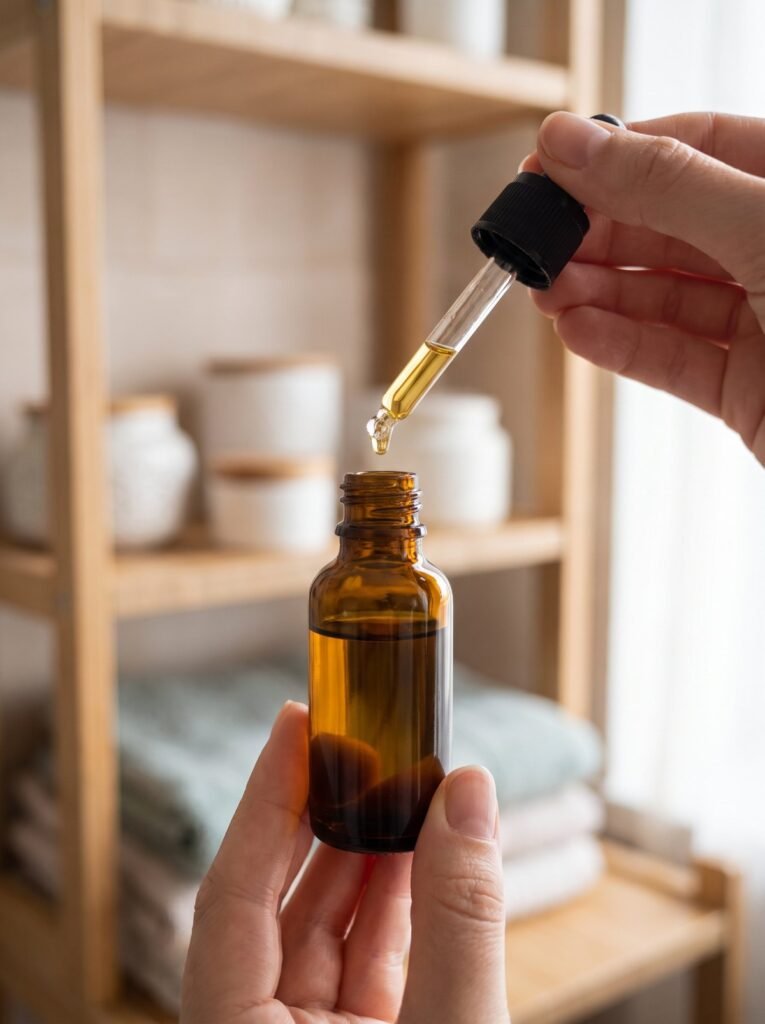
What is nut grass oil?
Nut grass (Cyperus rotundus), also called purple nutsedge or coco grass, is a grass-like plant that grows in warm climates around the world and is often treated as a weed. Nut grass essential oil is made from the plant. The plant has a long history in Ayurveda and traditional Chinese medicine, including, according to a 2025 review, for hair removal[2]. Traditional use is not the same as proof that something works, though.
Does nut grass oil remove hair or stop hair growth?
Evidence: Limited Nut grass oil does not remove hair the way shaving or waxing does. The question is whether using it regularly makes hair grow back slower or finer. The answer, based on current evidence, is that we don’t know.
The study comparing nut grass oil with laser
Most claims trace back to a 2014 study in the Aesthetic Surgery Journal. In it, 65 people with unwanted underarm hair were randomly assigned to one of three groups: topical nut grass essential oil, saline (salt water) as a control, or alexandrite laser hair removal. Sixty finished the study. The results were judged by hair counts, independent assessors and the participants themselves[1].
The author reported that the overall results of the oil and the laser were not significantly different, that the oil worked better than the laser on white hair, and that no side effects were seen[1]. That is where the “as good as laser” claim comes from.
Why we don’t trust this study on its own
- It was a pilot study. Pilot studies are small first tests meant to see whether a bigger trial is worth running.
- It was open-label. Participants and assessors could know who got which treatment, which can make results look better than they are[1].
- It has one author. PubMed lists a single author for this randomized study, and the later studies on cyperus oil come largely from the same researcher[1][2][3]. Results are much more convincing when separate research teams find the same thing.
- It was about armpits, not faces. Underarm hair and facial hirsutism behave differently, and the study did not include women with hirsutism specifically.
- The “no difference from laser” result doesn’t prove the two are equal. A small study often lacks the statistical power to detect a real difference.
- Laser works poorly on white hair, so beating laser on white hairs is a low bar. Electrolysis, not laser, is the recommended method for white or blonde hair[4].
Other studies
A 2022 randomized, double-blind trial by the same author tested nut grass oil for darkened underarm skin (hyperpigmentation) in 153 people, against hydroquinone (a skin-lightening cream) and a placebo cream. Hair growth was not the main outcome, but the author reported a greater reduction in hair growth with the oil than with hydroquinone[3]. Again, this was not a study of facial hair or hirsutism, and it has not been repeated independently.
Is nut grass oil anti-androgenic?
Evidence: None Sellers often say nut grass oil works because it is anti-androgenic, meaning it blocks male hormones in the skin. We found no human studies showing that nut grass oil lowers androgen levels or blocks androgens in women. The 2014 study measured hair counts, not hormones[1].
Even if it did have anti-androgen activity, that would not automatically make it effective. The Endocrine Society’s hirsutism guideline suggests against topical anti-androgens for hirsutism, because they have not been shown to work well enough[4]. And an oil that really did act on hormones through the skin would raise its own safety questions. Lavender and tea tree oils, for example, showed weak hormone-like activity in lab tests and were linked in case reports to breast growth in young boys who used products containing them[5].
Is nut grass oil safe?
The 2014 and 2022 studies reported no serious side effects[1][3], but they were small and short and can’t rule out rarer problems. There are no long-term safety data on daily use on the face. What we do know about essential oils in general:
- Essential oils can cause allergies. Fragrance chemicals in essential oils can cause allergic contact dermatitis, an itchy, red rash. Oxidized lavender oil, for example, caused reactions in 2.8% of patients patch tested for suspected skin allergy[6].
- Product quality varies. Essential oils are not regulated as medicines, so strength and purity can differ from bottle to bottle.
- Pregnancy, breastfeeding and children: There is no safety information, so it’s best to avoid using it in these situations.

How to use nut grass oil more safely if you try it
If you decide to try it anyway, these practical steps reduce the risk of irritation:
- Dilute it in a plain carrier oil or fragrance-free lotion. Don’t put undiluted oil on your face.
- Patch test a small amount on your inner forearm and wait a day or two.
- Apply it to intact skin. Wait until any nicks or raw patches from waxing or shaving have healed.
- Never swallow it, and keep it away from your eyes and from children.
- Stop if you notice redness, itching, burning or a rash.
- Take photos in the same light every few weeks. Because hair grows in cycles, it’s easy to see changes that aren’t really there.
What works better for unwanted hair?
If your goal is lasting hair reduction, the Endocrine Society guideline supports these options[4]:
- Laser hair removal (photoepilation) for brown or black hair, and electrolysis for white or blonde hair. See our guide to permanent hair removal.
- Hormonal birth control pills as the first medicine for most women who aren’t trying to get pregnant, with an anti-androgen added if needed after 6 months. Anti-androgens must be used with reliable contraception. See hirsutism medication.
- Eflornithine cream, a prescription cream that slows facial hair growth, alongside laser.
If you prefer to start with natural options, our hub on essential oils for facial hair removal compares the evidence for each oil, and our spearmint for hirsutism guide covers the best-studied herb.
When to see a doctor
Hirsutism is often caused by an underlying hormone condition, most commonly PMOS (formerly PCOS), so it’s worth getting it checked[4]. Start with our hirsutism self-check. See a doctor soon if hair growth starts suddenly or gets worse quickly, or if you notice signs of virilization such as a deepening voice, an enlarged clitoris or more muscle mass. These can point to a rare androgen-producing tumor[4]. Irregular or missing periods are also worth discussing with a doctor.
Frequently asked questions
Does nut grass oil permanently remove hair?
There is no reliable evidence that it does. The main study was a small pilot on underarm hair with no independent confirmation[1]. The proven ways to reduce hair long term are laser and electrolysis[4].
How long does nut grass oil take to work?
We can’t say, because there is no reliable evidence that it works. Hair grows in cycles lasting months, so any treatment that affects hair growth needs months to judge. The Endocrine Society suggests at least 6 months for hirsutism medicines[4].
Can I use nut grass oil on my face?
It hasn’t been studied on the face. If you try it, dilute it, patch test first, and keep it away from your eyes.
Is nut grass oil the same as tiger nut oil?
No. Tiger nut oil comes from Cyperus esculentus, a related plant, and is a cooking and carrier oil. Nut grass essential oil comes from Cyperus rotundus. The hair studies above used Cyperus rotundus essential oil[1].
Key takeaways
- Evidence that nut grass oil reduces hair is limited to a small, open-label, single-author pilot study on underarm hair.
- There are no good studies of nut grass oil on facial hair or hirsutism, and no evidence it lowers androgens in women.
- Like other essential oils, it can irritate the skin or cause allergies, so dilute it and patch test it first.
- For lasting hair reduction, laser, electrolysis and medical treatment have much stronger evidence.
Free: The Hirsutism Action Plan
A 12-page guide: what’s causing your hair growth, which tests to ask your doctor for, and which treatments actually work, plus a printable doctor visit checklist.
You’ll also get our weekly email. Unsubscribe anytime.
Sources
- Mohammed GF. Topical Cyperus rotundus oil: a new therapeutic modality with comparable efficacy to Alexandrite laser photo-epilation. Aesthet Surg J. 2014;34(2):298-305. PubMed 24408514
- Mohammed GF, Al-Dhubaibi MS, Bahaj SS, et al. The potential of Cyperus rotundus L. as a natural hair removal agent: A review of traditional and modern applications. Phytomedicine Plus. 2025;5(4):100854. DOI 10.1016/j.phyplu.2025.100854
- Mohammed GF. Topical Cyperus rotundus essential oil for treatment of axillary hyperpigmentation: a randomized, double-blind, active- and placebo-controlled study. Clin Exp Dermatol. 2022;47(3):534-541. PubMed 34618367
- Martin KA, Anderson RR, Chang RJ, et al. Evaluation and Treatment of Hirsutism in Premenopausal Women: An Endocrine Society Clinical Practice Guideline. J Clin Endocrinol Metab. 2018;103(4):1233-1257. PubMed 29522147
- Henley DV, Lipson N, Korach KS, Bloch CA. Prepubertal gynecomastia linked to lavender and tea tree oils. N Engl J Med. 2007;356(5):479-485. PubMed 17267908
- Hagvall L, Bråred Christensson J. Patch Testing with Main Sensitizers Does Not Detect All Cases of Contact Allergy to Oxidized Lavender Oil. Acta Derm Venereol. 2016;96(5):679-683. PubMed 26671837
This article is for education and is not medical advice. Talk to a doctor about diagnosis and treatment.