
Short answer: You can trim sideburns at home with small scissors or a facial trimmer, using two mirrors so you can see the side of your face. If you want the hair gone rather than shorter, shaving, tweezing, waxing, threading and epilators all work temporarily, and the Endocrine Society suggests laser or electrolysis for longer-lasting results. Shaving will not make the hair grow back thicker.
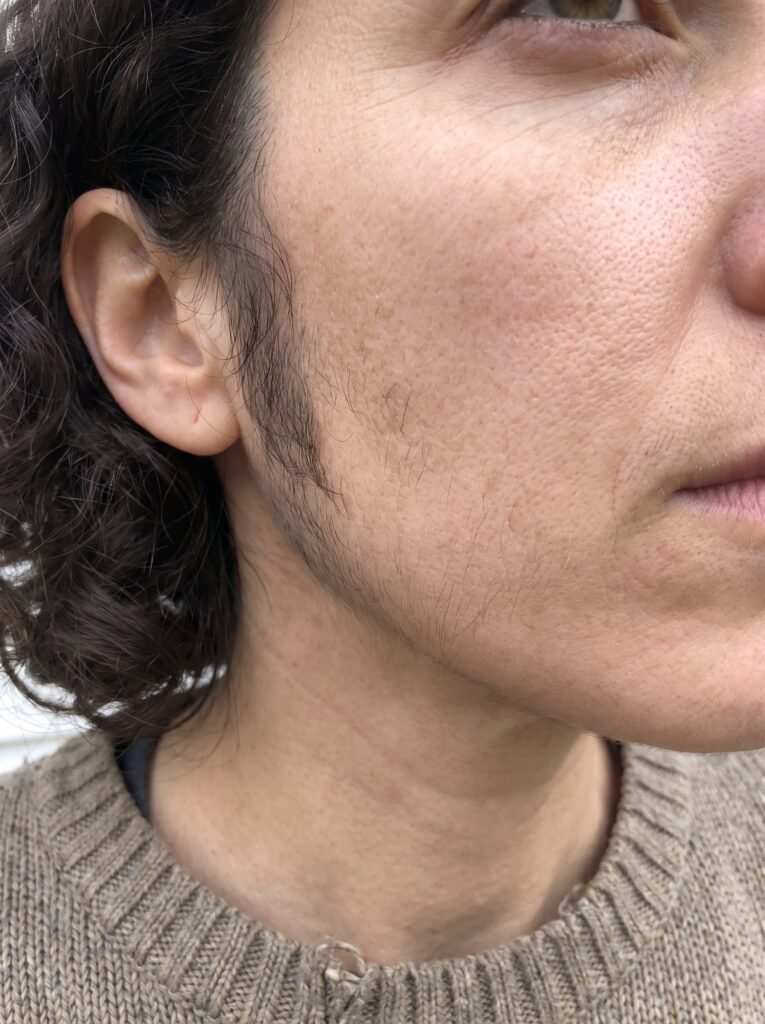
Sideburns are the strip of hair that runs from your hairline down in front of your ears. Everyone has some hair there, but in some women it is longer, darker or spreads further down the cheek than they would like. Sideburns are awkward to manage on your own because you can’t see them straight on, and the skin there is close to your hairline, ears and jaw.
This guide covers how to trim sideburns neatly at home, how each hair removal method works on this part of the face, and when sideburn hair is worth mentioning to a doctor. Whether you trim, remove or leave them alone is your choice. There is no medical reason you have to do anything about facial hair.
Are thick sideburns a sign of hirsutism?
Not necessarily. Hirsutism means coarse, dark hair growing in a male-like pattern because of androgens (hormones such as testosterone) or hair follicles that are extra sensitive to them. Doctors usually measure it with the modified Ferriman-Gallwey score, which rates nine androgen-sensitive body areas from 0 to 4. [1]
The Endocrine Society guideline points out that this score does not include the sides of the face from the hairline to below the ear, even though that area is androgen-sensitive. [1] So noticeable sideburns alone don’t tell you whether you have hirsutism, but sideburns that extend onto your cheeks or jaw together with coarse hair on your chin, upper lip, chest or belly are worth checking. You can score yourself with the hirsutism self-check and read more about the Ferriman-Gallwey score.
What you need to cut sideburns at home
- A wall mirror and a handheld or stand mirror, so you can see the side of your face
- Good light from the front or side, not only from above
- Small, sharp scissors with rounded tips, or a small trimmer with a guard
- A fine-tooth comb
- Hair clips or a hair tie to pull your scalp hair back and away from the sideburn
Clean your scissors or trimmer head before and after use, and keep them for your face only.
How to trim sideburns as a woman, step by step
- Pull your scalp hair back with a hair tie or clips so only the sideburn is loose.
- Stand side-on to the wall mirror and hold the second mirror in front of you, angled so you can see the reflection of your sideburn. A mirror on a stand frees up both hands.
- Comb the sideburn downward in the direction it grows.
- Decide where you want the sideburn to end. Many women use the top of the ear or the middle of the ear as a guide. Mark the line in your mind on both sides before you start.
- Trim a little at a time. With scissors, cut parallel to the skin and never point the tips toward your face. With a trimmer, start with a longer guard and go shorter only if you need to.
- Check the other side before you trim it, so you can match the length and the bottom edge.
- Brush away the loose hairs and look at both sides in daylight before deciding whether to take more off.
Trimming makes sideburns shorter and softer looking but leaves the hair in place. If the hair is dark, a short trim can still show as a shadow, which is why many women combine trimming with lightening, makeup or removal.
Should you shave your sideburns?
Evidence: Strong Shaving is a safe, quick way to remove sideburn hair for a day or two. It cuts the hair just below the skin surface. The Endocrine Society guideline states that shaving does not change how fast hair grows, how long it grows or how thick it is. Regrowth only feels coarser because the cut end is blunt rather than tapered. [1] The British Association of Dermatologists also says the belief that shaving causes more hair growth is not true. [2]
The downsides are stubble, which shows quickly on dark hair, and irritation. Frequent shaving can irritate the skin, and both shaving and waxing can cause razor bumps (pseudofolliculitis), where cut hairs curl back into the skin. [2] The American Academy of Dermatology (AAD) recommends these steps to reduce irritation: [3]
- Wet your skin and hair first. Shaving right after a shower works well.
- Use a shaving cream or gel, a sensitive-skin formula if your skin reacts easily.
- Shave in the direction the hair grows, which on sideburns is usually downward.
- Rinse the blade after each stroke and replace it after 5 to 7 shaves.
- Let the razor dry completely between uses and store it somewhere dry.
Read our full guide to shaving your face as a woman for more detail.
Plucking, threading and epilators
Evidence: Strong Plucking, threading and epilators (electric devices with rotating tweezers) pull hairs out by the root, so results last longer than shaving. Removing the whole hair shaft and bulb typically keeps an area smooth for around 6 weeks, although timing varies. [4] The Endocrine Society describes epilation as relatively safe and inexpensive, and notes that it does not make hairs thicker. [1]
The trade-off is discomfort and some risk to the skin. Possible side effects of epilation include pain, inflamed hair follicles (folliculitis), ingrown hairs, scarring and dark marks after inflammation, which are more common in women with darker skin. [5], [1] To lower the risk:
- Tweeze or epilate after a warm shower, when the skin is soft.
- Clean tweezers with rubbing alcohol before and after use to reduce the chance of infection. [6]
- Pull in the direction of growth and don’t dig into the skin to reach short hairs.
- Never pluck a hair that is trapped in a bump. [7]
- If you use an epilator, choose a small head designed for the face so you can work close to the ear and hairline.
Threading is often done in salons and is considered less painful than plucking or waxing. [5] For a more detailed comparison, see the pros and cons of tweezing facial hair.

Waxing sideburns
Evidence: Strong Waxing removes many hairs at once and lasts roughly 3 to 6 weeks. The hair needs to be at least 6 mm (about a quarter inch) long for wax to grip it. [6] The British Association of Dermatologists says waxing can irritate the skin and should be used with caution on the face. [2]
If you use retinoid creams such as tretinoin, or take isotretinoin for acne, skip waxing, because these medicines make the skin more fragile. [6] Keep wax away from your scalp hairline so you don’t pull out hair you want to keep. You can learn more about how waxing affects regrowth over time.
Lightening sideburns instead of removing them
Evidence: Moderate Bleaching does not remove hair, but products with hydrogen peroxide can make dark hair less visible, especially on the face. Side effects include irritation, itching and possible skin discoloration. [1] The British Association of Dermatologists adds that bleaching creams can temporarily lighten darker skin tones. [2] Always do a patch test on a small area first and keep the product away from your eyes and scalp hair.
Longer-lasting options: Laser and electrolysis
Evidence: Strong If you are tired of repeated trimming or plucking, the Endocrine Society suggests photoepilation (laser or intense pulsed light) for brown, black or auburn hair, and electrolysis for white or blonde hair. [1] A Cochrane review found that alexandrite and diode lasers reduced hair by about 50% for up to six months, although none of the included trials were of high quality and long-term effects were not recorded. [8]
One warning is especially relevant to sideburns. The guideline says women of Mediterranean and Middle Eastern background with facial hirsutism have a higher risk of paradoxical hypertrichosis, where laser treatment triggers more hair growth, and suggests electrolysis or topical treatment instead for them. [1] Our guide to laser, IPL and electrolysis explains the options in detail.
A prescription cream, eflornithine 13.9% (Vaniqa), slows facial hair growth. In two trials of 594 women, about 32% had marked improvement after 24 weeks, compared with 8% using a cream without the drug. It does not remove hair, and growth returns to previous levels within about 8 weeks of stopping. [9]
When to see a doctor
Sideburn hair on its own is usually harmless. See a doctor if:
- Hair on your face or body started suddenly or is getting worse quickly
- You notice a deeper voice, an enlarged clitoris or other signs of virilization. A rapid onset of hair growth or signs of virilization can point to an androgen-secreting tumor, which is rare but needs prompt tests. [1]
- Your periods are irregular or have stopped
- Coarse hair is also growing on your chin, chest or belly
Many of these signs can point to a hormonal condition such as PMOS, previously called polycystic ovary syndrome (PCOS). The condition was renamed in 2026 after a global consensus process. [10] Read more about what causes hirsutism.
Frequently asked questions
Is it normal for women to have sideburns?
Yes. Everyone has hair in front of the ears. How long, dark or thick it is varies with genetics and hormones. The area is androgen-sensitive, so it can become more noticeable with hormonal changes, but it is not scored in the standard hirsutism assessment. [1]
Will my sideburns grow back thicker if I shave them?
No. Shaving does not change hair thickness or growth rate. Regrowth feels coarser only because the tip has been cut bluntly. [1]
What is the least painful way to remove sideburns?
Trimming and shaving are painless. Among methods that remove hair from the root, threading is considered less painful than plucking or waxing. [5]
Can I get rid of sideburns permanently?
Electrolysis is the only method generally regarded as truly permanent. [4] Laser reduces hair for months but usually needs repeat sessions. [8]
Key takeaways
- Two mirrors, good light and small rounded scissors or a trimmer make it easy to trim sideburns at home.
- Shaving is quick and safe and does not make hair grow back thicker.
- Plucking, threading, waxing and epilators last longer but can cause irritation, ingrown hairs and dark marks.
- For long-term reduction, laser suits dark hair and electrolysis suits light hair. Women of Mediterranean or Middle Eastern background should ask about the risk of laser-triggered hair growth.
- Sudden or rapidly worsening hair growth, or signs like a deeper voice, needs a doctor’s visit.

Free: The Hirsutism Action Plan
A 12-page guide: what’s causing your hair growth, which tests to ask your doctor for, and which treatments actually work, plus a printable doctor visit checklist.
You’ll also get our weekly email. Unsubscribe anytime.
Sources
- Martin KA, Anderson RR, Chang RJ, et al. Evaluation and Treatment of Hirsutism in Premenopausal Women: An Endocrine Society Clinical Practice Guideline. J Clin Endocrinol Metab. 2018;103(4):1233-1257. PubMed 29522147
- British Association of Dermatologists. Hirsutism (BAD Patient Hub). Accessed October 2026. Link
- American Academy of Dermatology. Hair removal: How to shave. Accessed October 2026. Link
- Gutierrez A, Coffel BN, Wong EB. Management of facial hair in women. Cutis. 2025;116(6):198-201. DOI 10.12788/cutis.1310
- DermNet. Epilation. Accessed October 2026. Link
- Nemours KidsHealth. Hair Removal (medically reviewed August 2022). Accessed October 2026. Link
- American Academy of Dermatology. Razor bump remedies for men with darker skin tones. Accessed October 2026. Link
- Haedersdal M, Gøtzsche PC. Laser and photoepilation for unwanted hair growth. Cochrane Database Syst Rev. 2006;(4):CD004684. Cochrane summary
- US National Library of Medicine, DailyMed. Vaniqa (eflornithine hydrochloride) cream, 13.9%. Prescribing information. Accessed October 2026. Link
- Teede HJ, Bahri Khomami M, Morman R, et al. Polyendocrine metabolic ovarian syndrome, the new name for polycystic ovary syndrome: a multistep global consensus process. Lancet. 2026;407(10545):2329-2339. PubMed 42119588
This article is for education and is not medical advice. Talk to a doctor about diagnosis and treatment.