
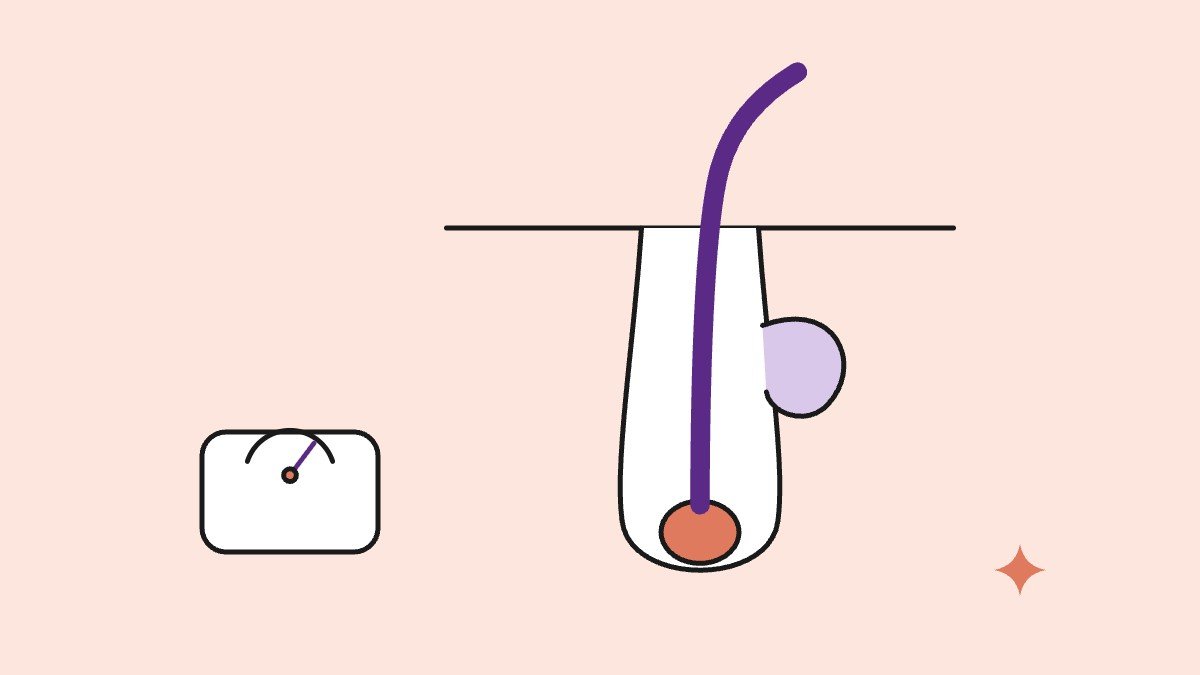
Short answer: Hirsutism and trichotillomania are different conditions. Hirsutism is excess hair growth caused mainly by hormones. Trichotillomania (trich) is a mental health condition in which you feel an urge you cannot resist to pull out your hair, usually from the scalp, eyebrows or eyelashes. Removing hair you do not want is not trich. But if tweezing feels driven by tension and relief, and you cannot stop even when it causes damage, it is worth talking to a doctor, because trich is treatable.
Many women with hirsutism spend a lot of time checking and tweezing facial hair. Sometimes that is simply hair removal. For some people, though, pulling can start to feel compulsive. This article explains what trichotillomania is, how it differs from hair removal and where to find help.

What is hirsutism?
Hirsutism is excess coarse, dark hair in a male-like pattern, on areas such as the upper lip, chin, chest, stomach and back. It is caused by androgens, hormones such as testosterone, acting on hair follicles that are sensitive to them.[4] The most common underlying condition in adults is PMOS, previously called polycystic ovary syndrome (PCOS), which was renamed in 2026 after a global consensus.[5][6] Learn more in what is hirsutism? or score yourself with our hirsutism self-check.
What is trichotillomania?
Trichotillomania is a condition in which a person cannot resist the urge to pull out their hair.[1] It is classed as an obsessive-compulsive and related disorder, and its exact causes are not clearly understood.[2] It is one of a group of conditions called body-focused repetitive behaviors (BFRBs), which also include skin picking and nail biting.[7]
Signs of trichotillomania
- A growing tension and intense urge before pulling, and relief or pleasure afterward[1][2]
- Pulling during stress, or almost without noticing[1]
- Bald patches or thinning that look uneven or have an unusual shape[1][2]
- Pulling from the scalp most often, but also the eyebrows, eyelashes, genital area or body hair[1][2]
- Feelings of shame, hiding the pulling, or denying it[1][2]
- Sometimes eating the pulled hair, which can cause hairballs in the stomach and needs medical attention[1][2]
Who gets it?
MedlinePlus estimates that up to about 4% of people are affected, and that women are about four times as likely as men to have it. It usually starts between the ages of 10 and 13.[1][2] It can run in families.[1] Many people with trich also have depression, anxiety or a poor self-image.[2]
Hirsutism and trichotillomania: what is the link?
We could not find any studies that looked at how often women with hirsutism develop trichotillomania, so we cannot say whether it is more common in this group. What we can say is how the two can overlap in daily life.
| Hair removal for hirsutism | Trichotillomania | |
|---|---|---|
| Why you pull | To remove hair you do not want | To relieve an urge or tension |
| Which hair | Unwanted coarse hair, such as on the chin | Often scalp, eyebrows or eyelashes, including hair you want to keep |
| How it feels | A chore, sometimes a relief to be done | Rising tension, then relief or pleasure, often followed by shame |
| Can you stop? | Yes, or you switch methods | Hard to stop, even when it causes damage |
Some signs that tweezing may be moving beyond hair removal include spending a long time searching for hairs to pull, pulling fine hairs that nobody else would notice, pulling until the skin is sore or bleeding, and feeling unable to stop even when you want to. Both NHS and MedlinePlus describe this pattern of urge, relief and difficulty stopping as typical of trich.[1][2]
Hirsutism itself can take a real emotional toll. The International PCOS Guideline recognizes the link between facial hirsutism, depression, anxiety and quality of life, and recommends laser and light therapies partly for that reason.[5] If you find yourself constantly checking and pulling, it may help to switch to a method that removes hair in one go, such as shaving, and to look at longer-term options such as laser or electrolysis. See also our guide to the pros and cons of tweezing facial hair.
How is trichotillomania diagnosed?
A doctor will ask about your pulling and examine your skin, hair and scalp. Sometimes a small skin sample (biopsy) is taken to rule out other causes of hair loss, such as a scalp infection.[2] Compulsive hair pulling is one of the recognized causes of hair loss that a dermatologist will consider.[3]
Treatment for trichotillomania
Habit reversal training
Evidence: Moderate Habit reversal training, a type of cognitive behavioral therapy (CBT), is the usual treatment, according to the NHS.[1] It involves:[1]
- Keeping a diary of when and where you pull
- Identifying your triggers and finding ways to avoid them
- Replacing pulling with a harmless action, such as tensing your arm muscles
- Getting support from people close to you
MedlinePlus also lists behavioral therapy and habit reversal as treatments that may help.[2] We were not able to verify the size of the benefit in clinical trials for this article, so we rate the evidence as moderate.
Medication
Evidence: Limited Experts disagree about medication. MedlinePlus reports that naltrexone and SSRI antidepressants have been shown to reduce some symptoms.[2] The NHS says antidepressants are not usually prescribed for trich.[1] If you are interested in medication, talk it through with a doctor or psychiatrist who knows the condition.
Self-help ideas
The NHS suggests these practical steps to make pulling harder or to give your hands something else to do:[1]
- Squeeze a stress ball or use a fidget toy
- Tense your arm muscles when you feel the urge
- Put plasters (adhesive bandages) on your fingertips
- Wear a bandana or a close-fitting hat
- Cut your hair short
- Try deep breathing, a warm bath or exercise to manage stress
If facial hair is your trigger, keeping tweezers and magnifying mirrors out of easy reach and removing hair at a set time, rather than whenever you spot one, may help.
Support
The TLC Foundation for Body-Focused Repetitive Behaviors offers education, a therapist directory and support groups.[7] In the UK, the NHS points to OCD UK for information and self-help.[1] Talking to others who understand can also help. See our list of support groups and online communities.
Outlook
For many people, hair pulling stops within 12 months. For others it is long-lasting, but treatment often improves both the pulling and the related mood and self-image problems. When trich begins before age 6, it may go away without treatment.[2]
When to see a doctor
See a doctor if you, or your child, keep pulling out hair, or if you eat hair.[1] See a doctor about your hair growth itself if you notice:
- Hair growth that starts suddenly or gets worse quickly
- A deepening voice, an enlarged clitoris or increased muscle mass, which are signs of virilization
- Irregular or missing periods
If you are struggling with low mood or anxiety, please reach out to your doctor. Our article on what women with hirsutism want you to know covers the emotional side.
Frequently asked questions
Is plucking chin hairs a form of trichotillomania?
Not usually. Removing hair you do not want is hair removal. It may be trich if pulling is driven by an urge and relief, and you cannot stop despite damage or distress.[1][2]
Can trichotillomania cause hirsutism?
No. Hirsutism is driven by hormones acting on hair follicles, not by pulling.[4] Pulling causes hair loss, not extra hair.
Does hair grow back after trichotillomania?
Regrowth often appears as stubble in bare spots.[2] Long-term pulling can damage the skin, so see a dermatologist if you are worried.
What is the best treatment for trichotillomania?
Habit reversal training, a form of CBT, is the usual first treatment.[1]
Key takeaways
- Hirsutism is hormone-driven hair growth; trichotillomania is an urge-driven hair pulling disorder.
- Tweezing unwanted hair is not trich, but pulling driven by tension and relief that you cannot stop may be.
- Trich affects up to about 4% of people, more often women, and usually starts between 10 and 13.
- Habit reversal training is the usual treatment, and help and support groups are available.

Free: The Hirsutism Action Plan
A 12-page guide: what’s causing your hair growth, which tests to ask your doctor for, and which treatments actually work, plus a printable doctor visit checklist.
You’ll also get our weekly email. Unsubscribe anytime.
Sources
- NHS. Trichotillomania (hair pulling disorder). Accessed October 2026. Link
- MedlinePlus. Trichotillomania. Accessed October 2026. Link
- American Academy of Dermatology. Do you have hair loss or hair shedding?. Accessed October 2026. Link
- Martin KA, Anderson RR, Chang RJ, et al. Evaluation and Treatment of Hirsutism in Premenopausal Women: An Endocrine Society Clinical Practice Guideline. J Clin Endocrinol Metab. 2018;103(4):1233-1257. PubMed 29522147
- Teede HJ, Tay CT, Laven JJE, et al. Recommendations from the 2023 International Evidence-based Guideline for the Assessment and Management of Polycystic Ovary Syndrome. J Clin Endocrinol Metab. 2023;108(10):2447-2469. PubMed 37580314
- Teede HJ, et al. Polyendocrine metabolic ovarian syndrome, the new name for polycystic ovary syndrome: a multistep global consensus process. Lancet. 2026;407(10545):2329-2339. Published online May 12, 2026. PubMed 42119588
- The TLC Foundation for Body-Focused Repetitive Behaviors. Home page. Accessed October 2026. Link
This article is for education and is not medical advice. Talk to a doctor about diagnosis and treatment.