
Short answer: Shaving your face as a woman is safe, quick and painless, and it does not make hair grow back thicker, darker or faster. To avoid cuts and bumps, shave on wet skin with a sharp blade and a shaving cream or gel, go in the direction of hair growth, and rinse the blade after every stroke. The main downsides are stubble within a day or two and, for some women, razor bumps.
More women are talking openly about shaving their faces, whether to remove fine peach fuzz before makeup or to manage coarse, dark hair caused by hirsutism. If you have hirsutism, shaving can be the most practical way to stay on top of daily regrowth. Still, many women worry it will make things worse. It won’t, and this guide explains why, along with how to get a close, comfortable shave.
Whether you shave, use another method or leave your facial hair alone is entirely your choice.
Does shaving make facial hair grow back thicker?
No. The Endocrine Society guideline states that shaving does not affect how fast hair grows, how long it stays in its growth phase, or how thick it is. [1] Shaving cuts the hair at the surface, leaving a blunt tip instead of the natural tapered one. That blunt tip can feel stubbly and look slightly darker as it grows out, which creates the illusion of thicker hair. [1], [2] The British Association of Dermatologists also says the belief that shaving encourages more hair growth is not true. [3]
Pros and cons of shaving your face
| Pros | Cons |
|---|---|
| Painless and fast | Regrowth within 1 to 3 days [4] |
| Cheap and easy to do at home | Stubble can be visible on dark hair |
| Works on fine and coarse hair | Risk of razor bumps, nicks and irritation [4], [3] |
| Does not change hair growth [1] | Needs to be repeated often, sometimes daily |
| Gives makeup a smoother base | Can irritate acne-prone skin [5] |
Peach fuzz vs coarse hair: Does it matter?
Yes, for how often you shave and what to expect. Fine, light peach fuzz (vellus hair) grows back soft and is hard to see, so many women shave it only once or twice a week. Coarse, dark terminal hair on the chin, jaw or upper lip grows back as visible stubble, and women with hirsutism often need to shave daily.
Coarse hair in a male-like pattern can be a sign of hirsutism, which is caused by androgens (hormones such as testosterone) or by hair follicles that are extra sensitive to them. [1] A common underlying cause is PMOS, previously called polycystic ovary syndrome (PCOS). The condition was renamed in 2026 after a global consensus process. [6] If you are not sure which type of hair you have, take the hirsutism self-check or read about excessive peach fuzz on the face.
What razor should you use to shave your face?
Evidence: Strong Shaving is a well-established, guideline-recognized way to remove facial hair temporarily. [1] You don’t need a particular brand. What matters is the type of razor and that the blade is sharp.
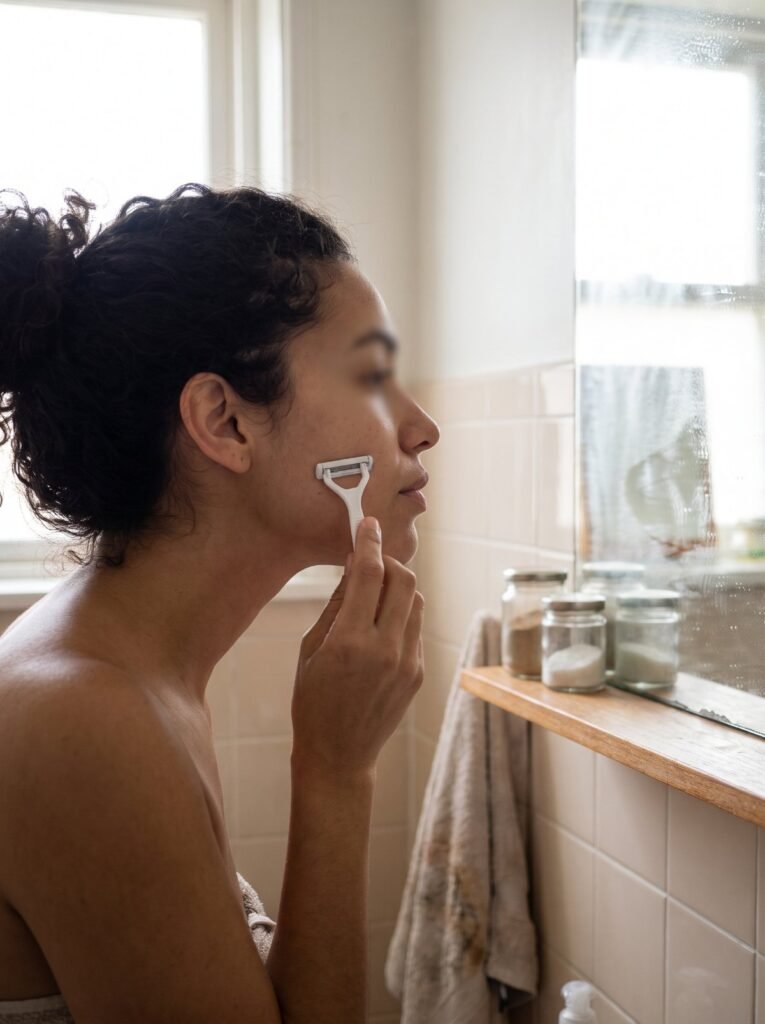
- Single-blade facial razor: Small, straight-edged razors made for the face give you control around the lips, chin and jawline. They work well for peach fuzz and for coarse hair.
- Safety razor or cartridge razor: Good for larger areas like the jaw and neck.
- Electric shaver or trimmer: Doesn’t cut as close, but causes fewer nicks and is a good option if you have acne or get bumps easily. The AAD suggests people with acne experiment with electric or disposable razors to see which suits their skin. [5]
Whatever you use, replace the blade or disposable razor after 5 to 7 shaves, and let it dry fully between uses. A dull blade makes razor bumps much more likely. [5], [7]
How to shave your face as a woman, step by step
- Wash your face with a gentle cleanser. Avoid shaving over active pimples or open spots.
- Soften the hair. Shave right after a shower or hold a warm, damp cloth on your face for a few minutes. Warm, moist skin is free of excess oil and dead skin cells that clog the blade. [5]
- Apply a shaving cream or gel. If your skin is dry or sensitive, choose one labeled for sensitive skin. [5] A plain, fragrance-free facial oil is an alternative some women prefer, especially with a single-blade razor.
- Shave in the direction the hair grows, using short, light strokes. This helps prevent razor bumps and burn. [5] Don’t press hard. If you need pressure to cut the hair, the blade is too dull.
- Don’t pull or stretch your skin while shaving. [7] To shave around the mouth, push your tongue against the inside of your upper lip or cheek to create a firm, flat surface.
- Rinse the blade after every stroke. [5]
- Rinse your face with lukewarm water, pat dry, and apply a cool compress if your skin feels warm. [7]
Aftercare: What to put on your face after shaving
Use a gentle, fragrance-free moisturizer or soothing gel after shaving. Products with alcohol, strong fragrance or exfoliating acids can sting freshly shaved skin, so leave those for another time of day. If you plan to wear makeup, give your skin time to settle first. Our guide on how to hide stubble with makeup covers this step by step.

How to prevent razor bumps and ingrown hairs
Razor bumps (pseudofolliculitis barbae) happen when shaved hairs curl back and grow into the skin, causing red, sometimes painful bumps. They are often thought of as a men’s problem, but women can be considerably affected too. [2] Both shaving and waxing can cause them. [3]
The AAD recommends shaving in the direction of hair growth, using a sharp blade, not stretching the skin, and never plucking a hair trapped inside a bump. [7] If bumps keep coming back, see our guide to treating and preventing razor bumps, or ask a dermatologist about longer-term options such as laser.
What is dermaplaning?
Evidence: Limited Dermaplaning is a facial treatment where a trained professional uses a fine, single blade to scrape away peach fuzz and the top layer of dead skin cells. At home, small dermaplaning tools work on the same principle. In practice, it is a form of shaving, so it does not make hair grow back thicker. [1] We could not find good-quality clinical trials on dermaplaning for facial hair, so claims about extra skin benefits are not well supported. If your skin is sensitive, acne-prone or you use prescription retinoids, ask a dermatologist before trying it.
What a transgender woman can teach you about shaving your face
Many transgender women have spent years perfecting how to shave coarse facial hair and cover beard shadow, and their routines are useful for any woman dealing with stubble. The most practical lessons are:
- Shave as close to the time you go out as you can. Coarse, dark hair shows again within hours, so a late shave buys you the most time.
- Prep matters as much as the razor. Warm water, a good shaving cream and a sharp blade make a closer, gentler shave. [5]
- Go with the grain, then stop. Shaving against the grain gives a closer result but raises the risk of bumps. [5]
- Color correct the shadow. A thin layer of peach or orange corrector cancels the gray-blue shadow of dark hair under the skin before foundation goes on. We found no clinical studies on this technique, but it is widely used.
- Think about long-term options. Laser for dark hair and electrolysis for white or blonde hair are the options the Endocrine Society suggests for women with hirsutism. [1]
Most of all, shaving your face is ordinary grooming, not something to hide or feel ashamed of.
When shaving isn’t enough
If you are shaving every day and it is wearing you down, other options include:
- Eflornithine cream (Vaniqa): A prescription cream that slows facial hair growth. In two trials of 594 women, about 32% had marked improvement after 24 weeks, compared with 8% using a cream without the drug. You keep shaving while using it. [8]
- Laser: The Endocrine Society suggests laser or intense pulsed light for brown, black or auburn hair. [1] A Cochrane review found about 50% hair reduction for up to six months with alexandrite and diode lasers, based on trials of limited quality. [9]
- Electrolysis: Suggested for white or blonde hair, and the only method generally regarded as truly permanent. [1], [2]
- Medical treatment: If you have raised androgen levels, medication can reduce regrowth. [1] See hirsutism medication.
Read our guide to permanent hair removal for a full comparison.
When to see a doctor
See a doctor if facial hair appeared suddenly or is getting worse quickly, if you notice a deeper voice, an enlarged clitoris or other signs of virilization, or if your periods are irregular or have stopped. Rapid onset or signs of virilization need prompt testing because, rarely, they are caused by an androgen-secreting tumor. [1]
Frequently asked questions
Should you use shaving cream on your face?
Yes, or a gel. The AAD recommends applying shaving cream or gel after wetting the skin, and choosing a sensitive-skin formula if your skin reacts easily. [5]
Does shaving your face every day increase hair growth?
No. Shaving does not change how fast or how thick hair grows, no matter how often you do it. [1] Daily shaving can irritate the skin, though, so a gentle technique matters. [3]
Can women use an electric razor on their face?
Yes. Electric shavers don’t cut as close as blades but cause fewer nicks, and the AAD suggests trying them if you have acne. [5]
How often should a woman shave her face?
It depends on your hair. Peach fuzz may only need shaving once or twice a week, while coarse, dark hair often needs daily shaving because stubble returns within 1 to 3 days. [4]
Key takeaways
- Shaving does not make facial hair grow back thicker, darker or faster.
- Shave on warm, wet skin with a sharp blade and a shaving cream or gel, in the direction of hair growth.
- Replace blades after 5 to 7 shaves and don’t stretch the skin, to reduce razor bumps.
- Color correcting and a late shave help hide beard shadow.
- If daily shaving is exhausting, ask about eflornithine, laser, electrolysis or treating the hormonal cause.

Free: The Hirsutism Action Plan
A 12-page guide: what’s causing your hair growth, which tests to ask your doctor for, and which treatments actually work, plus a printable doctor visit checklist.
You’ll also get our weekly email. Unsubscribe anytime.
Sources
- Martin KA, Anderson RR, Chang RJ, et al. Evaluation and Treatment of Hirsutism in Premenopausal Women: An Endocrine Society Clinical Practice Guideline. J Clin Endocrinol Metab. 2018;103(4):1233-1257. PubMed 29522147
- Gutierrez A, Coffel BN, Wong EB. Management of facial hair in women. Cutis. 2025;116(6):198-201. DOI 10.12788/cutis.1310
- British Association of Dermatologists. Hirsutism (BAD Patient Hub). Accessed October 2026. Link
- Nemours KidsHealth. Hair Removal (medically reviewed August 2022). Accessed October 2026. Link
- American Academy of Dermatology. Hair removal: How to shave. Accessed October 2026. Link
- Teede HJ, Bahri Khomami M, Morman R, et al. Polyendocrine metabolic ovarian syndrome, the new name for polycystic ovary syndrome: a multistep global consensus process. Lancet. 2026;407(10545):2329-2339. PubMed 42119588
- American Academy of Dermatology. Razor bump remedies for men with darker skin tones. Accessed October 2026. Link
- US National Library of Medicine, DailyMed. Vaniqa (eflornithine hydrochloride) cream, 13.9%. Prescribing information. Accessed October 2026. Link
- Haedersdal M, Gøtzsche PC. Laser and photoepilation for unwanted hair growth. Cochrane Database Syst Rev. 2006;(4):CD004684. Cochrane summary
This article is for education and is not medical advice. Talk to a doctor about diagnosis and treatment.