
Short answer: There is no set number. No study has shown that plucking a hair a certain number of times stops it from growing back. A plucked hair usually returns within about 3 to 8 weeks because the follicle that makes it stays in the skin. Some dermatologists believe years of repeated plucking can damage some follicles, but this has not been measured. If you want hair gone for good, electrolysis is the only method generally considered permanent.
From our survey: Plucking was the most-tried method for chin hair (81% of 269 women), and 91% of women said they get ingrown hairs. See the full results.
If you have been tweezing the same chin hairs for years, you have probably wondered whether they will ever give up. It is one of the most common questions about plucking, and the internet is full of confident answers. The honest answer is that nobody has counted.
This article explains what happens to a hair follicle when you pluck, how long regrowth takes, whether plucking makes hair thicker, and how plucking compares with shaving.
What happens when you pluck a hair?
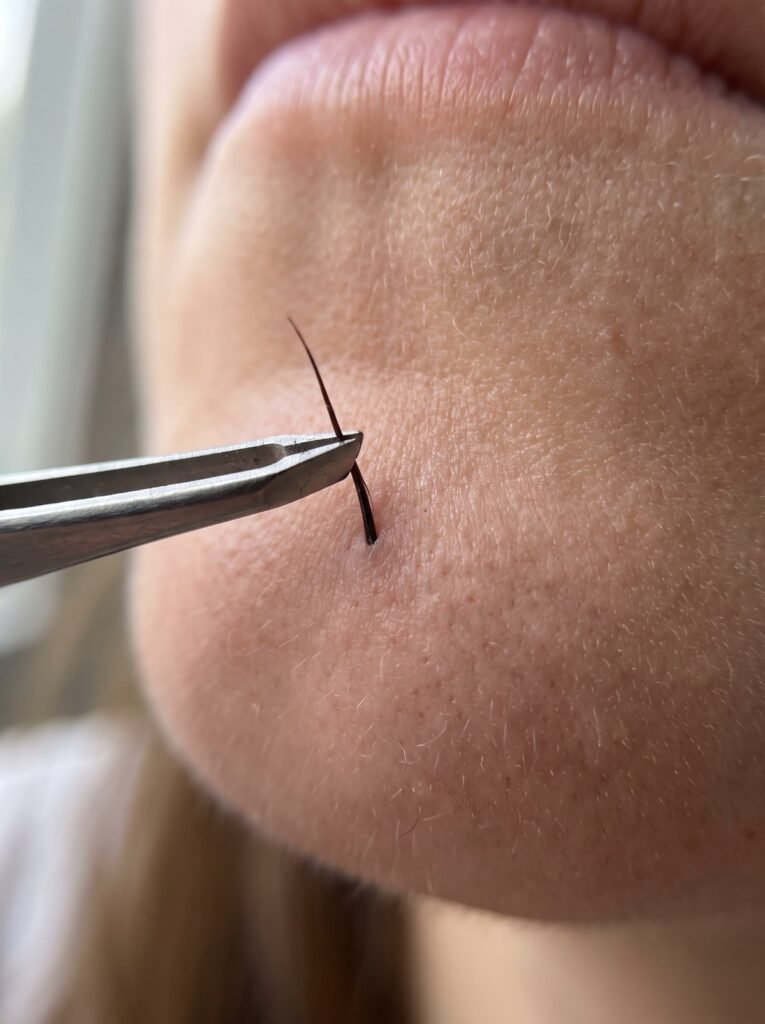
Each hair grows from a follicle, a small pocket in the skin. Hair grows in cycles. A growth phase (anagen) is followed by a short transition phase and a resting phase, after which the old hair sheds and a new one starts growing. Plucking pulls out the hair shaft and its bulb at the root. [1] But the follicle, including the stem cells that rebuild the hair, stays in the skin. That is why the hair grows back.
Lab research in mice shows how resilient follicles are. In a 2015 study in mice, plucked follicles regenerated, and plucking a large number of hairs from a small patch of skin even triggered unplucked neighboring follicles to start growing. [2] This was an animal study and doesn’t tell us exactly what happens in human facial hair, but it shows that plucking a follicle does not simply switch it off.
How long does it take for plucked hair to grow back?
Results from epilation, which includes plucking, typically last around 6 weeks. [1] Consumer health guidance gives a range of 3 to 8 weeks for tweezing. [3] The exact time depends on the body area, where the hair was in its growth cycle, and your hormones.
Can plucking stop hair from growing permanently?
Evidence: None A 2025 dermatology review states that repeated plucking during the growth phase can damage the part of the follicle that makes hair (the matrix) and could potentially lead to permanent hair reduction. [1] However, we could not find any study in humans that measured how often this happens or how many plucks it takes.
If your unwanted hair is caused by androgens (hormones such as testosterone), the follicles keep receiving the signal to grow coarse hair, whatever you do at the surface. In that case, plucking manages the hair but doesn’t address the cause. [4]
Does plucking make hair grow back thicker or darker?
No. The Endocrine Society guideline states that epilation methods such as plucking and waxing do not increase hair diameter. [4] The mouse study above found that plucking many hairs close together in a small area could prompt neighboring follicles to grow, but that effect has not been shown in human facial hair. [2]
Plucking can cause other problems, though. Side effects include pain, inflamed follicles (folliculitis), ingrown hairs, scarring and dark marks after inflammation. [5] Dark marks are particularly likely in women of color. [4] If a hair snaps below the skin instead of coming out cleanly, it is more likely to become ingrown. [3]
Is it better to shave or pluck facial hair?
Neither is better for everyone. Shaving is fast and painless but lasts only 1 to 3 days, while plucking lasts weeks but is slow and uncomfortable. [3] Neither method makes hair thicker. [4]
| Shaving | Plucking | |
|---|---|---|
| How it works | Cuts hair at the skin surface [4] | Pulls out the hair and bulb [1] |
| How long it lasts | 1 to 3 days [3] | About 3 to 8 weeks [3] |
| Pain | Painless | Uncomfortable, especially on the upper lip |
| Time | Fast for whole areas | Slow, one hair at a time |
| Regrowth | Blunt stubble that can feel coarse [4] | New hair with a natural tapered tip |
| Main risks | Razor bumps, nicks, irritation [3], [6] | Ingrown hairs, folliculitis, dark marks, scarring [5] |
| Best for | Upper lip, larger or denser areas, daily upkeep | A few scattered coarse hairs |
When shaving makes more sense
- You have many hairs or a dense area, such as the whole upper lip, jaw or neck
- Plucking leaves you with red bumps, dark marks or ingrown hairs
- You are spending a lot of time each day tweezing
When plucking makes more sense
- You only have a few coarse hairs, for example on the chin
- Visible stubble bothers you more than the occasional regrowing hair
- You want results that last weeks and don’t mind the time
Many women combine both. For more detail, read how to shave your face as a woman and the pros and cons of tweezing facial hair.
Where you should not pluck
- Inside a bump or ingrown hair. The AAD advises never plucking a hair trapped inside a razor bump. [7]
- On broken, infected or irritated skin. Let it heal first.
- Hairs growing from a mole. Trim them with small scissors instead, and show a doctor any mole that changes.
If you are wondering about nipple hair, read whether plucking nipple hair causes cancer.
What actually stops hair from growing back?
Electrolysis
Evidence: Moderate Electrolysis passes a small electrical current into each follicle through a fine needle. [6] It is the only method generally regarded as truly permanent and works on all hair colors, although about 15% to 25% of people see some regrowth within 6 months and results vary between practitioners. [1] The Endocrine Society suggests it for white or blonde hair. [4]
Laser hair removal
Evidence: Strong The Endocrine Society suggests laser or intense pulsed light for brown, black or auburn hair. [4] A Cochrane review found about 50% hair reduction for up to six months with alexandrite and diode lasers, but the trials were not high quality and long-term results were not recorded. [8] Laser does not work on white or gray hair. [1]
Eflornithine cream
Evidence: Strong Eflornithine 13.9% cream (Vaniqa) is a prescription cream that slows facial hair growth. In two trials of 594 women, about 32% had marked improvement after 24 weeks, compared with 8% using a cream without the drug. It doesn’t remove hair, so you keep plucking or shaving, and growth returns to previous levels within about 8 weeks of stopping. [9]
Treating the hormonal cause
Evidence: Strong For women with raised androgen levels, the Endocrine Society suggests medication to reduce regrowth alongside hair removal, and recommends trying a medication for at least 6 months before changing it. [4] See hirsutism medication and our guide to permanent hair removal.
When to see a doctor
If you are plucking more and more hairs over time, it is worth finding out why. See a doctor if:
- Hair growth started suddenly or is getting worse within months
- You notice a deeper voice, an enlarged clitoris or other signs of virilization. These can point to an androgen-secreting tumor, which is rare but needs prompt tests. [4]
- Your periods are irregular or have stopped
- You have coarse hair on your chest, belly or back as well as your face
A common cause of unwanted hair is PMOS, previously called polycystic ovary syndrome (PCOS), which was renamed in 2026. [10] Try the hirsutism self-check and read what causes hirsutism.
Frequently asked questions
Does plucking kill the hair follicle?
Usually not. The follicle stays in the skin and grows a new hair, typically within 3 to 8 weeks. [3] A dermatology review suggests repeated plucking may damage some follicles over time, but this has not been measured in humans. [1]
If I pluck one hair, will two grow back?
No. Plucking doesn’t make hairs thicker, [4] and there is no evidence in humans that plucking one facial hair makes extra hairs appear.
Is it OK to pluck chin hairs every day?
Plucking a few hairs is generally safe, but plucking the same area daily raises the risk of folliculitis, ingrown hairs and dark marks. [5] If you are tweezing every day, shaving, eflornithine or laser may be easier on your skin.
Is it better to pluck or shave chin hair?
For a few hairs, plucking lasts longer. For many hairs, shaving is faster and gentler. Neither changes how thick the hair grows back. [4], [3]
Key takeaways
- There is no proven number of plucks that stops a hair from growing.
- Plucked hair usually grows back within 3 to 8 weeks because the follicle stays in the skin.
- Neither plucking nor shaving makes hair thicker. Shaving suits larger areas, and plucking suits a few stray hairs.
- Electrolysis is the only method generally regarded as permanent. Laser, eflornithine and hormonal treatment reduce regrowth.
- Hair that is increasing quickly or comes with other symptoms needs a doctor’s visit.

Free: The Hirsutism Action Plan
A 12-page guide: what’s causing your hair growth, which tests to ask your doctor for, and which treatments actually work, plus a printable doctor visit checklist.
You’ll also get our weekly email. Unsubscribe anytime.
Sources
- Gutierrez A, Coffel BN, Wong EB. Management of facial hair in women. Cutis. 2025;116(6):198-201. DOI 10.12788/cutis.1310
- Chen CC, Wang L, Plikus MV, et al. Organ-level quorum sensing directs regeneration in hair stem cell populations. Cell. 2015;161(2):277-290. PMC4393531
- Nemours KidsHealth. Hair Removal (medically reviewed August 2022). Accessed October 2026. Link
- Martin KA, Anderson RR, Chang RJ, et al. Evaluation and Treatment of Hirsutism in Premenopausal Women: An Endocrine Society Clinical Practice Guideline. J Clin Endocrinol Metab. 2018;103(4):1233-1257. PubMed 29522147
- DermNet. Epilation. Accessed October 2026. Link
- British Association of Dermatologists. Hirsutism (BAD Patient Hub). Accessed October 2026. Link
- American Academy of Dermatology. Razor bump remedies for men with darker skin tones. Accessed October 2026. Link
- Haedersdal M, Gøtzsche PC. Laser and photoepilation for unwanted hair growth. Cochrane Database Syst Rev. 2006;(4):CD004684. Cochrane summary
- US National Library of Medicine, DailyMed. Vaniqa (eflornithine hydrochloride) cream, 13.9%. Prescribing information. Accessed October 2026. Link
- Teede HJ, Bahri Khomami M, Morman R, et al. Polyendocrine metabolic ovarian syndrome, the new name for polycystic ovary syndrome: a multistep global consensus process. Lancet. 2026;407(10545):2329-2339. PubMed 42119588
This article is for education and is not medical advice. Talk to a doctor about diagnosis and treatment.