
Short answer: Razor bumps are inflamed bumps caused by shaved hairs curling back into the skin. “Strawberry legs” is a nickname for dark dots on the legs that can be clogged pores, inflamed follicles (folliculitis), keratosis pilaris or razor bumps. Most cases improve with gentler hair removal, regular moisturizing and a mild chemical exfoliant. For repeated razor bumps, laser hair removal is the best long-term option, although studies on bumps specifically are small.
From our survey: 91% of the 269 women with hirsutism we surveyed get ingrown hairs, but only 47% do anything specific to prevent them. See the full results.
If your legs look dotted or bumpy a day after shaving, you are not alone and you are not doing anything “dirty.” Several different, harmless skin conditions can cause it, and each responds to slightly different care. This guide explains how to tell them apart, how to remove hair with fewer bumps, how to treat ingrown hairs, and which simple routine dermatologists recommend for bumpy legs.
The same advice applies to the bikini line, underarms and chin. If you remove hair because it grows thick and dark in places like the chin, chest or stomach, it may be worth checking whether it could be hirsutism with our hirsutism self-check.
What are razor bumps?
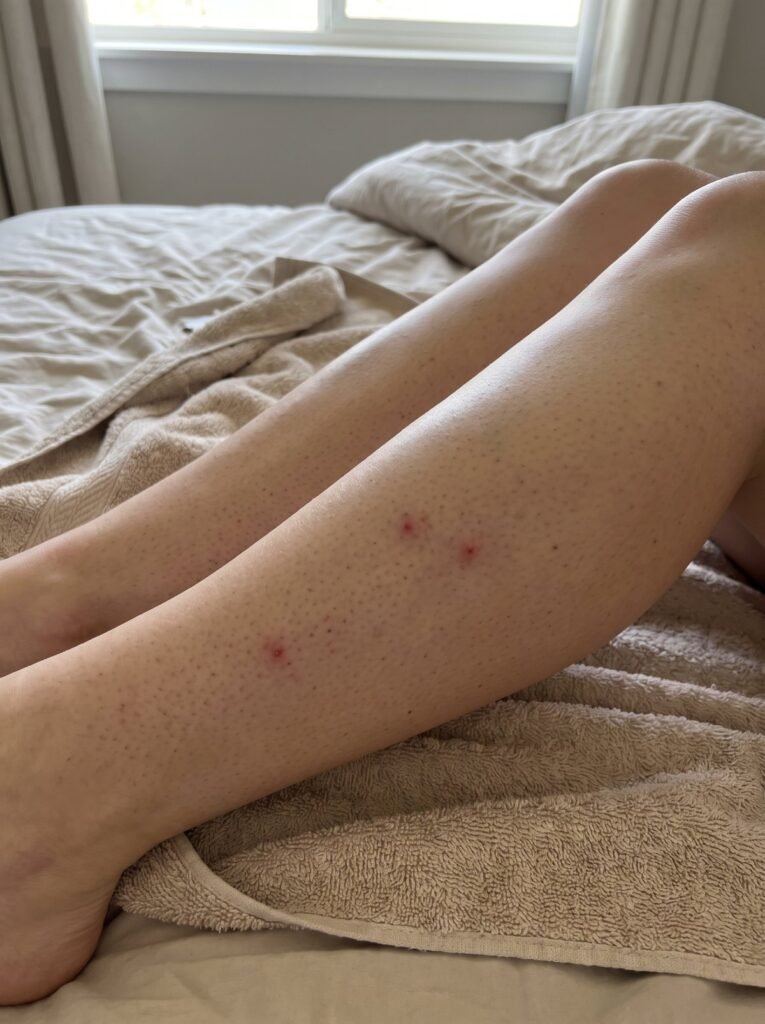
Razor bumps, medically called pseudofolliculitis barbae, are an inflammatory reaction around the hair follicle. They appear as small red or skin-colored bumps that can itch, hurt or bleed when you shave over them. [1] They happen when a closely shaved hair, which now has a sharp tip, curls back and grows into the skin. The body treats the hair like a splinter and reacts with inflammation. [1][2]
Razor bumps are most common in people with curly or coarse hair and in darker skin, and they can leave dark marks (post-inflammatory hyperpigmentation) or scars. [1] In women they often appear on the legs, underarms and pubic area. On the face they are less common, but they are seen more often in women with hirsutism caused by PMOS, previously called polycystic ovary syndrome (PCOS). [2] PMOS is the new name agreed in a global consensus published in 2026. [3]
What are strawberry legs?
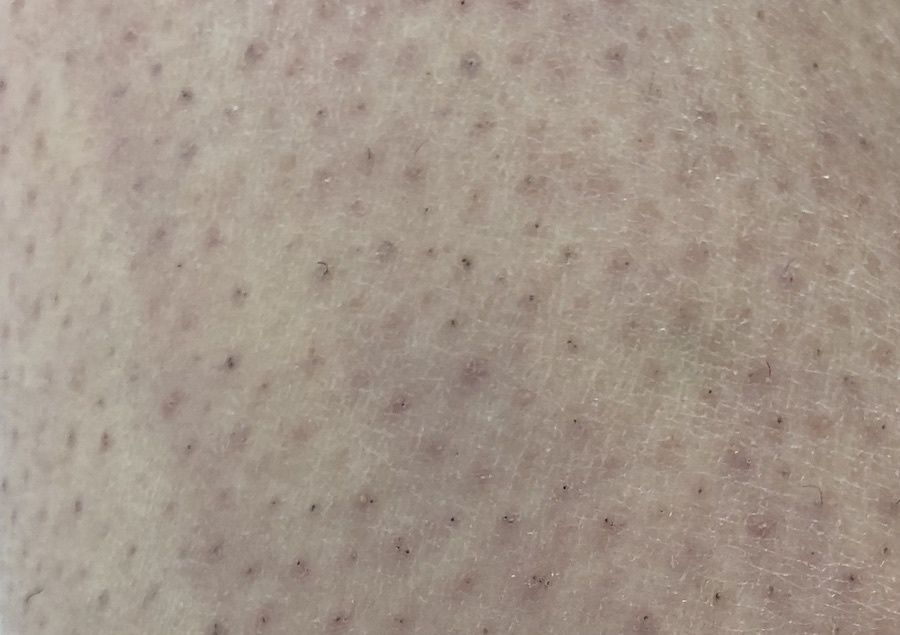
“Strawberry legs” is not a medical diagnosis. It describes small dark or red dots on the legs that look like the seeds on a strawberry and are often most visible after shaving. Dermatologists point to several possible causes, and you may have more than one at once. [4]
| Cause | What it looks like | What helps most |
|---|---|---|
| Open comedones (clogged pores) | Flat dark dots in the pores, like blackheads | Salicylic acid or glycolic acid, gentle exfoliation |
| Folliculitis | Red bumps or small pus spots around hairs that may itch or sting | A break from shaving or waxing, warm compresses, a doctor if it spreads |
| Keratosis pilaris | Rough “chicken skin” bumps, often on thighs and upper arms, present even without shaving | Moisturizers with urea or lactic acid |
| Razor bumps and ingrown hairs | Red or dark bumps after shaving, sometimes with a trapped hair | Better shaving technique, less close shaving, laser in stubborn cases |
Open comedones (clogged pores)
A comedo is a hair follicle plugged with skin cells and oil. An open comedo is a blackhead, and it looks dark because of skin pigment at the surface, not because of dirt. Ingredients that loosen the plug include salicylic acid and glycolic acid. [5] Shaving can make these pores more noticeable. [4]
Folliculitis
Folliculitis is inflammation or infection of the hair follicle, often caused by the bacterium Staphylococcus aureus. Shaving, waxing and plucking can damage follicles and let germs in, and hot, sweaty skin and tight clothing make it more likely. It looks like a sudden, acne-like breakout, and each spot may have a red ring. [6][7]
Keratosis pilaris
Keratosis pilaris (KP) is a very common, harmless condition in which keratin, a skin protein, builds up in the follicles. It causes rough bumps on the thighs and upper arms that can look red on light skin and brown or dark on darker skin. It affects about 40% of adults and is often worse in winter. [8] Unlike razor bumps, KP is there whether or not you shave, though shaving and waxing can make the bumps flare. [9]
How to prevent and treat ingrown hair
An ingrown hair is a hair that has grown back into the skin instead of up and out. It shows up as a raised, often itchy bump, sometimes with the hair visible under the skin. Shaving is the most common cause, but waxing, plucking and threading can cause ingrown hairs too, and people with coarse or curly hair get them more often. [10] Razor bumps are essentially many ingrown hairs at once, so prevention is the same for both.
Does an ingrown hair heal on its own?
Usually, yes. Untreated ingrown hairs usually heal within one to two weeks, although they can become infected. [11] Most need no medical help. [10]
How to shave without getting razor bumps
Evidence: Moderate These steps come from dermatology guidance rather than large trials, but they are consistent across the American Academy of Dermatology (AAD), the NHS and DermNet. [12][10][1]
- Soften the hair first. Shave at the end of a warm shower, or hold a warm, damp cloth on the area first. Softer hair is less likely to curl back into the skin. [12]
- Use a moisturizing shaving cream or gel rather than soap. [12][10]
- Shave in the direction your hair grows, with short, light strokes, and avoid going over the same spot again and again. [1]
- Don’t stretch the skin tight while you shave. [1] Stretched skin lets the blade cut the hair below the surface, where it can grow back in.
- Don’t shave too close. Leaving about 1 mm of stubble helps. An electric razor or trimmer does this for you. [10]
- Use a sharp, clean blade. The AAD suggests replacing disposable razors after 5 to 7 shaves. [12] Rinse the razor after each stroke. [10]
- Cool down afterward with a cool, wet cloth on the skin. [10]
How often to shave is debated. The NHS advises not shaving every day if you can avoid it, while the AAD notes that shaving daily or every 2 to 3 days gives hairs less time to grow and curl back. [10][12] In practice, give irritated skin a break until bumps settle, then find the rhythm that works for you. The only certain prevention is to stop shaving the area, although a dermatology review notes that existing bumps can take weeks to calm down. [2]
How to treat ingrown hairs and razor bumps at home
- Don’t pick, squeeze or scratch. This can damage the skin, cause infection and leave dark marks or scars. [10][11]
- Use warm compresses. Hold a warm, damp cloth on the area for 10 to 15 minutes to soften the skin. [11] For folliculitis, dermatologists suggest 15 to 20 minutes, 3 to 4 times a day. [6]
- Exfoliate gently with warm water and a washcloth, soft brush or mild scrub to help free trapped hairs. [11][10]
- Only release hairs that are already looped above the skin. Clean the skin with rubbing alcohol and lift the end out with a sterile needle or tweezers. [11] Don’t dig into the skin.
- Take a break from hair removal. If shaving, waxing or plucking caused folliculitis, the AAD recommends stopping for 30 days. [6]
Evidence: None What about tea tree oil? It is often suggested as an antiseptic for ingrown hairs. We couldn’t find any studies testing it on ingrown hairs or razor bumps, so we don’t recommend it as a treatment. If you want an antiseptic, a pharmacist can suggest a mild one. [10]
Treatments a doctor can prescribe
Evidence: Limited For stubborn or inflamed bumps, doctors may use a short course of steroid cream to calm swelling, antibiotic creams or tablets for infection, and retinoid creams such as tretinoin to reduce the buildup of skin cells around the follicle. [10][11][1] One trial found that a gel combining benzoyl peroxide and clindamycin reduced razor bumps compared with an inactive gel. [2] Most of this evidence comes from small studies of beard bumps in men, so results on women’s legs and bikini lines are less certain.
Does hair removal cream cause ingrown hairs?
Hair removal creams (depilatories) dissolve the protein structure of the hair at the skin surface instead of cutting it. [11] A dermatology review notes that depilatories rarely cause razor bumps, because they leave the hair with a blunt tip that is less likely to pierce the skin. [2] DermNet and Cleveland Clinic list them as an option for people prone to ingrown hairs, and the NHS suggests them as an alternative to shaving. [1][11][10] So the short answer is no, creams are less likely to cause ingrown hairs than shaving.
The trade-off is irritation. The chemicals in depilatories can sting, burn or cause a rash, and some people develop irritation after using the same product without problems for months or years. [13][2] The AAD recommends a patch test: Apply a small amount, rinse it off at the stated time or at the first sign of burning or stinging, and only use the product on that area if there is no reaction within 24 hours. [13] Don’t use depilatories on broken or already irritated skin.
You may have seen claims that a particular cream cuts ingrown hairs by a set percentage. These figures come from manufacturers rather than independent studies, so we haven’t repeated them.
A simple routine for bumpy legs
You don’t need a long product list. The AAD’s home plan for keratosis pilaris, which also suits clogged pores and mild bumps, has three steps: Exfoliate gently, use a chemical exfoliant, and moisturize. [9]
- Wash with a mild cleanser in a short, warm (not hot) shower. Bar soap can dry the skin. [9]
- Exfoliate gently. A washcloth or soft loofah is enough. Hard scrubbing irritates the skin. [9]
- Add one chemical exfoliant, such as a lotion with lactic acid, glycolic acid, salicylic acid or urea. [9] In a randomized trial of 50 people with keratosis pilaris, a 10% lactic acid cream reduced bumps by 66% after 12 weeks, compared with 52% for a 5% salicylic acid cream. [14] If your skin becomes dry or stings, stop for a few days. [9]
- Moisturize within a few minutes of bathing while the skin is still damp, and again whenever it feels dry. A thick cream or ointment works better than a thin lotion. [9]
- Protect your skin from the sun. Alpha hydroxy acids (AHAs) such as glycolic and lactic acid make skin more sensitive to sunburn. The FDA advises sunscreen, protective clothing and limiting sun exposure while using them and for a week after. [15]
Give it time. Dermatologists say to expect improvement within about 4 to 6 weeks. [16] For a closer look at each ingredient, how strong it should be and how to avoid irritation, see our guide to chemical exfoliants and creams for strawberry legs.
What about the Reddit SkinCareAddiction routine?
The popular beginner routine from Reddit’s r/SkinCareAddiction community is built around three basics: A gentle cleanser, a moisturizer and sunscreen, with other products added later for specific problems. That fits well with dermatology advice. For legs, the “specific problem” step is usually one chemical exfoliant, as in the routine above. The core idea is sound: Start simple, add one product at a time, and give each a few weeks before judging it. [16]
Are other hair removal methods better for bumps?
Waxing and epilators pull hairs out from the root, so results last longer than shaving, but they can also cause folliculitis, ingrown hairs and dark marks. [17] Read more in how many times you have to wax before hair stops growing.
Evidence: Limited Laser hair removal reduces the number and thickness of hairs, which leaves fewer hairs that can grow back into the skin. Dermatology sources list it as a treatment for stubborn razor bumps, ingrown hairs and repeated folliculitis, and the AAD notes that laser can remove hair without triggering keratosis pilaris flares. [1][7][9] Studies on bumps specifically are small, but laser itself is well studied for hair reduction. See our guide to laser, IPL and electrolysis.
When to see a doctor
- An ingrown hair or bump is very painful, hot or swollen, or contains pus [10]
- You have a fever, chills or feel unwell along with skin bumps [10][18]
- Bumps are spreading, firm or draining fluid, or not improving with home care [18][11]
- You keep getting razor bumps and can’t stop shaving. A dermatologist can prescribe treatment and help prevent scarring. [6]
If the hair itself worries you, see a doctor. This applies especially to dark, coarse hair on your chin, chest or stomach that started suddenly or is getting worse quickly, or that comes with irregular or missing periods, a deepening voice or an enlarged clitoris. These can be signs of a hormone problem. [19] Learn more in what is hirsutism.
Frequently asked questions
Do strawberry legs go away?
Often they improve a lot. Clogged pores and razor bumps usually settle with gentler hair removal, regular exfoliation and moisturizing. [4] Keratosis pilaris has no cure, but it often fades with age and can be kept under control with moisturizers. [8][16]
Is it OK to pop an ingrown hair?
No. Squeezing or picking can cause infection, dark marks and scars. Use warm compresses instead, and only lift out a hair that is already looped above the skin, using a sterile needle. [10][11]
Does hair removal cream cause ingrown hairs?
It is less likely to than shaving, because the hair is dissolved and left with a blunt tip. [2] The main risk with creams is skin irritation, so always do a patch test first. [13]
Should I exfoliate before or after shaving?
We couldn’t find studies comparing the two. A practical approach is to exfoliate gently on days you don’t shave, especially if your skin is sensitive, and to stop any exfoliant for a few days if your skin gets dry or irritated. [9]
Can laser hair removal get rid of strawberry legs?
It can help when the dots are caused by razor bumps, ingrown hairs or folliculitis, because there are fewer hairs to remove. [1][7] It won’t cure keratosis pilaris, though some lasers can reduce its redness and the dark marks it leaves. [16]
Key takeaways
- “Strawberry legs” can be clogged pores, folliculitis, keratosis pilaris or razor bumps, and you may have a mix.
- Shave softened hair with the grain, without stretching the skin, using a sharp blade and a lubricating gel, and don’t shave too close.
- Don’t pick ingrown hairs. Warm compresses and gentle exfoliation help, and most heal within one to two weeks.
- Hair removal cream is less likely than shaving to cause ingrown hairs, but patch test it first.
- A simple routine of mild cleanser, one chemical exfoliant, moisturizer and sun protection works for most bumpy legs. For repeated razor bumps, laser is the best long-term option.

Free: The Hirsutism Action Plan
A 12-page guide: what’s causing your hair growth, which tests to ask your doctor for, and which treatments actually work, plus a printable doctor visit checklist.
You’ll also get our weekly email. Unsubscribe anytime.
Sources
- DermNet. Pseudofolliculitis barbae (razor bumps). Accessed October 2026. Link
- Ogunbiyi A. Pseudofolliculitis barbae; current treatment options. Clin Cosmet Investig Dermatol. 2019;12:241-247. doi:10.2147/CCID.S149250
- Teede HJ, et al. Polyendocrine metabolic ovarian syndrome, the new name for polycystic ovary syndrome: a multistep global consensus process. Lancet. 2026;407(10545):2329-2339. Published online May 12, 2026. PubMed 42119588
- Cleveland Clinic. 5 ways to get rid of strawberry legs. Accessed October 2026. Link
- DermNet. Comedonal acne. Accessed October 2026. Link
- American Academy of Dermatology. Acne-like breakouts could be folliculitis. Accessed October 2026. Link
- DermNet. Bacterial folliculitis. Accessed October 2026. Link
- DermNet. Keratosis pilaris. Accessed October 2026. Link
- American Academy of Dermatology. Keratosis pilaris: Self-care. Accessed October 2026. Link
- NHS. Ingrown hairs. Accessed October 2026. Link
- Cleveland Clinic. Ingrown hair. Accessed October 2026. Link
- American Academy of Dermatology. 6 razor bump prevention tips from dermatologists. Accessed October 2026. Link
- American Academy of Dermatology. 6 ways to remove unwanted hair. Accessed October 2026. Link
- Kootiratrakarn T, Kampirapap K, Chunhasewee C. Epidermal Permeability Barrier in the Treatment of Keratosis Pilaris. Dermatol Res Pract. 2015;2015:205012. doi:10.1155/2015/205012
- U.S. Food and Drug Administration. Alpha hydroxy acids. Accessed October 2026. Link
- American Academy of Dermatology. Keratosis pilaris: Diagnosis and treatment. Accessed October 2026. Link
- DermNet. Epilation. Accessed October 2026. Link
- Cleveland Clinic. Folliculitis. Accessed October 2026. Link
- Martin KA, Anderson RR, Chang RJ, et al. Evaluation and Treatment of Hirsutism in Premenopausal Women: An Endocrine Society Clinical Practice Guideline. J Clin Endocrinol Metab. 2018;103(4):1233-1257. PubMed 29522147
This article is for education and is not medical advice. Talk to a doctor about diagnosis and treatment.
Isnt Hyaluronic Acid a hydrating agent? Did you mean AHA?
Hi Bridget! Yes, it is! You’re absolutely right! I meant AHA. Thanks for being so attentive and calling me out on it. Making the change right away! Kathrin #thank you