
Short answer: These eight women describe what living with hirsutism is really like: The hiding, the hours of hair removal, the effect on dating, and how each of them found her own way to cope. Their experiences match the research. Unwanted hair affects roughly 5% to 10% of women,[1] and studies show it often takes a real psychological toll.[2][3] You are not alone.
Hirsutism means coarse, dark hair growing in a male-like pattern, for example on the chin, chest or belly. It is usually caused by androgens, hormones such as testosterone, and most often by PMOS, the condition called polycystic ovary syndrome (PCOS) until 2026.[4][5]
myHirsutism was started by Kathrin Folkendt, who lives with PMOS. You can read more about Kathrin and this site. Over the years, we have collected stories from women who have spoken openly about their hair. Here are eight of them, with links to where they were first published. We have summarized each story in our own words, and quotes are taken directly from the original articles.
Why personal stories matter
Hirsutism is not just a cosmetic issue. In a UK study of 88 women with facial hair and suspected PCOS (now PMOS), women spent an average of 104 minutes a week managing their hair. Two thirds kept checking mirrors, 40% felt uncomfortable in social situations, and three quarters had anxiety scores in the clinical range. The authors concluded that psychological support is a neglected part of care.[2] A review of 30 studies found that women with PCOS were several times more likely to have symptoms of depression and anxiety than other women.[3] The International PCOS Guideline now recommends that doctors screen women with PMOS for both and recognize the effect on body image.[6]
Numbers only tell part of it. The stories below show what those feelings look like in everyday life.
8 women share their hirsutism stories
1. Renae: “False confidence” at the supermarket
Renae, 32, spoke to The Cut about growing up with excess hair through school and college. Working at a supermarket, she felt exposed facing customers all day, and she covered her hurt by laughing off comments. Over time, she came to terms with her hair. Read her story: What It’s Like to Be a Hairy Woman (The Cut).
2. Leah: Ditching the razor
Leah Jorgensen, a behavioral health technician from Wisconsin, has PCOS (now PMOS). She was bullied from age 14 and spent years shaving for hours and hiding her body hair. After a 2015 car accident left her hair exposed to paramedics and hospital staff, she realized other people’s reactions were the real issue. She stopped removing her body hair, now wears sleeveless tops and a bikini, and still shaves her face, but much less often. In her words: “The problem was not with the hair, it was with people’s perception of it.” Read her story: Brave PCOS Sufferer Decides To Ditch The Razor And Embrace Her Hairiness (LADbible). Leah also shared her journey on Instagram as @happyandhairy.
3. Anureet: “I am not the problem”
Anureet Kaur, 20, wrote about living as an Indian woman with hirsutism. She describes stares and unwanted comments from relatives, classmates and strangers, including a stranger at a beauty parlor who told her to wax before marriage. She has chosen to accept her body and stop hiding it, and she decided against birth control pills, saying the condition mainly affects how others see her. Her advice to others: Don’t offer unrequested remedies, and focus on health and skin care. Her message to people who stare: “Seriously, I am not the problem, you are.” Read her story: What It’s Like To Live As An Indian Woman With A Condition That Makes My Body Hairy (Youth Ki Awaaz).
4. Claire: A secret all the time
Claire, a pseudonym, was a college senior in the American South when she spoke to VICE’s Broadly. She first noticed facial hair at 14 and had a full beard within about two years. Her family doesn’t know. Every morning she shaves and puts on makeup, and she loves a feminine style that her facial hair feels at odds with. Bullying, isolation and fear of being touched have made dating and intimacy hard. “Touch has been hard for me,” she said. She found support in the trans community and wants less stigma for women like her. Read her story: “I Have a Secret All the Time”: What It’s Like to Be a Bearded Woman in Your 20s (VICE).
5. Katie: From hiding to self-acceptance
Katie Dwaileebe, a nutritionist, first noticed she was hairier than other girls at 11, when classmates teased her about her underarm hair. She tried medication, bleaching, threading, laser, shaving, tweezing and electrolysis. The costs added up, her skin was irritated, and her self-esteem suffered. She avoided eye contact, social situations and certain lighting. Learning the word “hirsutism,” and later about PCOS (now PMOS), helped her connect the dots with her irregular periods and acne. Today she still trims, threads and tweezes, but spends far less time and money on it and worries much less. Read her story: Living With Hirsutism and PCOS (Nicole Jardim).
6. A Greek Cypriot woman on dating with “excess” hair
Writing anonymously for Refinery29, this woman grew up in a large Greek Cypriot family and was teased about her facial hair at eight. A PCOS diagnosis before college came as her hair became thicker. Fear of being seen sabotaged her dates. Before sleeping with someone new, she once shaved her face in secret, cut herself, hid it and left with an excuse. She never heard from him again. Later she tried IPL and was prescribed spironolactone by a dermatologist. Today she cares much less, and believes people who judge her for her hair aren’t worth her time. Read her story: What It’s Like To Date With “Excess” Facial & Body Hair (Refinery29).
7. A South Asian woman inspired by Harnaam Kaur
In another Refinery29 story, a South Asian woman, 31 at the time of writing, describes her facial and body hair changing in college. Dermatologists dismissed her for years, and she finally found the words for her symptoms through an online PCOS forum. Frequent threading and waxing left scarring and ingrown hairs, and she went through a period of depression. Laser hair removal, after several sessions, finally freed her from twice-weekly salon visits and motivated her to look after her health. She was inspired by body-positivity activist Harnaam Kaur, who keeps her beard, and wishes she had had a role model like her when she was younger. Read her story: Refinery29.
8. Carly: The Pink Razor Project
Carly started The Pink Razor Project, a blog where she wrote about her own facial hair and shared interviews with other women with hirsutism, including women with beards, mustaches and goatees. The blog has not been updated since 2015, but its archive is still online: The Pink Razor Project.
What these stories have in common
- Years of hiding. Almost every woman describes hiding her hair, often for years, before talking about it.
- A name helps. Several women felt relief once they learned the word “hirsutism” or got a diagnosis.
- Dating and touch are hard. Fear of stubble being felt or seen comes up again and again.
- There is no single right way to cope. Some chose laser or medication, some stopped removing hair altogether, and some found a middle path.
- Community matters. Online forums, role models and other women’s stories helped many of them feel less alone.
If you’d like to connect with others, see our list of support groups and online communities, or read Sarah’s story about dating with hirsutism and what women with hirsutism want you to know.
When to see a doctor
If unwanted hair bothers you, it is worth getting checked. The Endocrine Society suggests hormone testing for women with an abnormal hirsutism score.[4] See a doctor promptly if hair growth starts suddenly or worsens quickly, or comes with a deepening voice, an enlarged clitoris or irregular or missing periods, since these can point to a rare hormone-producing tumor.[4] Start with our hirsutism self-check and read which doctor to see. If low mood or anxiety are weighing on you, tell your doctor too. Psychological therapy is recommended for women with PMOS who have depression or anxiety.[6]
Frequently asked questions
How common is hirsutism?
Hirsutism affects roughly 5% to 10% of women of reproductive age.[1]
Can hirsutism affect your mental health?
Yes. Studies link hirsutism and PMOS (formerly PCOS) with higher rates of anxiety and depression and with social discomfort.[2][3]
Do you have to remove hair if you have hirsutism?
No. Hair removal is a personal choice. As these stories show, some women remove all of it, some none, and many something in between.
Where can I read more stories from women with hirsutism?
Online support groups and communities are a good place to start. We list some in our guide to hirsutism support groups.
Key takeaways
- Hirsutism is common, affecting about 1 in 10 to 1 in 20 women, and most often caused by PMOS (formerly PCOS).
- Research confirms that it can take a real toll on mental health, time and social life.
- Women cope in very different ways, from laser and medication to letting their hair grow.
- Talking to others and getting a diagnosis helped many women feel less alone.
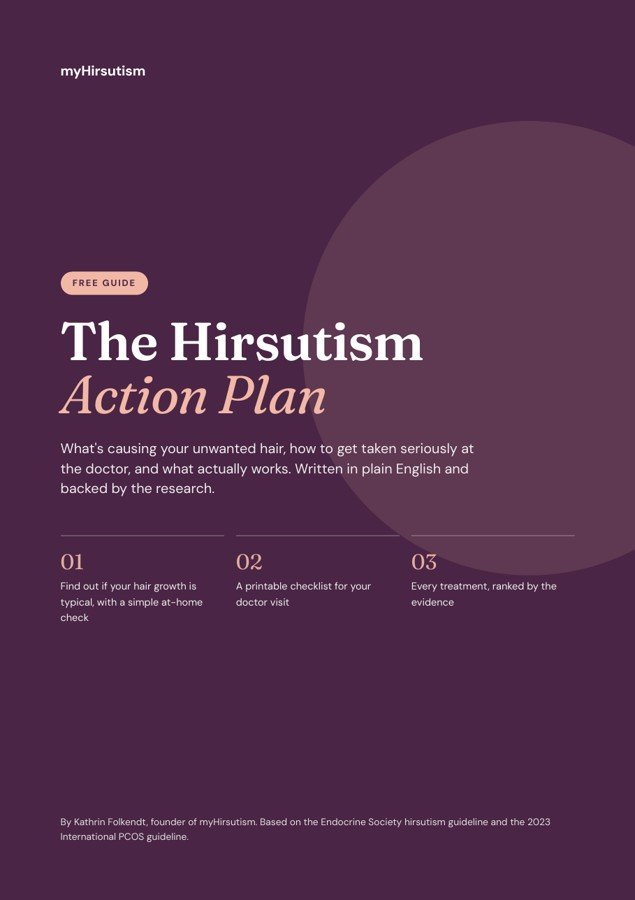
Free: The Hirsutism Action Plan
A 12-page guide: what’s causing your hair growth, which tests to ask your doctor for, and which treatments actually work, plus a printable doctor visit checklist.
You’ll also get our weekly email. Unsubscribe anytime.
Sources
- van Zuuren EJ, Fedorowicz Z, Carter B, Pandis N. Interventions for hirsutism (excluding laser and photoepilation therapy alone). Cochrane Database Syst Rev. 2015, Issue 4 (CD010334). Plain language summary accessed October 2026. Link
- Lipton MG, Sherr L, Elford J, Rustin MH, Clayton WJ. Women living with facial hair: the psychological and behavioral burden. J Psychosom Res. 2006;61(2):161-168. PubMed 16880018
- Cooney LG, Lee I, Sammel MD, Dokras A. High prevalence of moderate and severe depressive and anxiety symptoms in polycystic ovary syndrome: a systematic review and meta-analysis. Hum Reprod. 2017;32(5):1075-1091. PubMed 28333286
- Martin KA, Anderson RR, Chang RJ, et al. Evaluation and Treatment of Hirsutism in Premenopausal Women: An Endocrine Society Clinical Practice Guideline. J Clin Endocrinol Metab. 2018;103(4):1233-1257. PubMed 29522147
- Teede HJ, et al. Polyendocrine metabolic ovarian syndrome, the new name for polycystic ovary syndrome: a multistep global consensus process. Lancet. 2026;407(10545):2329-2339. Published online May 12, 2026. PubMed 42119588
- Teede HJ, Tay CT, Laven JJE, et al. Recommendations From the 2023 International Evidence-based Guideline for the Assessment and Management of Polycystic Ovary Syndrome. J Clin Endocrinol Metab. 2023;108(10):2447-2469. PubMed 37580314
This article is for education and is not medical advice. Talk to a doctor about diagnosis and treatment.