
Short answer: The three mistakes I see most often, and made myself, are treating only the hair and never asking why it grows, trying lots of supplements at once, and believing you are the only one. Hirsutism is a medical sign with a cause that a doctor can test for, most often PMOS (formerly PCOS).[1][3] Most supplements have little evidence behind them, so if you try one, try it on its own. And you are far from alone: Unwanted hair affects roughly 5% to 10% of women of reproductive age.[4]
I first noticed thick, dark hair on my chin and thighs as a teenager. I had never heard the word “hirsutism,” so I assumed I was just hairier than other girls. I avoided shorts, shaved every day and wore heavy foundation to cover the dark shadow on my chin.
I felt ashamed and kept it to myself. I cried at night and struggled with my body image, low mood and anxiety. It wasn’t until my 30s that a doctor finally gave it a name. Once I had a diagnosis, I could look for treatment and support, learn about my options and, slowly, feel more confident.
Looking back, I wish I had known some things much earlier. Here are the three mistakes that cost me the most years, and what the evidence says you can do instead.
Mistake 1: Treating the hair, but not the cause
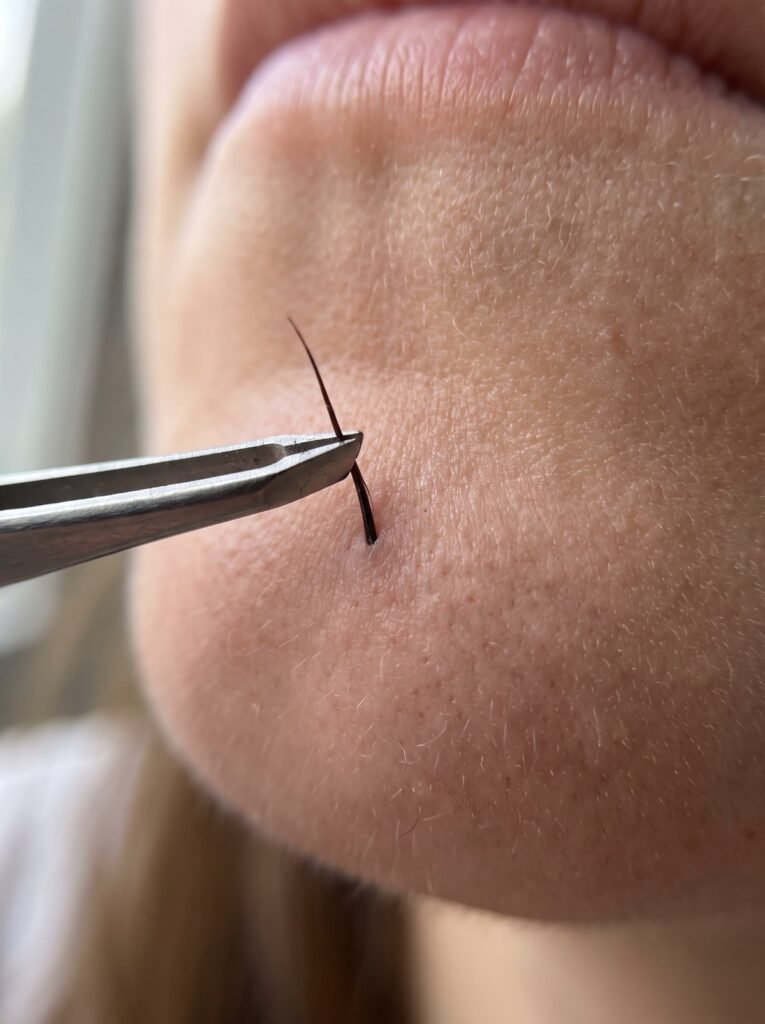
For years I had an intense routine of plucking, shaving and trying every lotion I could find. What I never did was ask why the hair was there in the first place. Hair removal became my “normal,” and I didn’t see it as a sign of a medical condition.
Hirsutism means coarse, dark hair growing in a male-like pattern, such as on the upper lip, chin, chest or lower belly. It is usually driven by androgens, hormones such as testosterone. In 70% to 80% of women with hirsutism, the cause is PMOS (formerly PCOS).[1] In May 2026, PCOS was officially renamed polyendocrine metabolic ovarian syndrome (PMOS), because the condition affects several hormone systems and metabolism, not just the ovaries.[3] The International PCOS Guideline goes as far as saying that hirsutism alone should be considered a strong sign of high androgens and PMOS in adults.[2] Less common causes include adrenal conditions, medications and, rarely, hormone-producing tumors. Read more in what causes hirsutism.
This matters for more than your hair. PMOS is linked to irregular periods, metabolic changes and mental health, so a diagnosis can open the door to care you might otherwise miss.[2]
What to do instead: See a doctor early
Evidence: Strong The Endocrine Society suggests testing androgen levels in every woman with an abnormal hirsutism score.[1] If the hair bothers you despite shaving or plucking, its guideline suggests medication, usually a combined birth control pill as the first choice for women who are not trying to get pregnant.[1] Anti-androgens such as spironolactone can be added after six months if needed, but they must be combined with reliable contraception because they can harm a developing baby.[1] A Cochrane review found that the trials behind these drugs are often small and of moderate to very low quality, and that treatment takes 6 to 12 months to reach its full effect.[4] Even so, they are the best-studied options we have. See our guide to hirsutism medication.
You don’t need to wait until it is “bad enough.” The guideline defines treatable hirsutism as unwanted hair of any degree that bothers you enough to want help.[1] A good first step is to score yourself with our hirsutism self-check, then read which doctor to see for hirsutism.
Mistake 2: Trying too many supplements at the same time
When I read that some supplements might help, I went to the drugstore and bought a basketful: Spearmint tea, zinc, DIM and a few essential oils. I took them all at once. Some months I thought things were improving, but I had no idea which product, if any, was responsible.
Evidence: Limited For most supplements, the evidence for hirsutism is limited to small, short studies, and many have no studies at all. We go through each one in our guide to supplements for hirsutism (including spearmint). Keep in mind that in the US, the FDA does not approve dietary supplements for safety or effectiveness before they go on sale, so quality and dose can vary between products.[5]
What to do instead: One change at a time
- Research first. Look for human studies that measured hair growth, not just hormone levels in a blood test.
- Pick one. If you start three things at once and see a change, you won’t know which one helped, or which one caused a side effect.
- Give it time. Hair grows in slow cycles. Even prescription drugs need at least six months before doctors judge whether they work,[1] so a few weeks is too short to judge a supplement.
- Keep notes. Photos taken in the same light every few weeks, or a simple hair score, are more reliable than memory.
- Tell your doctor. Supplements can interact with medicines, and some are not safe in pregnancy.
Mistake 3: Thinking you’re alone
For years I was sure I was the only woman dealing with this. Only after my diagnosis did I join support groups and meet other women who understood. They didn’t dismiss me. They shared what had helped them and which mistakes to avoid. Over time I felt less ashamed and started to see hirsutism as a medical condition, not a personal failing.
Research shows how common these feelings are. In a UK study of 88 women with facial hair and suspected PCOS (now PMOS), 40% felt uncomfortable in social situations, and three quarters had anxiety scores in the clinical range.[6] A review of 30 studies found that women with PCOS were several times more likely than other women to have symptoms of depression and anxiety, and these symptoms were linked, weakly, with higher hirsutism scores.[7] Because of this, the International PCOS Guideline recommends screening women with PMOS for depression and anxiety.[2]
What to do instead: Find your people
Look for a support group, online or in person. Our list of support groups and online communities for women with hirsutism is a good place to start. If low mood or anxiety is weighing on you, talk to your doctor. Talking therapies such as cognitive behavioral therapy (CBT) are recommended for women with PMOS who have depression or anxiety.[2] We cover this in more depth in what women with hirsutism want you to know.

When to see a doctor
See a doctor about any unwanted hair that bothers you. Go sooner if you notice any of these, because they can point to a rare hormone-producing tumor:[1]
- Hair growth that starts suddenly or gets worse quickly, over months rather than years
- A deepening voice, an enlarged clitoris or noticeably more muscle
- Periods that become irregular or stop
Read more about these signs in what is virilization.
Frequently asked questions
Is hirsutism a medical condition or just cosmetic?
It is a medical sign. In most women it is caused by higher androgen levels, most often from PMOS (formerly PCOS), so it is worth getting checked.[1] How you choose to manage the hair itself is up to you.
Can supplements cure hirsutism?
No supplement has been shown to cure hirsutism. A few have small studies behind them, but most have little or no evidence.
How long does hirsutism treatment take to work?
Medical treatments need at least six months before a doctor judges whether they work, and the full effect can take 6 to 12 months.[1][4]
Am I the only one with hirsutism?
Not at all. Hirsutism affects roughly 5% to 10% of women of reproductive age.[4]
Key takeaways
- Hirsutism is a sign with a cause. A doctor can test your hormones and look for PMOS (formerly PCOS) or other conditions.
- Guideline-backed treatments exist, but they take at least six months to show results.
- If you try supplements, try one at a time, give it months and tell your doctor.
- Anxiety and low mood are common with hirsutism. Support groups and talking therapy can help.

Free: The Hirsutism Action Plan
A 12-page guide: what’s causing your hair growth, which tests to ask your doctor for, and which treatments actually work, plus a printable doctor visit checklist.
You’ll also get our weekly email. Unsubscribe anytime.
Sources
- Martin KA, Anderson RR, Chang RJ, et al. Evaluation and Treatment of Hirsutism in Premenopausal Women: An Endocrine Society Clinical Practice Guideline. J Clin Endocrinol Metab. 2018;103(4):1233-1257. PubMed 29522147
- Teede HJ, Tay CT, Laven JJE, et al. Recommendations From the 2023 International Evidence-based Guideline for the Assessment and Management of Polycystic Ovary Syndrome. J Clin Endocrinol Metab. 2023;108(10):2447-2469. PubMed 37580314
- Teede HJ, et al. Polyendocrine metabolic ovarian syndrome, the new name for polycystic ovary syndrome: a multistep global consensus process. Lancet. 2026;407(10545):2329-2339. Published online May 12, 2026. PubMed 42119588
- van Zuuren EJ, Fedorowicz Z, Carter B, Pandis N. Interventions for hirsutism (excluding laser and photoepilation therapy alone). Cochrane Database Syst Rev. 2015, Issue 4 (CD010334). Plain language summary accessed October 2026. Link
- U.S. Food and Drug Administration. Questions and Answers on Dietary Supplements. Accessed October 2026. Link
- Lipton MG, Sherr L, Elford J, Rustin MH, Clayton WJ. Women living with facial hair: the psychological and behavioral burden. J Psychosom Res. 2006;61(2):161-168. PubMed 16880018
- Cooney LG, Lee I, Sammel MD, Dokras A. High prevalence of moderate and severe depressive and anxiety symptoms in polycystic ovary syndrome: a systematic review and meta-analysis. Hum Reprod. 2017;32(5):1075-1091. PubMed 28333286
This article is for education and is not medical advice. Talk to a doctor about diagnosis and treatment.