
Short answer: Chin stubble happens when coarse, dark hairs are cut at the skin surface by shaving or hair removal creams, so the blunt tips grow back within a day or two. To reduce it, you can remove hair from the root (waxing, threading), slow regrowth with prescription eflornithine cream, or reduce the hair long term with laser or electrolysis. If the stubble comes from hirsutism caused by PMOS (formerly PCOS), medication can also slow new growth.
For many women with hirsutism, stubble is the most frustrating part. You shave in the morning and by evening you can feel it again. Plucking takes forever, and a “shadow” can show through makeup. It can affect how you feel in close conversations, at the gym, or with a partner.
You are not imagining the burden. In a UK study of 88 women with facial hair, participants spent an average of 104 minutes a week managing it, and 76% said they kept checking their faces by touch.[1] This guide covers what actually helps, from better daily routines to longer-term treatments.
Why do women get chin stubble?
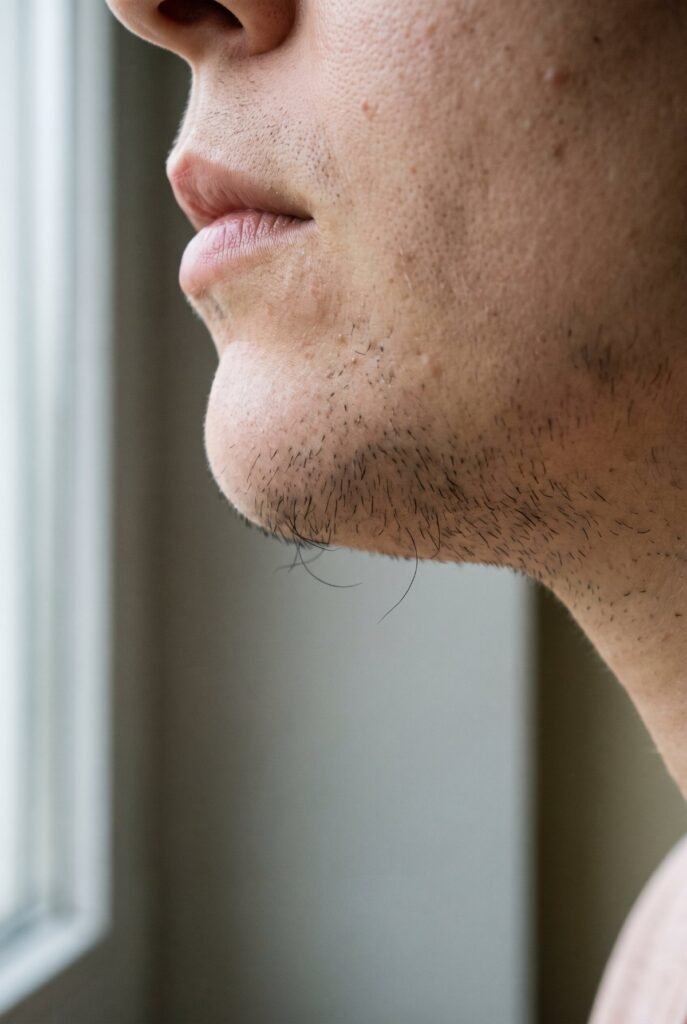
Stubble needs two things: hair that is coarse and dark enough to notice, and a removal method that cuts it at the surface.
- The hair itself. Coarse chin hair is terminal hair, which is generally pigmented and can grow beyond 5 mm.[2] It develops when androgens, hormones such as testosterone, act on sensitive follicles, either because androgen levels are high or because follicles are more sensitive to them.[3] The most common cause of hirsutism is PMOS (polyendocrine metabolic ovarian syndrome), previously called polycystic ovary syndrome (PCOS).[4]
- The way it is removed. Shaving and hair removal creams only remove hair at or near the surface, so regrowth shows quickly.[5] Shaving does not make hair thicker or darker, but the blunt tip of a regrowing hair feels coarse and can look darker for a while.[6]
On lighter skin, pigmented hairs just under the surface can also show as a shadow even right after shaving. That is why methods that remove or destroy the hair below the skin usually look smoother.
Is chin stubble a sign of hirsutism?
Not always. A few coarse hairs that you shave are common. Hirsutism is defined by the amount of terminal hair across nine body areas, using the modified Ferriman-Gallwey score, with a cutoff of 4 to 6 depending on ethnicity.[2] Because shaving hides the hair, the 2023 guideline notes that self-treatment can make hirsutism look milder than it is, and that a woman’s own view of her unwanted hair is valid.[2] Try our hirsutism self-check.
How to get rid of chin stubble
There is no single best option. Many women combine a daily method with a longer-term one.
Shave in a way that leaves less stubble
Evidence: Strong Shaving is one of the standard cosmetic measures in the Endocrine Society guideline, and there is nothing wrong with shaving your face as a woman.[7] It is quick and cheap but needs repeating.[5] Practical tips for a closer, gentler shave:
- Soften the hair first with warm water, or shave after a shower.
- Use a shaving gel or cream rather than shaving dry.
- Use a fresh, sharp blade and rinse it often.
- Shave with the direction of growth first. Going against the grain gives a closer shave but raises the risk of irritation and ingrown hairs.
- Shave in the evening if your stubble is most noticeable late in the day.
If you get red bumps, read our guide to preventing and treating razor bumps and ingrown hairs. For a complete routine, see the ultimate guide to shaving your face as a woman.
Remove hair from the root: waxing, threading and epilators
Evidence: Strong Methods that pull hair out by the root avoid stubble between sessions. Waxing results last a few weeks or longer. Threading lasts about 4 to 5 weeks and causes little irritation, so it can suit sensitive or acne-prone skin. Don’t wax if you are taking or recently took isotretinoin, or use tretinoin or an antibiotic, because skin may tear.[8] The catch: hair has to grow out a little before each session, which is hard if your stubble bothers you daily.
Electric epilators work like many tweezers at once. Hold the skin taut, move slowly with the direction of growth, and expect discomfort the first few times. Like other root methods, they can cause ingrown hairs in some people.
Hair removal creams
Evidence: Moderate Depilatory creams dissolve hair, and results tend to last a little longer than shaving.[8] Choose a product made for the face, and patch test first: apply a small amount, rinse at the stated time or as soon as it burns or stings, and wait 24 hours before using it more widely.[8]
Eflornithine cream to slow regrowth
Evidence: Strong Eflornithine 11.5% cream (Vaniqa) is a prescription cream that slows facial hair growth. In two randomized trials with 596 women, 35% of those using it for up to 24 weeks had marked improvement or better, versus 9% on a cream without the drug. It doesn’t remove hair, so you keep shaving or plucking, but stubble returns more slowly. Wait at least 5 minutes after shaving before applying it to avoid stinging. Effects can take 8 weeks, and hair returns to its old pattern within about 8 weeks of stopping. Acne is the most common side effect, and it shouldn’t be used during pregnancy or breastfeeding.[9] Availability differs by country: see how to stop hair growth on a woman’s face.
Laser hair removal
Evidence: Strong The Endocrine Society suggests laser or other light-based treatment for most women who want hair removal beyond home methods.[7] A Cochrane review found about 50% hair reduction up to six months after treatment with alexandrite and diode lasers, but long-term results were not well studied.[10] Laser works best on dark hair and usually takes 6 or more sessions. On a woman’s face, results are not permanent because of hormones, so most women need touch-ups.[11] About 3% of people develop paradoxical hypertrichosis, new hair growth near the treated area, almost always on the face or neck.[12] People with darker skin can still have laser, but it needs extra care, because some lasers carry a higher risk of skin darkening, lightening or blistering.[13][5]
Electrolysis
Evidence: Moderate Electrolysis uses an electric current to destroy individual follicles. It works on any hair color and can be permanent, but it takes several sessions, can sting, and should be done by a board-certified dermatologist or electrologist to avoid scarring or infection.[8] It is a good fit for a smaller chin area or for light hairs that laser cannot treat.
Medication that treats the cause
Evidence: Strong If your stubble is part of hirsutism, the Endocrine Society suggests a combined estrogen-progestin birth control pill for most women, adding an anti-androgen after 6 months if results are not good enough. Anti-androgens must not be used without reliable contraception because they can harm a developing baby.[7][5] In a Cochrane review, spironolactone 100 mg a day reduced hirsutism scores more than placebo, though the evidence was low quality.[14] Medication slows new growth but doesn’t remove existing hair, and it takes six months or longer to see results.[5] Read more in hirsutism medication.
What about spearmint tea?
Evidence: Limited Spearmint tea is often suggested for facial hair, but the evidence is thin. In one 30-day trial of 42 women with PCOS, spearmint tea twice daily lowered testosterone and women felt their hair was less bothersome, but objectively measured hair scores did not change significantly.[15] It is unlikely to make a noticeable difference to stubble. Read more on spearmint for hirsutism.
How to hide chin stubble
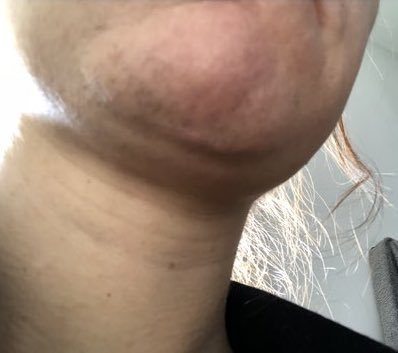
While you work on longer-term options, makeup can help. A color corrector in a peach or orange tone can neutralize a bluish or gray shadow on lighter skin before foundation. Use thin layers and set with powder so it lasts. Our step-by-step guide on how to hide stubble with makeup goes into more detail.
When to see a doctor
See a doctor if your stubble covers more than a small area, if you also have irregular periods, acne or scalp hair thinning, or if you simply want to know the cause. The NHS advises an urgent appointment if thick, dark hair starts growing suddenly, or your voice deepens or your muscles get bigger.[3] New or rapidly worsening hirsutism should be investigated to rule out a rare androgen-producing tumor.[2] If facial hair is affecting your mood, mention that too. Guidelines ask doctors to take the emotional impact seriously, whatever the clinical severity.[2] You may also find support in what women with hirsutism want you to know.
Frequently asked questions
Is it OK for a woman to shave her chin?
Yes. Shaving is a standard, safe way to manage facial hair, and it doesn’t make hair grow back thicker, darker or faster.[7][6]
How do I stop chin stubble from coming back so fast?
Switch from surface methods to root methods such as threading or waxing, add eflornithine cream to slow regrowth, or consider laser or electrolysis for longer-term reduction.[8][9][7]
Does laser permanently remove chin stubble?
Not usually for women’s faces. It reduces hair, often a lot, but hormones mean hair tends to come back and needs maintenance sessions.[11] Electrolysis can be permanent.[8]
Why do I have stubble but no long hairs?
If you shave or use creams regularly, you never see the hair at full length. The blunt regrowing tips feel like stubble.[6]
Key takeaways
- Chin stubble comes from coarse, pigmented hair being cut at the surface. Shaving doesn’t make it worse.
- Root methods (threading, waxing) avoid daily stubble. Eflornithine cream slows regrowth.
- Laser and electrolysis offer the longest-lasting results, but laser on a woman’s face usually needs maintenance.
- If stubble is part of hirsutism, medication such as the pill, sometimes with an anti-androgen, can slow new growth over 6 months or more.
- Spearmint tea has only limited evidence and is unlikely to change stubble on its own.

Free: The Hirsutism Action Plan
A 12-page guide: what’s causing your hair growth, which tests to ask your doctor for, and which treatments actually work, plus a printable doctor visit checklist.
You’ll also get our weekly email. Unsubscribe anytime.
Sources
- Lipton MG, Sherr L, Elford J, Rustin MHA, Clayton WJ. Women living with facial hair: the psychological and behavioral burden. J Psychosom Res. 2006;61(2):161-168. PubMed 16880018
- Teede HJ, Tay CT, Laven JJE, et al. Recommendations From the 2023 International Evidence-based Guideline for the Assessment and Management of Polycystic Ovary Syndrome. J Clin Endocrinol Metab. 2023;108(10):2447-2469. PubMed 37580314
- NHS. Hirsutism. Accessed October 2026. Link
- Carmina E, Rosato F, Jannì A, Rizzo M, Longo RA. Extensive clinical experience: relative prevalence of different androgen excess disorders in 950 women referred because of clinical hyperandrogenism. J Clin Endocrinol Metab. 2006;91(1):2-6. PubMed 16263820
- Mayo Clinic. Hirsutism: Diagnosis and treatment. Accessed October 2026. Link
- Mayo Clinic. Shaving hair: Does shaved hair grow back thicker? Accessed October 2026. Link
- Martin KA, Anderson RR, Chang RJ, et al. Evaluation and Treatment of Hirsutism in Premenopausal Women: An Endocrine Society Clinical Practice Guideline. J Clin Endocrinol Metab. 2018;103(4):1233-1257. PubMed 29522147
- American Academy of Dermatology. 7 ways to remove unwanted hair. Accessed October 2026. Link
- European Medicines Agency. Vaniqa: EPAR, summary of product characteristics. Accessed October 2026. Link
- Haedersdal M, Gøtzsche PC. Laser and photoepilation for unwanted hair growth. Cochrane Database Syst Rev. 2006;(4):CD004684. PubMed 17054211
- American Academy of Dermatology. Laser hair removal: Overview. Accessed October 2026. Link
- Snast I, Kaftory R, Lapidoth M, Levi A. Paradoxical Hypertrichosis Associated with Laser and Light Therapy for Hair Removal: A Systematic Review and Meta-analysis. Am J Clin Dermatol. 2021;22(5):615-624. PubMed 34057666
- American Academy of Dermatology. Laser hair removal: FAQs. Accessed October 2026. Link
- van Zuuren EJ, Fedorowicz Z, Carter B, Pandis N. Interventions for hirsutism (excluding laser and photoepilation therapy alone). Cochrane Database Syst Rev. 2015;(4):CD010334. PubMed 25918921
- Grant P. Spearmint herbal tea has significant anti-androgen effects in polycystic ovarian syndrome. A randomized controlled trial. Phytother Res. 2010;24(2):186-188. PubMed 19585478
This article is for education and is not medical advice. Talk to a doctor about diagnosis and treatment.