
Short answer: Some facial hair is normal for every woman. Fine, light “peach fuzz” is expected, and it often increases with age, especially after menopause.[1] A few coarse, dark hairs on the chin or upper lip are also common. In a study of 633 unselected US women, about 1 in 5 scored 3 or more on the standard hair-growth scale, where 0 means no coarse hair in any area.[3] Facial hair becomes a medical question when coarse, dark hair covers larger areas, appears suddenly, or comes with symptoms such as irregular periods.[1][5]
There is no single “normal” amount of facial hair. Genes, ethnicity, age and hormones all play a part, and so do cultural expectations about how women should look. This article explains what doctors consider within the usual range, when facial hair may be a sign of hirsutism, and whether women can grow a full beard. Whether you remove any facial hair is entirely your choice.
Peach fuzz vs coarse hair: What counts?
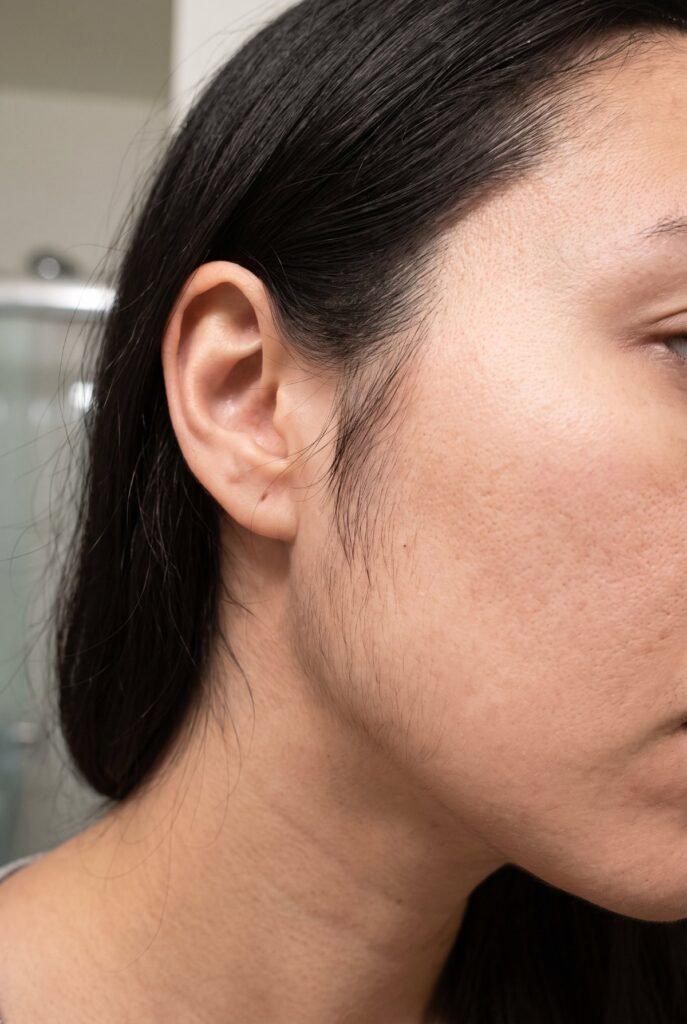
Doctors distinguish two types of hair. Vellus hair is the fine, light, short hair that covers most of the face and body. Terminal hair is thick, dark and coarse, like eyebrow or scalp hair. Hirsutism means excess terminal hair in a male-like pattern.[2] The NHS says lighter, finer hair on the face or body is probably not hirsutism, and most women get more of it as they age.[1] If peach fuzz is your main concern, see what to do about excessive peach fuzz.
How much facial hair is normal?
Doctors measure hair growth with the modified Ferriman-Gallwey (mFG) scale. It scores coarse hair in 9 areas from 0 to 4. Two of those areas are the upper lip and chin.[3][8]
In the general population, most women score very low. A study of 633 unselected Black and white US women found that most scores fell below 2. A score of 3 or more was seen in 22.1% of women. Of those, 69.3% considered themselves hirsute, compared with 15.8% of women who scored lower. Black and white women did not differ.[3] Hirsutism itself affects about 10% of women in most populations, though it is less common in women of Far-East Asian descent.[4]
| What you see | What it usually means |
|---|---|
| Fine, light hair on the cheeks, lip or chin | Normal vellus hair[1] |
| A few coarse chin or lip hairs, stable for years, regular periods | Common and often within the normal range. Guidelines do not suggest hormone tests for hair in one area with regular periods and a normal score.[5] |
| Coarse hair on the lip and chin plus the chest, abdomen or thighs | Could be hirsutism. Check your score and see a doctor.[5] |
| New, thick, dark hair appearing suddenly, or a deepening voice | Needs an urgent doctor’s appointment[1] |
Estimate your own score with our hirsutism self-check, and learn how the scale works in our Ferriman-Gallwey guide.
How ethnicity and family background affect what’s normal
The cutoff for hirsutism varies by ethnic group. The Endocrine Society uses an mFG score of 8 or more for Black and white women in the US and UK, 9-10 for Mediterranean, Hispanic and Middle Eastern women, and between 2 and 7 for Asian women.[5] The 2023 International guideline for PMOS, previously called polycystic ovary syndrome (PCOS), uses 4-6, depending on ethnicity.[6][13] A 2025 study of 9,829 unselected women in 8 countries found cutoffs from 4 to 8. White Iranian, white Italian and Black African women had the highest cutoffs, and white American and Korean women had the lowest.[7]
In practice, that means a few coarse hairs may be typical in one family and unusual in another. What matters most is a change from what is normal for you.
Facial hair after menopause
More facial hair after menopause is common. Most women develop more fine, light hair with age.[1] Coarse hair can also increase, because the balance between estrogen and androgens shifts during the menopausal transition. This relative androgen excess, or PMOS, is the most likely cause of mild symptoms.[9] Rapidly developing symptoms, a deeper voice or an enlarged clitoris after menopause can point to ovarian hyperthecosis (ovarian tissue overproducing androgens) or a hormone-producing tumor, and need prompt investigation.[9] See hirsutism and menopause.

Can women grow beards?
Yes. Some women grow coarse hair across the chin, jaw and neck that looks like a beard. This sits at the far end of the hirsutism spectrum. The usual causes are the same as for other hirsutism: PMOS (formerly PCOS) in about 80-90% of cases, idiopathic hirsutism (no cause found) in 5-10%, and non-classic congenital adrenal hyperplasia, an inherited adrenal condition, in 1-10% depending on ethnicity.[8] Rarer causes include androgen-secreting tumors, certain medicines, Cushing’s syndrome and acromegaly.[8][1] Read what causes facial hair in women.
Not all excess hair is hirsutism. Hypertrichosis is excess hair beyond what is normal for a person’s age, sex and ethnicity that does not follow a male pattern. It can affect the whole body or small patches.[10] Learn more about hirsutism vs hypertrichosis.
A beard that develops quickly, especially with a deepening voice or larger muscles, needs an urgent appointment.[1] Hirsutism can occasionally be the first sign of a tumor that needs treatment.[4]
Medication for beard-like growth
Evidence: Strong For most premenopausal women, the Endocrine Society suggests the combined pill first, adding an anti-androgen after 6 months if the response is not good enough. Anti-androgens should not be used without reliable contraception.[5] Medicines often take 6 months or more to make a difference.[11]
Removing beard hair
Evidence: Strong For women who choose hair removal treatment, the guideline suggests laser or other light-based hair removal for most, with electrolysis as an alternative.[5] Shaving is quick and safe. It does not change the thickness, color or growth rate of hair, although the blunt tip of regrowing hair can feel stubbly and look darker for a while.[12] See how to shave your face as a woman.
When to see a doctor
- Coarse, dark hair on your face plus other areas such as the chest, abdomen, back or thighs[1]
- Irregular or missing periods along with facial hair[1]
- New hair that appears suddenly or worsens within months[1][5]
- A deeper voice, larger muscles or an enlarged clitoris, which are signs of virilization[1][5]
Frequently asked questions
Is it normal for a woman to have chin hair?
A few coarse chin hairs are common. If they are stable, your periods are regular and your overall score is normal, guidelines don’t suggest hormone tests.[5] Read what to do about dark chin hairs.
Is upper lip hair normal for women?
Fine, light hair on the upper lip is normal. Coarse, dark hair there counts toward a hirsutism score, but the score depends on all 9 areas, not just the lip.[1][3]
Why am I suddenly growing more facial hair?
A gradual increase with age is common. Sudden growth, especially with other changes, should be checked by a doctor promptly.[1]
Does shaving make facial hair grow back thicker?
No. Shaving does not change the thickness, color or growth rate of hair.[12]
Key takeaways
- Fine peach fuzz is normal for every woman, and a few coarse chin or lip hairs are common.
- Hirsutism affects about 1 in 10 women and is defined by a hair score across 9 areas, with cutoffs that vary by ethnicity.
- Women can grow beard-like hair, most often because of PMOS. Sudden growth needs prompt checks.
- Removing facial hair is a personal choice, and effective medical and hair removal options exist.
Free: The Hirsutism Action Plan
A 12-page guide: what’s causing your hair growth, which tests to ask your doctor for, and which treatments actually work, plus a printable doctor visit checklist.
You’ll also get our weekly email. Unsubscribe anytime.
Sources
- NHS. Excessive hair growth (hirsutism). Accessed October 2026. Link
- Yildiz BO, Bolour S, Woods K, et al. Visually scoring hirsutism. Hum Reprod Update. 2010;16(1):51-64. PubMed 19567450
- DeUgarte CM, Woods KS, Bartolucci AA, et al. Degree of facial and body terminal hair growth in unselected black and white women: toward a populational definition of hirsutism. J Clin Endocrinol Metab. 2006;91(4):1345-1350. PubMed 16449347
- Escobar-Morreale HF, Carmina E, Dewailly D, et al. Epidemiology, diagnosis and management of hirsutism: a consensus statement by the Androgen Excess and Polycystic Ovary Syndrome Society. Hum Reprod Update. 2012;18(2):146-170. PubMed 22064667
- Martin KA, Anderson RR, Chang RJ, et al. Evaluation and Treatment of Hirsutism in Premenopausal Women: An Endocrine Society Clinical Practice Guideline. J Clin Endocrinol Metab. 2018;103(4):1233-1257. PubMed 29522147
- Teede HJ, Tay CT, Laven JJE, et al. Recommendations From the 2023 International Evidence-based Guideline for the Assessment and Management of Polycystic Ovary Syndrome. J Clin Endocrinol Metab. 2023;108(10):2447-2469. PubMed 37580314
- Bizuneh AD, Joham AE, Tay CT, et al. The PCOS Phenotype in Unselected Populations study: ethnic variation in population-based normative cut-offs for defining hirsutism. Eur J Endocrinol. 2025;192(3):228-239. PubMed 40036973
- Azziz R, Amiri M, Bril F, et al. Approach to the Patient: Hirsutism. J Clin Endocrinol Metab. 2025;110(10):e3503-e3519. PubMed 40200552
- Lindén Hirschberg A. Approach to Investigation of Hyperandrogenism in a Postmenopausal Woman. J Clin Endocrinol Metab. 2023;108(5):1243-1253. PubMed 36409990
- DermNet. Hypertrichosis. Accessed October 2026. Link
- Mayo Clinic. Hirsutism: Diagnosis and treatment. Accessed October 2026. Link
- Mayo Clinic. Shaving hair: Does shaved hair grow back thicker? Accessed October 2026. Link
- Teede HJ, Bahri Khomami M, Morman R, et al. Polyendocrine metabolic ovarian syndrome, the new name for polycystic ovary syndrome: a multistep global consensus process. Lancet. 2026;407(10545):2329-2339. PubMed 42119588
This article is for education and is not medical advice. Talk to a doctor about diagnosis and treatment.