
Short answer: Fine hair on the back of the neck below the hairline is normal for women. If it bothers you, you can shave or trim it, pluck a few strays, wax it, or go for laser or electrolysis for longer-lasting results. Shaving and trimming are the easiest and safest to do at home, ideally with a mirror and a helper. Thick, dark hair on the neck can be part of hirsutism, especially if it shows up on other areas too.
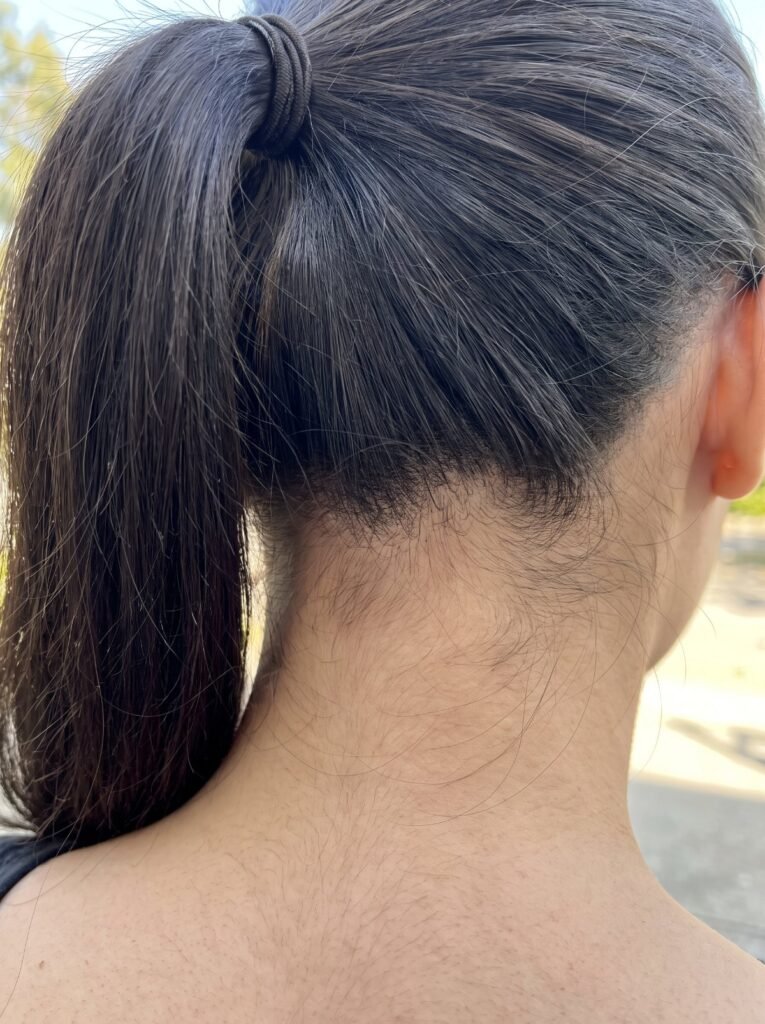
Most women have a soft fringe of fine hair at the nape, the back of the neck below the hairline. For some, a few of these hairs are darker, longer or spread further down the neck. It mostly matters when you wear your hair up or short, and that is when it can start to bother you.
This guide explains why you have hair on the back of your neck, how to remove it without ruining your hairline, and when it could point to something hormonal.
Why do I have hair on the back of my neck?
Hair at the nape is part of normal hair growth. Where your hairline sits and how much fine hair grows below it depend largely on your genes and ethnic background. Body hair in general varies a lot between ethnic groups.[1]
Hair on the neck can also be part of hirsutism, which is excess, male-pattern hair growth. The NHS lists the neck alongside the face, chest, tummy, lower back, buttocks and thighs as areas where women with hirsutism grow thick, dark hair.[2] Hirsutism affects about 1 in 10 women and is most often caused by PMOS (formerly PCOS).[3][1]
The back of the neck is not one of the nine areas in the modified Ferriman-Gallwey score, the scale doctors use to measure hirsutism.[3] So hair only on the nape doesn’t count toward a diagnosis by itself. What matters is whether you also have coarse, dark hair on areas such as your upper lip, chin, chest, stomach or back. You can check this with our hirsutism self-check or read about the Ferriman-Gallwey score.
Before you start: Protect your hairline
The trickiest part of removing nape hair is keeping a natural-looking hairline. A few practical tips:
- Use two mirrors, a large one behind you and a handheld one in front, or ask a friend or hairdresser to help.
- Mark the line you want with an eyebrow or makeup pencil before you start, then remove only the hair below it.
- Follow your natural hairline rather than cutting a straight line. A softer edge looks more natural as it grows back.
- Start conservatively. You can always take away more hair next time, but you can’t put it back.
Shaving and trimming the back of your neck
Evidence: Strong Shaving and trimming are the simplest options. They are painless and quick, but results are short-lived, so you may need to repeat them every few days.[4] Shaving does not make hair grow back thicker or darker. Shaved hair only feels coarser because of its blunt tip.[5][3]
- An electric trimmer or an electric razor is easier to handle behind your head than a blade, and less likely to nick you.
- If you use a blade, wet the skin, use a shaving gel, shave in the direction the hair grows and use a sharp blade.[6]
- The neck is one of the areas where ingrown hairs are common after shaving.[7] Shaving less often and not too close lowers the risk.[7]
Many hairdressers will tidy the nape with clippers during a haircut, which is an easy option if the area is hard to reach.
Tweezing stray hairs
Evidence: Strong Plucking works well for a few stray dark hairs, especially just below the hairline. It is safe and inexpensive but uncomfortable, and it can rarely cause scarring or dark marks.[1] It can also cause ingrown hairs.[7]
- Pluck after a warm shower, when the hair is softer.
- Use clean, slanted tweezers, grip the hair close to the skin and pull in the direction it grows.
- Don’t pluck hairs from inside your actual hairline, or you may thin it.
Waxing the nape
Evidence: Strong Waxing removes hair from the root, so results can last weeks, but it can be painful and leave the skin red. Wax that is too hot can burn.[4] Many salons offer nape waxing, which is easier than doing it yourself.
- Don’t wax if you use isotretinoin (or stopped it less than 6 months ago), topical tretinoin or some antibiotics, because these thin the skin and it can tear.[4]
- At a salon, make sure the therapist uses fresh sticks and never double dips into the wax.[4]
- Avoid waxing over sunburned, broken or irritated skin, including flaky or itchy skin at the scalp edge.

Hair removal creams
Evidence: Strong Depilatory creams dissolve hair at the surface and can irritate the skin, so always patch test first.[4][8] They are tricky on the nape because the cream can spread into the hair you want to keep. If you use one, apply it carefully below your marked line and rinse off at the time on the label, or as soon as it stings.[4]
Laser hair removal and electrolysis
Laser hair removal
Evidence: Strong Laser targets the pigment in hair and damages the follicle. It works on dark hair but not on blonde, white, gray or red hair.[4] Most people need 2 to 6 treatments spaced 4 to 6 weeks apart, and many stay hair-free for months or years, sometimes with top-up sessions.[9] For darker skin, the Endocrine Society suggests long-wavelength lasers such as Nd:YAG or diode lasers.[1] It also warns that Mediterranean and Middle Eastern women having facial hair treated with light-based methods risk paradoxical hypertrichosis, where treatment triggers more hair growth.[1] If that applies to you, ask the practitioner about this risk before treating the neck and jawline.
Because the nape is close to your hairline, discuss exactly where the treated area should end before your first session.
Electrolysis
Evidence: Moderate Electrolysis destroys each follicle with an electric current and can permanently remove hair of any color, but it needs several sessions.[4][3] It suits small areas like the nape well. Choose a board-certified dermatologist or a certified electrologist, as inexperienced operators can cause burns or scarring.[4] Compare both methods in our guide to permanent hair removal.
Can hirsutism cause hair on the back of the neck?
Yes, it can. Hirsutism produces thick, dark hair in a male-like pattern, and the NHS includes the neck among affected areas.[2] The most common cause is PMOS, previously called polycystic ovary syndrome (PCOS), a hormonal and metabolic condition renamed in 2026.[10][1]
If you have hirsutism, treating the hormone side can slow regrowth. Guidelines suggest the combined birth control pill as first-line treatment for most women who are not trying to get pregnant, with an anti-androgen added after 6 months if needed. Anti-androgens must be combined with reliable contraception.[1] See our guide to hirsutism medication. Hair growing along the sides of the face is covered in how to cut sideburns as a woman.
When to see a doctor
Hair on the nape alone is rarely a medical concern. See a doctor if you also have dark hair on your face, chest, stomach or back, or irregular periods.[2] Get an urgent appointment if you notice sudden new growth of thick, dark hair, a deepening voice or bigger muscles.[2] An enlarged clitoris and rapidly worsening hair growth are also warning signs, as they can rarely point to an androgen-producing tumor.[1] Read more about virilization.
Frequently asked questions
Is it normal for a woman to have hair on the back of her neck?
Yes. Fine hair below the hairline is normal. It is only a possible sign of hirsutism if it is thick and dark and you have similar hair in other areas.[2][3]
Should I shave the back of my neck as a woman?
If it bothers you, yes, you can. Shaving is safe and does not make hair thicker.[5] Mark your hairline first and use an electric trimmer or ask someone to help.
Will the hair grow back thicker if I shave my neck?
No. Shaving does not change hair thickness, color or growth speed.[5]
What is the most permanent way to remove neck hair?
Electrolysis can permanently remove hair of any color. Laser gives long-lasting reduction for dark hair.[4][9]
Key takeaways
- Fine hair on the back of the neck is normal and removing it is optional.
- Mark your hairline before removing anything, and get help or use two mirrors.
- Trimming and shaving are easiest. Waxing lasts longer. Laser and electrolysis give the most lasting results.
- Thick, dark neck hair plus hair on other areas can be hirsutism, most often due to PMOS.
Free: The Hirsutism Action Plan
A 12-page guide: what’s causing your hair growth, which tests to ask your doctor for, and which treatments actually work, plus a printable doctor visit checklist.
You’ll also get our weekly email. Unsubscribe anytime.
Sources
- Martin KA, Anderson RR, Chang RJ, et al. Evaluation and Treatment of Hirsutism in Premenopausal Women: An Endocrine Society Clinical Practice Guideline. J Clin Endocrinol Metab. 2018;103(4):1233-1257. PubMed 29522147
- NHS. Excessive hair growth (hirsutism). Accessed October 2026. Link
- Escobar-Morreale HF, Carmina E, Dewailly D, et al. Epidemiology, diagnosis and management of hirsutism: a consensus statement by the Androgen Excess and Polycystic Ovary Syndrome Society. Hum Reprod Update. 2012;18(2):146-170. PubMed 22064667
- American Academy of Dermatology. 6 ways to remove unwanted hair. Accessed October 2026. Link
- Mayo Clinic. Shaving hair: Does shaved hair grow back thicker? Accessed October 2026. Link
- American Academy of Dermatology. Hair removal: How to shave. Accessed October 2026. Link
- NHS. Ingrown hairs. Accessed October 2026. Link
- DermNet. Hirsutism. Accessed October 2026. Link
- American Academy of Dermatology. Laser hair removal: FAQs. Accessed October 2026. Link
- Teede HJ, Bahri Khomami M, Morman R, et al. Polyendocrine metabolic ovarian syndrome, the new name for polycystic ovary syndrome: a multistep global consensus process. Lancet. 2026;407(10545):2329-2339. PubMed 42119588
This article is for education and is not medical advice. Talk to a doctor about diagnosis and treatment.