
Short answer: A few fine, light hairs on the upper lip are normal for women. A darker, coarser moustache usually means androgens (hormones such as testosterone) are acting on hair follicles that respond to them. In women who see a specialist for it, the most common cause is PMOS (formerly PCOS). Other causes include adrenal conditions, some medications and, rarely, a hormone-producing tumor. Sudden or fast-growing facial hair needs a doctor’s check.
If you have noticed dark hairs above your lip, you are far from alone. Hirsutism, meaning excess coarse hair in a male-like pattern, affects around 1 in 10 women in most populations.[1] Many more women have some facial hair that is completely normal but still bothers them.
Facial hair can take a real toll. In a UK study of 88 women with suspected PCOS and facial hair, participants spent an average of 104 minutes a week managing it, and two thirds said they kept checking their faces in mirrors.[2] Understanding why the hair grows is the first step toward choosing what to do about it, whether that is treating a cause, removing the hair, or simply leaving it be.
Is it normal for a woman to have a moustache?
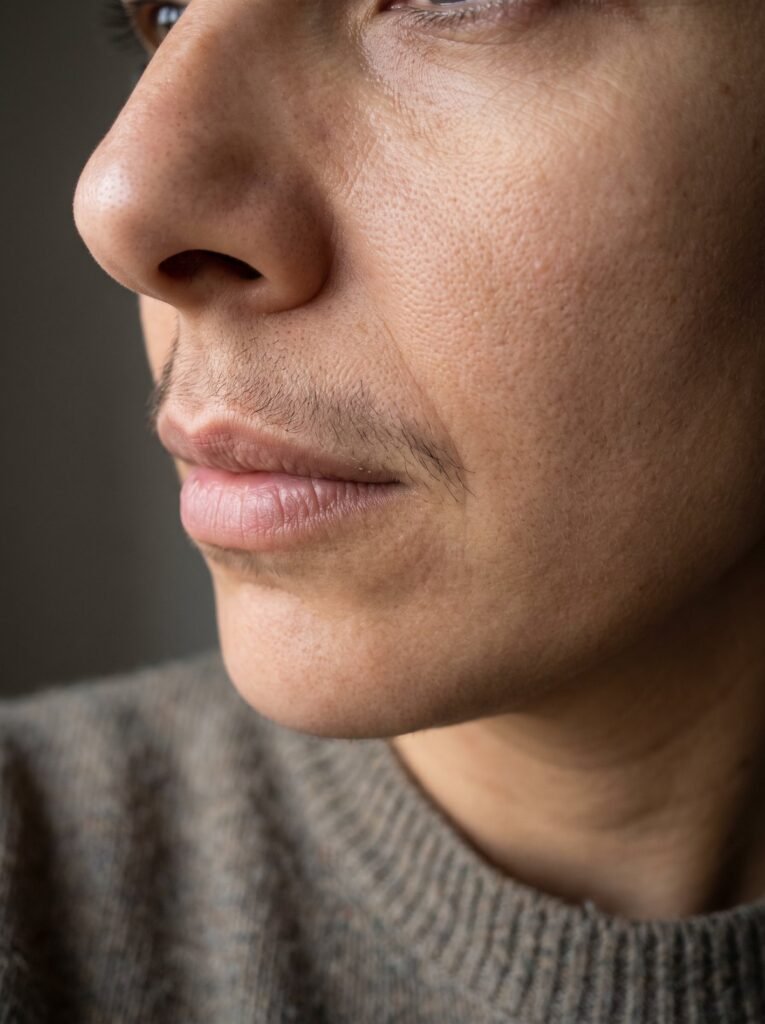
Yes, to a point. Almost all of your face is covered in vellus hair, the short, soft, pale “peach fuzz” that is hard to see. Hirsutism is about terminal hair: thicker hair that is usually pigmented and can grow longer than 5 mm if you leave it alone. Only terminal hairs count when doctors score hirsutism.[3]
Lighter, finer hair on the face is probably not hirsutism, and most women grow more facial hair as they get older, especially after menopause.[4] How visible your hair looks also depends on your hair and skin color, so two women with the same amount of hair can see very different results in the mirror.
Doctors use the modified Ferriman-Gallwey (mFG) score, which rates hair in nine body areas, including the upper lip and chin. The 2023 international guideline uses a score of 4 to 6 or more, depending on ethnicity, to define hirsutism.[3] You can learn more about how the Ferriman-Gallwey score works or try our hirsutism self-check.
If you remove your hair regularly, a doctor may underestimate how much you have. The guideline notes that self-treatment is common and that your own assessment of unwanted hair is valid and worth taking seriously.[3] It helps to let some regrowth show, or bring photos, before an appointment.
What causes facial hair in women?
Coarse facial hair in women is driven mainly by androgens. When androgen levels rise, or hair follicles are more sensitive to them, fine vellus hairs in androgen-sensitive areas such as the upper lip, chin, chest and abdomen can turn into darker terminal hairs.[1][4]
The best data on the causes come from a study of 950 women referred to two endocrine clinics in Palermo, Italy, for signs of androgen excess, most often hirsutism:[5]
| Cause | Share of patients | What it means |
|---|---|---|
| PMOS (formerly PCOS) | 72.1% | A common hormonal and metabolic condition in which the ovaries make more androgens |
| Idiopathic hyperandrogenism | 15.8% | Raised androgen levels with regular cycles and no other cause found |
| Idiopathic hirsutism | 7.6% | Hirsutism with normal androgen levels and regular cycles |
| Non-classic congenital adrenal hyperplasia (NCAH) | 4.3% | An inherited enzyme problem that makes the adrenal glands overproduce androgens |
| Androgen-secreting tumors | 0.2% | Rare tumors of the ovary or adrenal gland |
These numbers come from specialist clinics, so they are not a picture of every woman with a few hairs on her lip. But the order is consistent: PMOS is by far the most common cause, and tumors are rare.[5][1] For a deeper look at each cause, read what causes hirsutism.
PMOS (formerly PCOS)
PMOS, previously called polycystic ovary syndrome (PCOS), was officially renamed polyendocrine metabolic ovarian syndrome in May 2026 after a global consensus process. The new name reflects that the condition affects several hormone systems and metabolism, not just the ovaries. It affects about one in eight women.[6] Besides facial hair, PMOS can cause acne and irregular periods.[4] The 2023 guideline says hirsutism alone is a strong signal of raised androgens and PMOS in adults.[3] See the difference between hirsutism and PMOS.
Idiopathic hirsutism
“Idiopathic” means no underlying cause is found. In the Palermo study, about 1 in 4 women had either idiopathic hirsutism or idiopathic hyperandrogenism.[5] This is a diagnosis doctors make only after checking that your periods are regular and your hormone tests are normal, so it is not a shortcut to skip testing.
Adrenal conditions and Cushing’s syndrome
Non-classic congenital adrenal hyperplasia is an inherited condition that can look very much like PMOS. In the Palermo study, women with it tended to be younger and more hirsute.[5] Cushing’s syndrome (too much of the stress hormone cortisol) and acromegaly (too much growth hormone) are rarer hormonal causes.[4]
Medications
Some medicines can cause facial hair, including anabolic steroids, other steroids and some epilepsy medicines.[4] If your hair growth started after a new prescription, tell your doctor, but don’t stop a medicine on your own. See our list of drugs that can cause hirsutism.
Tumors (rare)
Very rarely, a tumor of the ovary or adrenal gland produces androgens. These made up 0.2% of cases in the Palermo study.[5] Guidelines stress that the timing matters most: hair growth that starts suddenly or gets worse quickly needs investigation, even if hormone levels are only mildly raised.[3][7]
Genes, ethnicity and family history
How much facial hair you have runs in families and varies between ethnic groups. The Androgen Excess and PCOS Society found that hirsutism affects about 10% of women in most populations but is less common in women from Far-East Asia.[1] The 2023 guideline adds that the severity of hirsutism may vary by ethnicity, which is why the mFG cutoff ranges from 4 to 6.[3]
What causes women to grow facial hair suddenly?
Most hirsutism starts slowly, often around puberty, and changes over years. Sudden new hair is different. The NHS advises seeing a doctor urgently if thick, dark hair suddenly starts growing on your face and body, your voice is getting deeper, or your muscles are getting bigger.[4] The 2023 guideline says new-onset severe or worsening hirsutism should be investigated to rule out androgen-secreting tumors.[3] These signs together are called virilization.
A gradual increase in a few chin or lip hairs in your 40s and 50s is more often linked to aging and menopause.[4]
How doctors find the cause
The Endocrine Society suggests testing androgen levels in all women with an abnormal hirsutism score. It suggests not testing women who have regular periods and only some unwanted hair in one area, such as the upper lip, without an abnormal overall score.[8] For PMOS, the 2023 guideline recommends measuring total and free testosterone.[3] Other tests depend on your symptoms. Our guide to blood tests and other labs for hirsutism explains what to expect.

What can you do about a female moustache?
Removing facial hair is a personal choice, not a medical necessity. If you do want to remove it, the Endocrine Society suggests that women whose hirsutism still bothers them despite shaving, plucking or waxing start with medication, usually a combined birth control pill, and add laser or electrolysis if they want more improvement.[8] For mild hirsutism without a hormone disorder, either medication or direct hair removal is reasonable.[8]
Shaving the upper lip is fine. It doesn’t change the thickness, color or growth rate of hair, although the blunt tips can feel stubbly as they grow out.[9] Bleaching can make fine dark hair less visible, mainly on lighter skin, but it can irritate, so test it on a small area first.[10] For a full comparison of creams, laser, electrolysis and medication, see how to stop hair growth on a woman’s face.
When to see a doctor
- Your facial hair is coarse and dark and spreading to other areas such as the chin, chest or stomach
- You have irregular or missing periods, acne or scalp hair thinning as well
- The hair appeared suddenly or is getting worse within months
- Your voice is deepening, your muscles are getting bigger, or you notice an enlarged clitoris
- The hair started after a new medication
The first three points can suggest PMOS or another hormone condition. The fourth needs prompt attention because it can be a sign of a rare tumor.[4][3]
Frequently asked questions
Does a moustache mean I have high testosterone?
Not necessarily. A few fine hairs are normal. Even with coarse hair, some women have normal androgen levels: in the Palermo study, 7.6% had idiopathic hirsutism with normal hormones and regular cycles.[5] Only a blood test can tell.
Can PMOS cause a moustache?
Yes. PMOS (formerly PCOS) is the most common cause of hirsutism, accounting for about 72% of cases in a large specialist clinic study.[5]
Why am I suddenly growing facial hair?
Possible reasons include a new medication, hormonal changes around menopause, or a hormone condition such as PMOS. Fast, sudden growth, especially with a deeper voice or more muscle, should be checked soon to rule out a rare tumor.[4][3]
Does shaving make a female moustache worse?
No. Shaving does not change hair thickness, color or how fast it grows. Regrowing hair just has a blunt tip, which can feel coarser for a while.[9]
Key takeaways
- Fine, light upper lip hair is normal. Hirsutism means coarse, pigmented terminal hair in a male-like pattern.
- Facial hair in women is mainly driven by androgens acting on sensitive hair follicles.
- PMOS (formerly PCOS) causes about 7 in 10 cases seen in specialist clinics. About 1 in 4 women have no clear cause.
- Sudden or rapidly worsening hair growth, a deeper voice or other signs of virilization need prompt medical attention.
- Treatment and removal are your choice. Medication, laser and electrolysis all have a role.
Free: The Hirsutism Action Plan
A 12-page guide: what’s causing your hair growth, which tests to ask your doctor for, and which treatments actually work, plus a printable doctor visit checklist.
You’ll also get our weekly email. Unsubscribe anytime.
Sources
- Escobar-Morreale HF, Carmina E, Dewailly D, et al. Epidemiology, diagnosis and management of hirsutism: a consensus statement by the Androgen Excess and Polycystic Ovary Syndrome Society. Hum Reprod Update. 2012;18(2):146-170. PubMed 22064667
- Lipton MG, Sherr L, Elford J, Rustin MHA, Clayton WJ. Women living with facial hair: the psychological and behavioral burden. J Psychosom Res. 2006;61(2):161-168. PubMed 16880018
- Teede HJ, Tay CT, Laven JJE, et al. Recommendations From the 2023 International Evidence-based Guideline for the Assessment and Management of Polycystic Ovary Syndrome. J Clin Endocrinol Metab. 2023;108(10):2447-2469. PubMed 37580314
- NHS. Hirsutism. Accessed October 2026. Link
- Carmina E, Rosato F, Jannì A, Rizzo M, Longo RA. Extensive clinical experience: relative prevalence of different androgen excess disorders in 950 women referred because of clinical hyperandrogenism. J Clin Endocrinol Metab. 2006;91(1):2-6. PubMed 16263820
- Teede HJ, Bahri Khomami M, Morman R, et al. Polyendocrine metabolic ovarian syndrome, the new name for polycystic ovary syndrome: a multistep global consensus process. Lancet. 2026;407(10545):2329-2339. Published online May 12, 2026. PubMed 42119588
- Elhassan YS, Hawley JM, Cussen L, et al. Society for Endocrinology Clinical Practice Guideline for the Evaluation of Androgen Excess in Women. Clin Endocrinol (Oxf). 2025;103(4):540-566. PubMed 40364581
- Martin KA, Anderson RR, Chang RJ, et al. Evaluation and Treatment of Hirsutism in Premenopausal Women: An Endocrine Society Clinical Practice Guideline. J Clin Endocrinol Metab. 2018;103(4):1233-1257. PubMed 29522147
- Mayo Clinic. Shaving hair: Does shaved hair grow back thicker? Accessed October 2026. Link
- Mayo Clinic. Hirsutism: Diagnosis and treatment. Accessed October 2026. Link
This article is for education and is not medical advice. Talk to a doctor about diagnosis and treatment.