
Short answer: Peach fuzz is vellus hair: short, soft, pale hair that covers most of the face and is normal for almost everyone. Even if yours seems thick, it is usually not hirsutism, which means coarse, dark terminal hair in a male-like pattern. You don’t need to remove it, but if you want to, a facial razor, dermaplaning, threading, waxing or bleaching all work. Laser is a poor fit for fine, light fuzz.
Maybe you noticed it in a photo with side lighting, or your foundation suddenly looks textured. Peach fuzz is easy to stop seeing once you have spotted it. The good news: it is a normal part of skin, and there are simple, inexpensive ways to manage it if it bothers you.
This article explains what peach fuzz is, how to tell it apart from hirsutism, when extra hair is worth a doctor’s visit, and which removal methods suit fine hair.
What is peach fuzz?
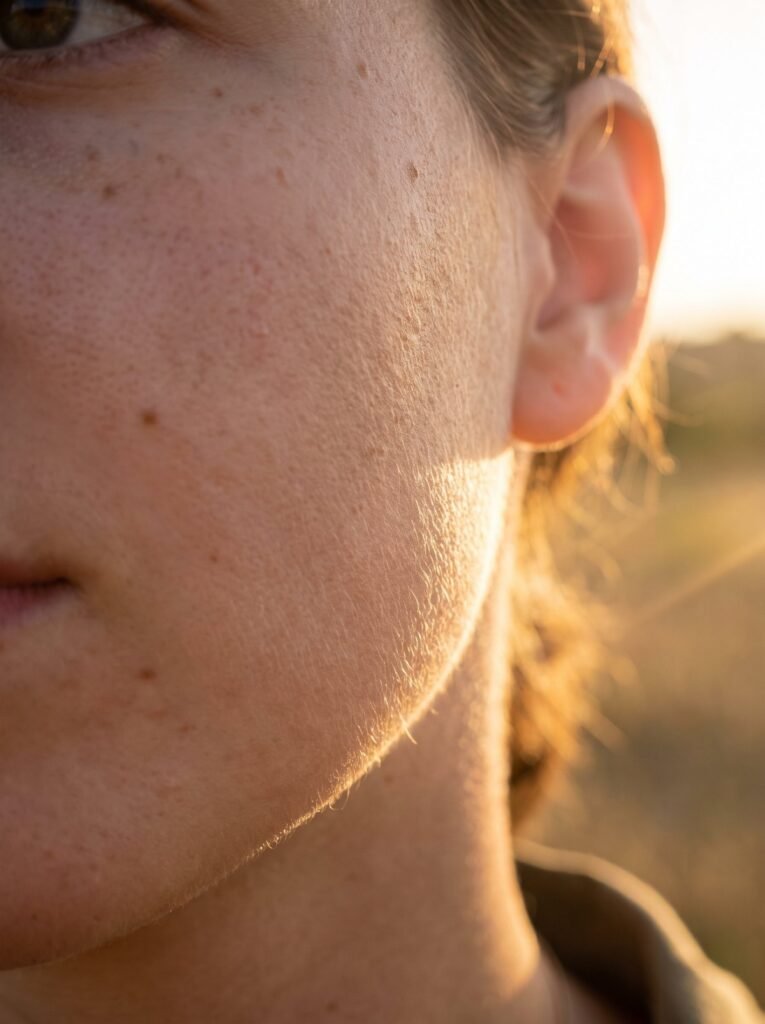
“Peach fuzz” is the everyday name for vellus hair, the fine, short, lightly colored hair that covers most of the body, named after the soft fuzz on a peach. It is different from terminal hair, which is thicker, generally pigmented and can grow longer than 5 mm. Doctors only count terminal hairs when they assess hirsutism.[1]
Lighter, finer hair on the face is probably not hirsutism, and most women grow more facial hair as they get older, especially after menopause.[2] How much fuzz you have, and how visible it is, also depends on your genes and on the contrast between your hair and skin color. If you want a sense of what is typical, read how much facial hair is normal for a woman.
Peach fuzz or hirsutism?
The main difference is the type of hair, not just how much you have.
| Peach fuzz (vellus hair) | Hirsutism (terminal hair) | |
|---|---|---|
| Texture | Soft, fine, short | Coarse, thicker, can grow longer than 5 mm[1] |
| Color | Pale or lightly colored | Usually pigmented[1] |
| Where | Most of the face and body | Male-pattern areas such as upper lip, chin, chest, stomach, back and inner thighs[2] |
| Main driver | Normal for everyone | Usually androgens, most often from PMOS (formerly PCOS)[3][4] |
| How common | Almost everyone | About 10% of women in most populations[3] |
Hirsutism happens when androgens, hormones such as testosterone, turn fine vellus hairs in hormone-sensitive areas into terminal hairs.[3] The most common cause is PMOS, previously called polycystic ovary syndrome (PCOS), which was renamed polyendocrine metabolic ovarian syndrome in 2026.[5][4] If you are unsure which you have, try our hirsutism self-check or read about the Ferriman-Gallwey score, the scale doctors use. Hirsutism can also be fair: see can hirsutism be blonde?.
What about hypertrichosis?
Hypertrichosis is a different condition: more hair than is normal for your age, sex and ethnic background, either all over or in patches, not only in male-pattern areas. When it is acquired later in life, it usually involves fine, unpigmented vellus hair. Some medicines can cause it, including minoxidil, ciclosporin and phenytoin.[6] Read more in hirsutism or hypertrichosis?.
What causes excessive peach fuzz?
- Genes and normal variation. Some people simply have more or darker vellus hair. This is the most likely reason if you have always had it.
- Age. Facial hair tends to increase with age, especially after menopause.[2]
- Medicines. Drugs such as minoxidil (including hair-loss solutions applied repeatedly), ciclosporin and phenytoin can cause extra hair growth.[6] See also drugs that can cause hirsutism.
- Less commonly, a medical condition. Widespread new fine hair that appears in adulthood has been linked to malnutrition, including anorexia nervosa, and rarely to cancer.[6]

How to get rid of peach fuzz on your face
Removing peach fuzz is optional. Many people leave it, and it can make skin look soft. If it bothers you, these are the main options. We couldn’t find clinical trials that test hair removal methods specifically on vellus facial hair, so the evidence below comes from dermatology guidance on hair removal in general.
Facial razor or dermaplaning
Evidence: Strong Shaving is a standard cosmetic hair removal method.[7] A small, single-blade facial razor or a “dermaplaning” tool removes fuzz in minutes. Shaving doesn’t make hair grow back thicker, darker or faster, though the blunt tip of regrowing hair can feel slightly coarse at first.[8] Professional dermaplaning, done by a dermatologist or trained cosmetologist, also scrapes off the outermost layer of skin and is used for peach fuzz and dull, dry skin. Its risks include infection, scarring and skin color changes, and you should talk to a provider first if you have an active acne breakout, cold sores, eczema, psoriasis, rashes or raised moles.[9] At home, use a clean, sharp blade on clean, dry skin, hold the skin taut, and use short, light strokes. See how to shave your face as a woman.
Bleaching
Evidence: Moderate Bleaching lightens hair instead of removing it, which suits fine fuzz that bothers you because of its color. It works best on lighter skin. Bleaches often contain hydrogen peroxide, which can irritate, so test on a small area first.[10] The hair stays, so it may still be visible up close or in some lighting.
Threading and waxing
Evidence: Strong Both pull hair out by the root. Threading lasts about 4 to 5 weeks and causes little irritation, which can suit sensitive or acne-prone skin. Waxing lasts a few weeks or longer but can leave skin red. Avoid waxing if you take or recently took isotretinoin, or use tretinoin or an antibiotic, because skin may tear.[11] Very fine hairs can be hard to grip, so results on soft fuzz vary.
Hair removal creams
Evidence: Moderate Depilatory creams dissolve hair and last a little longer than shaving. Facial skin is sensitive, so pick a product made for the face and patch test first: apply a little, rinse at the stated time or when it stings, and wait 24 hours.[11]
Spring tools and facial trimmers
Coiled hair removal springs pull out hairs when rolled over the skin, much like a manual epilator, and can be painful. Small electric facial trimmers cut hair at the surface without pulling. Both are cheap and easy to try. We found no studies on them, so think of them as variations of plucking and shaving.
Laser: usually not the right tool for peach fuzz
Evidence: Limited Laser targets pigment, so it works best on dark hair and does not work well on blonde, white, gray or red hair.[11] Fine, light vellus hair is a poor target. Laser can also cause paradoxical hypertrichosis, where treated areas grow more hair. A meta-analysis found this in about 3% of patients, almost only on the face and neck.[12] If you also have coarse dark hairs, laser can help with those. For the fuzz itself, other methods are usually a better choice.
Electrolysis
Evidence: Moderate Electrolysis treats one follicle at a time with an electric current and works on any hair color. It can be permanent but needs several sessions and can sting.[11] For a whole face of fine fuzz it would be very slow and expensive. It makes more sense for a limited area. For an overview of longer-term options, see how to stop hair growth on a woman’s face.
When to see a doctor
- Fine hair suddenly appears over large areas of your face or body, especially with weight loss or feeling unwell[6]
- The hair is turning coarse and dark in male-pattern areas such as the chin, upper lip, chest or stomach
- You also have irregular or missing periods, acne or scalp hair thinning
- Hair growth is rapid, or your voice deepens, your muscles get bigger or your clitoris enlarges[2][1]
- The hair started after a new medication
Frequently asked questions
Is it normal to have a lot of peach fuzz on your face?
Yes. Vellus hair covers most of the face, and lighter, finer facial hair is probably not hirsutism.[2] Visibility varies a lot between people.
Should I shave my peach fuzz?
Only if you want to. It is safe, and it doesn’t make the hair grow back thicker, darker or faster.[8]
Can PMOS cause peach fuzz?
PMOS (formerly PCOS) typically causes coarse terminal hair, not soft fuzz. Doctors only count terminal hairs when diagnosing hirsutism.[1] If your fuzz is changing into darker, thicker hair, talk to a doctor.
Does laser work on peach fuzz?
Usually not well. Laser needs pigment and works poorly on light hair, and facial laser carries a small risk of stimulating more hair growth.[11][12]
Key takeaways
- Peach fuzz is normal vellus hair. Hirsutism is coarse, pigmented terminal hair in male-pattern areas.
- Extra fuzz is usually genetic or age-related. Medicines such as minoxidil can also cause it.
- A facial razor, dermaplaning, bleaching, threading or waxing are the practical options for fine hair.
- Laser is a poor match for light, fine hair and can occasionally increase facial hair.
- See a doctor for sudden widespread hair, coarse dark hair in male-pattern areas, or other hormonal symptoms.
Free: The Hirsutism Action Plan
A 12-page guide: what’s causing your hair growth, which tests to ask your doctor for, and which treatments actually work, plus a printable doctor visit checklist.
You’ll also get our weekly email. Unsubscribe anytime.
Sources
- Teede HJ, Tay CT, Laven JJE, et al. Recommendations From the 2023 International Evidence-based Guideline for the Assessment and Management of Polycystic Ovary Syndrome. J Clin Endocrinol Metab. 2023;108(10):2447-2469. PubMed 37580314
- NHS. Hirsutism. Accessed October 2026. Link
- Escobar-Morreale HF, Carmina E, Dewailly D, et al. Epidemiology, diagnosis and management of hirsutism: a consensus statement by the Androgen Excess and Polycystic Ovary Syndrome Society. Hum Reprod Update. 2012;18(2):146-170. PubMed 22064667
- Carmina E, Rosato F, Jannì A, Rizzo M, Longo RA. Extensive clinical experience: relative prevalence of different androgen excess disorders in 950 women referred because of clinical hyperandrogenism. J Clin Endocrinol Metab. 2006;91(1):2-6. PubMed 16263820
- Teede HJ, Bahri Khomami M, Morman R, et al. Polyendocrine metabolic ovarian syndrome, the new name for polycystic ovary syndrome: a multistep global consensus process. Lancet. 2026;407(10545):2329-2339. Published online May 12, 2026. PubMed 42119588
- DermNet. Hypertrichosis. Accessed October 2026. Link
- Martin KA, Anderson RR, Chang RJ, et al. Evaluation and Treatment of Hirsutism in Premenopausal Women: An Endocrine Society Clinical Practice Guideline. J Clin Endocrinol Metab. 2018;103(4):1233-1257. PubMed 29522147
- Mayo Clinic. Shaving hair: Does shaved hair grow back thicker? Accessed October 2026. Link
- Cleveland Clinic. Dermaplaning. Accessed October 2026. Link
- Mayo Clinic. Hirsutism: Diagnosis and treatment. Accessed October 2026. Link
- American Academy of Dermatology. 7 ways to remove unwanted hair. Accessed October 2026. Link
- Snast I, Kaftory R, Lapidoth M, Levi A. Paradoxical Hypertrichosis Associated with Laser and Light Therapy for Hair Removal: A Systematic Review and Meta-analysis. Am J Clin Dermatol. 2021;22(5):615-624. PubMed 34057666
This article is for education and is not medical advice. Talk to a doctor about diagnosis and treatment.