
Short answer: Rarely, and usually not directly. The Endocrine Society lists an underactive thyroid (hypothyroidism) as an uncommon cause of hirsutism and advises testing the thyroid when there are symptoms of thyroid disease.[1] Thyroid problems are much more likely to cause scalp hair loss and period changes than extra body hair.[2], [6] The bigger link is indirect: Women with PMOS (formerly PCOS), the most common cause of hirsutism, are about three times more likely to have autoimmune thyroid disease.[3]
The thyroid is a butterfly-shaped gland at the front of the neck. Its hormones affect many body systems, including reproduction.[2] A large review of thyroid function and reproductive health found that changes in sex hormones, and in the protein that carries them in the blood, are a consistent feature of both underactive and overactive thyroid disease.[2] That is why doctors check the thyroid when investigating hormone-related symptoms.
Here is what the evidence says about the thyroid and unwanted hair, and what to ask your doctor.
Can an underactive thyroid cause hirsutism?
Possibly, but it is uncommon. The Endocrine Society hirsutism guideline lists hypothyroidism alongside Cushing’s syndrome, acromegaly and high prolactin as conditions doctors should consider. It also says they are “uncommon causes of hirsutism” and that patients usually have other symptoms specific to these conditions.[1]
The exact mechanism is not well established. Thyroid disease changes the levels of sex hormone-binding globulin (SHBG), the protein that binds testosterone in the blood, and other sex hormones.[2] Less SHBG means more free, active testosterone, which is why medicines that raise SHBG, such as the combined pill, help lower free androgens.[1] This is one theory for how an underactive thyroid could affect androgen-sensitive hair, but we did not find studies that measured hair growth as an outcome.
In practice, if your hirsutism comes with typical symptoms of an underactive thyroid, your thyroid may well be part of the picture. If it doesn’t, a thyroid problem is an unlikely explanation for excess hair. In a study of 950 women referred to specialist clinics with signs of androgen excess, 72.1% had PCOS (now PMOS), and thyroid disease was not among the main diagnoses.[8]
Symptoms of an underactive thyroid
The NHS lists these as common symptoms:[6]
- Feeling very tired
- Feeling cold more than usual
- Weight gain
- Constipation
- Difficulty concentrating
- Low mood or depression
- Dry skin, dry hair or hair loss
- A croaky (hoarse) voice
- Irregular or heavy periods
Can an overactive thyroid cause hirsutism?
We found no good evidence that an overactive thyroid (hyperthyroidism) causes hirsutism. It does affect reproductive hormones and periods. An overactive thyroid is mainly linked with lighter or more frequent periods, while an underactive thyroid is mainly linked with infrequent periods.[2]
The thyroid and PMOS (formerly PCOS)
PMOS is the condition called polycystic ovary syndrome (PCOS) until it was officially renamed polyendocrine metabolic ovarian syndrome in 2026. The new name reflects that it affects several hormone systems and metabolism.[5] It is the most common cause of hirsutism.[1], [8]
A 2018 systematic review and meta-analysis combined 13 studies with 1,210 women with PCOS and 987 women without it. Autoimmune thyroid disease, such as Hashimoto’s thyroiditis, was found in 26% of women with PCOS compared with 10% of the comparison group. That is about three times the odds (odds ratio 3.27).[3] The included studies were observational and varied in quality, and the authors advised caution in interpreting the results.[3]
So if you have PMOS, your thyroid deserves attention. But the hair growth is most likely driven by PMOS itself, not by your thyroid. The 2023 international PCOS guideline includes a thyroid-stimulating hormone (TSH) blood test among the tests used to rule out other conditions before diagnosing PMOS.[4] Read more in the difference between hirsutism and PCOS.
Is it hirsutism or hypertrichosis?
Not all extra hair is hirsutism. Hirsutism is coarse, dark hair growing in a male-type pattern, such as on the upper lip, chin, chest or abdomen. Hypertrichosis is excess hair beyond what is normal for your age, sex and ethnicity, and it does not follow a male pattern.[7] Unlike hirsutism, hypertrichosis is not caused by excess androgens.[1] If your extra hair is fine and spread over areas such as the back, arms or forehead, ask your doctor which one you have. Read more in hirsutism or hypertrichosis?
The thyroid and hair loss
Thyroid problems are more often linked with losing hair than gaining it. Dry hair and hair loss are listed among the symptoms of an underactive thyroid.[6] Androgen excess can also cause scalp hair thinning, so women with PMOS can have both excess body hair and thinning scalp hair.[1] If you are losing scalp hair, both causes are worth checking. See can hair loss from PCOS be reversed?

How doctors check the thyroid when you have hirsutism
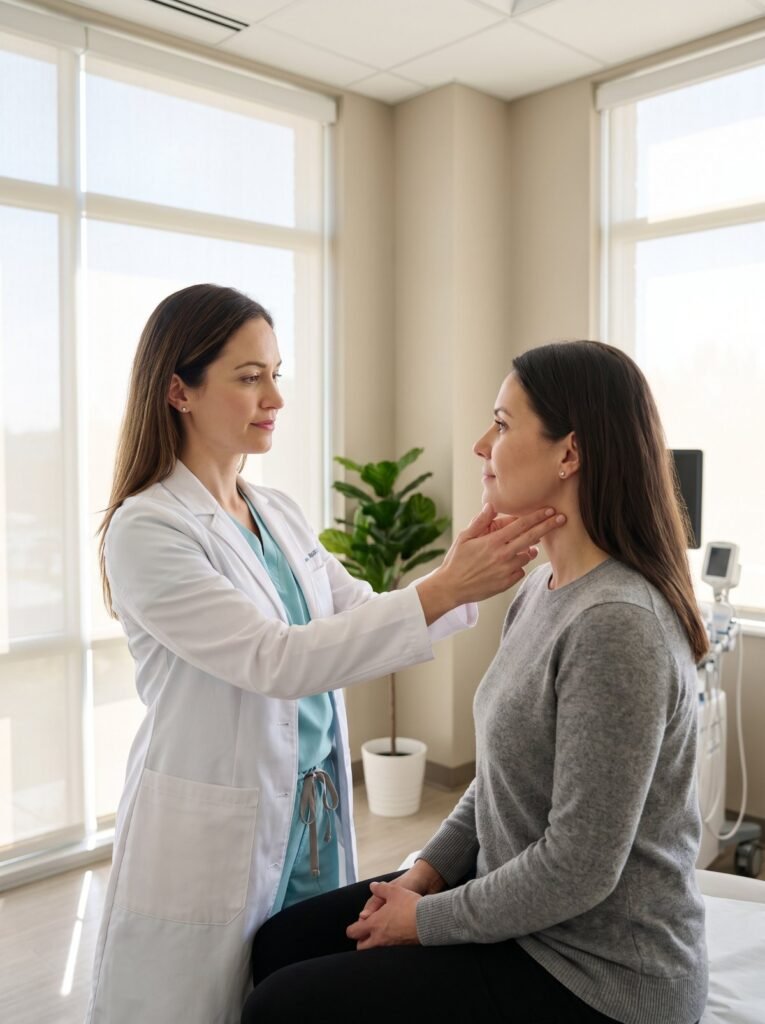
The evaluation of hirsutism starts with a history and examination and usually includes a testosterone blood test.[1] The thyroid is checked with a TSH blood test when there are thyroid symptoms, or as part of ruling out other conditions when PMOS is suspected.[1], [4] Hirsutism experts have long recommended ruling out thyroid abnormalities as part of a systematic evaluation.[9] Your doctor may also ask about:
- How fast the hair growth started and where it is
- Your periods and any fertility problems
- Symptoms of an underactive or overactive thyroid
- Medicines and supplements you take
- Family history of hirsutism, PMOS or thyroid disease
Learn more about each test in diagnosing hirsutism: Blood tests, ultrasound and other labs, and score your hair growth with the hirsutism self-check.
Will treating my thyroid reduce my hirsutism?
If an underactive thyroid is found, it should be treated for its own sake. But we could not find good studies showing how much, if at all, thyroid treatment reduces hirsutism. If your hair growth is due to PMOS or another androgen cause, it usually needs its own treatment.
Evidence: Strong For most women with hirsutism who are not trying to get pregnant, the Endocrine Society suggests combined oral contraceptive pills as the first treatment, with an anti-androgen added after 6 months if needed. Anti-androgens must be combined with reliable contraception because they can harm a developing baby.[1] See hirsutism medication.
Evidence: Moderate For hair removal, the guideline suggests laser or light-based treatment for dark hair and electrolysis for white or blonde hair, though it rates the evidence as low quality.[1] See the guide to permanent hair removal.
When to see a doctor
See a doctor if unwanted hair bothers you, especially with irregular periods,[10] or if you have symptoms of an underactive thyroid.[6] Seek an urgent appointment if new thick, dark hair suddenly starts growing on your face and body, your voice is getting lower or your muscles are getting bigger.[10] An enlarged clitoris also needs prompt checks.[1] These can be signs of virilization, which has nothing to do with the thyroid.
Frequently asked questions
Can hypothyroidism cause facial hair?
It is listed as an uncommon cause of hirsutism, usually alongside other thyroid symptoms.[1] If your thyroid is normal, look for other causes such as PMOS.
Does Hashimoto’s cause hirsutism?
There is no direct evidence that it does. But Hashimoto’s and other autoimmune thyroid diseases are about three times as common in women with PCOS (now PMOS), and PMOS is the most common cause of hirsutism.[3], [8]
Should I get my thyroid tested if I have hirsutism?
Ask your doctor. Testing is advised if you have thyroid symptoms, and TSH is part of the standard tests when PMOS is suspected.[1], [4]
Can thyroid problems cause hair loss and hair growth at the same time?
An underactive thyroid is mainly linked with dry hair and scalp hair loss.[6] Scalp thinning together with excess body hair is more typical of androgen excess, for example from PMOS.[1]
Key takeaways
- An underactive thyroid is an uncommon cause of hirsutism, usually with other thyroid symptoms.
- Thyroid problems are more often linked with scalp hair loss and period changes than with extra body hair.
- Women with PCOS (now PMOS) are about three times more likely to have autoimmune thyroid disease.
- A TSH blood test is a standard part of checking for other conditions when PMOS is suspected.
- Treating the thyroid has not been shown to reduce hirsutism, so hair growth often needs its own treatment.

Free: The Hirsutism Action Plan
A 12-page guide: what’s causing your hair growth, which tests to ask your doctor for, and which treatments actually work, plus a printable doctor visit checklist.
You’ll also get our weekly email. Unsubscribe anytime.
Sources
- Martin KA, Anderson RR, Chang RJ, et al. Evaluation and Treatment of Hirsutism in Premenopausal Women: An Endocrine Society Clinical Practice Guideline. J Clin Endocrinol Metab. 2018;103(4):1233-1257. PubMed 29522147
- Krassas GE, Poppe K, Glinoer D. Thyroid Function and Human Reproductive Health. Endocr Rev. 2010;31(5):702-755. DOI 10.1210/er.2009-0041
- Romitti M, Fabris VC, Ziegelmann PK, Maia AL, Spritzer PM. Association between PCOS and autoimmune thyroid disease: a systematic review and meta-analysis. Endocr Connect. 2018;7(11):1158-1167. DOI 10.1530/EC-18-0309
- Teede HJ, Tay CT, Laven JJE, et al. Recommendations From the 2023 International Evidence-based Guideline for the Assessment and Management of Polycystic Ovary Syndrome. J Clin Endocrinol Metab. 2023;108(10):2447-2469. PubMed 37580314
- Teede HJ, et al. Polyendocrine metabolic ovarian syndrome, the new name for polycystic ovary syndrome: a multistep global consensus process. Lancet. 2026;407(10545):2329-2339. Published online May 12, 2026. PubMed 42119588
- NHS. Underactive thyroid (hypothyroidism): Symptoms. Accessed October 2026. Link
- DermNet. Hypertrichosis. Accessed October 2026. Link
- Carmina E, Rosato F, Jannì A, Rizzo M, Longo RA. Extensive clinical experience: relative prevalence of different androgen excess disorders in 950 women referred because of clinical hyperandrogenism. J Clin Endocrinol Metab. 2006;91(1):2-6. PubMed 16263820
- Azziz R. The evaluation and management of hirsutism. Obstet Gynecol. 2003;101(5 Pt 1):995-1007. PubMed 12738163
- NHS. Excessive hair growth (hirsutism). Accessed October 2026. Link
This article is for education and is not medical advice. Talk to a doctor about diagnosis and treatment.