
Short answer: A few dark hairs on your chin are common and are often not a sign of anything wrong, especially if your periods are regular. Chin hair that is spreading, coarse and comes with irregular periods or acne can be a sign of PMOS (formerly PCOS) and is worth a doctor’s check. For removal, tweezing works for a few hairs. Laser or electrolysis, and the prescription cream eflornithine, have the best evidence for longer-term reduction.
You catch one in the rearview mirror or feel it when you rest your hand on your chin: a single dark, wiry hair that seems to grow back overnight. Chin hairs are one of the most common facial hair worries women have, and they often show up in the late 20s and 30s, which is why so many people search for this.
This guide explains why chin hairs appear, when they are worth getting checked, and how the main removal options compare, based on clinical guidelines and dermatology sources.
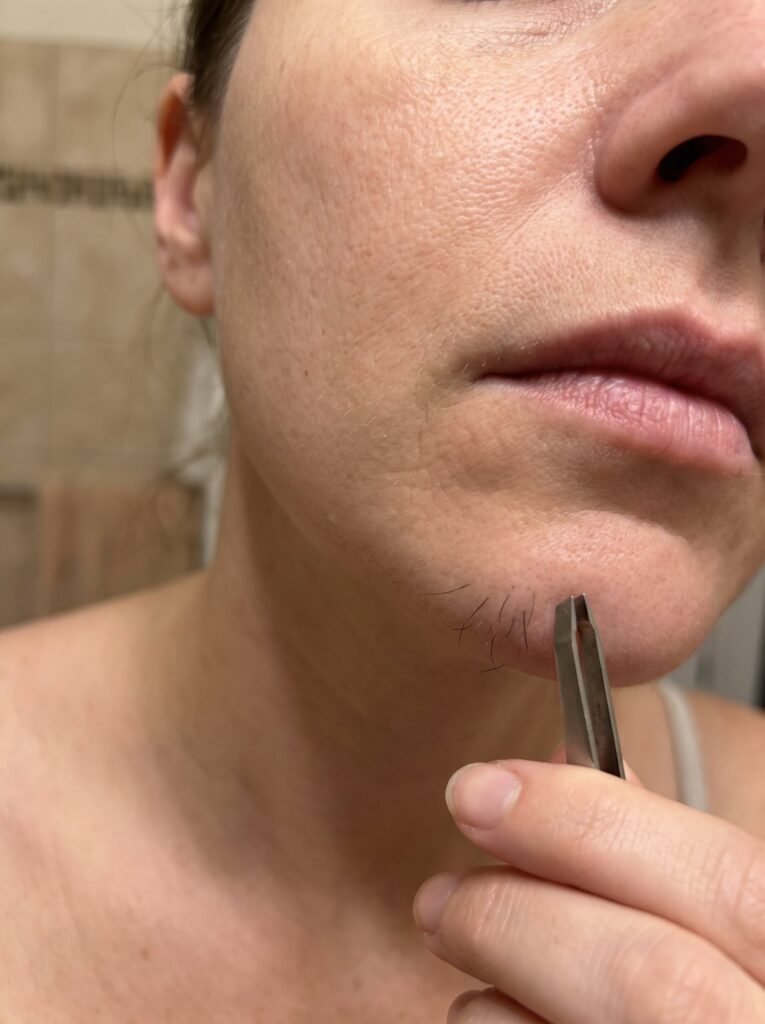
Why do women get dark hairs on the chin?
The chin is one of the areas where hair follicles respond to androgens, hormones such as testosterone that women make in smaller amounts than men. Under androgen influence, fine, pale vellus hairs can turn into darker, thicker terminal hairs.[1][2] Terminal hairs are generally pigmented and can grow longer than 5 mm if left alone.[3]
This can happen because androgen levels are higher than usual, or because your follicles are more sensitive to normal levels.[2] That second reason explains why some women with completely normal blood tests still grow a few coarse chin hairs. Genes play a big part too: how much facial hair you have runs in families and differs between ethnic groups.[1][3]
If you only have a few stray chin hairs and regular periods, the Endocrine Society suggests that hormone blood tests are usually not needed.[4] Hirsutism (excess hair in a male-like pattern) is diagnosed by looking at hair across nine body areas, not one, using the Ferriman-Gallwey score.[3] You can do a first check with our hirsutism self-check.
Why am I getting chin hair at 30?
There is no single switch that flips at 30, and we couldn’t find studies that track chin hair specifically by age in younger women. What we do know is this:
- Facial hair tends to increase with age. Most women grow more facial hair as they get older, especially after menopause.[2] A few chin hairs in your 30s can be the start of that normal trend.
- PMOS can show up at any age. PMOS (polyendocrine metabolic ovarian syndrome), previously called polycystic ovary syndrome (PCOS), affects about one in eight women.[5] It is the most common cause of hirsutism, found in 72% of women referred to specialist clinics in a large Italian study.[6] Some women first notice it in their late 20s or 30s, for example after stopping the birth control pill, which can mask raised androgens.[3]
- Non-classic congenital adrenal hyperplasia (NCAH) is an inherited adrenal condition that can look very similar to PMOS. It caused 4.3% of cases in the same study.[6]
- Medications such as anabolic steroids, other steroids and some epilepsy medicines can cause new facial hair.[2] See our list of drugs that can cause hirsutism.
- Cushing’s syndrome, caused by too much cortisol, is a rarer hormonal cause.[2]
In short, a few new chin hairs at 30 are common and usually not worrying on their own. What matters is the overall picture: how fast the hair is coming in, whether it appears in other places such as the upper lip, chest or stomach, and whether you have other symptoms.
When chin hair is a reason to see a doctor
- The hair is spreading beyond a few stray hairs, for example to your jawline, neck, upper lip, chest or stomach
- You also have irregular or missing periods, acne, or thinning hair on your scalp
- The hair appeared suddenly or is getting noticeably worse within months
- Your voice is getting deeper, your muscles are getting bigger, or you notice an enlarged clitoris
The NHS advises an urgent appointment if thick, dark hair starts growing suddenly, or comes with a deepening voice or bigger muscles.[2] Guidelines say rapidly worsening hirsutism needs investigation to rule out a rare androgen-producing tumor.[3][7] These signs are called virilization.

How to get rid of dark chin hairs
Removing chin hair is entirely your choice. The best method depends on how many hairs you have, your hair and skin color, your budget, and how long you want results to last. If an underlying condition such as PMOS is driving the growth, medical treatment can slow new growth, and most women combine it with a removal method.[4]
| Method | How long results last | Best for |
|---|---|---|
| Tweezing | Until the hair regrows | A few stray hairs[8] |
| Shaving | A day or two | Many hairs, quick fix[8] |
| Threading | 4 to 5 weeks | Small areas, sensitive or acne-prone skin[9] |
| Waxing | A few weeks or longer | Larger patches[9] |
| Hair removal cream | Longer than shaving | People who prefer no pulling[9] |
| Eflornithine cream | Slows regrowth while you use it | Adding to any other method[10] |
| Laser | Months or years, with maintenance on the face | Dark hair[11][12] |
| Electrolysis | Can be permanent | Any hair color, including gray or blonde[9] |
Tweezing
Evidence: Strong Plucking, shaving and waxing are the standard cosmetic measures in the Endocrine Society guideline.[4] Tweezing is only practical for a few stray hairs, and the hair often regrows.[8] Use clean, sharp, slanted tweezers, pluck in the direction of growth, and pull the skin taut. Picking at hairs below the surface can lead to ingrown hairs and marks. Read more about the pros and cons of tweezing facial hair.
Shaving
Evidence: Strong Shaving is quick and cheap but needs to be repeated regularly.[8] It doesn’t make hair grow back thicker, darker or faster. The blunt tip of a regrowing hair can just feel stubbly for a while.[13] Many women with hirsutism shave their chin daily, and there is nothing wrong with that. See our guide to shaving your face as a woman.
Threading and waxing
Evidence: Strong Both pull hair from the root. Threading results last 4 to 5 weeks, and it causes little irritation, so it can suit sensitive or acne-prone skin. It needs a skilled practitioner.[9] Waxing lasts a few weeks or longer but can leave skin red. Don’t wax if you are taking or recently took isotretinoin, or use tretinoin or an antibiotic, because your skin may tear. At a salon, check that a fresh stick is used for every dip.[9]
Hair removal creams and bleaching
Evidence: Moderate Hair removal creams (depilatories) dissolve the hair. Always do a patch test first: apply a little, rinse it off at the stated time or as soon as it stings, and wait 24 hours.[9] Bleaching lightens hair instead of removing it. It mainly helps on lighter skin and is less useful for coarse, dark chin hair. Its hydrogen peroxide can irritate skin, so test a small area first.[8] Both are standard home options listed by the NHS.[2]
Eflornithine cream
Evidence: Strong Eflornithine 11.5% cream (Vaniqa) is a prescription cream that slows facial hair growth. In two randomized trials with 596 women treated for up to 24 weeks, 35% of women using the cream had marked improvement or better, compared with 9% using a cream without the drug. Its licensed use is specifically the face and under the chin. It doesn’t remove hair, results can take 8 weeks, and hair returns to its previous level within about 8 weeks of stopping.[10] Availability varies by country, which we cover in how to stop hair growth on a woman’s face.
Laser hair removal
Evidence: Strong For women who want longer-lasting hair removal, the Endocrine Society suggests laser or other light-based treatment.[4] Laser works best on dark hair and may not work on blonde, white, gray or red hair.[9] On a woman’s face it is usually not permanent because of hormones, so expect maintenance sessions.[12] A small share of people, about 3% across studies, develop paradoxical hypertrichosis, extra hair growth in or near the treated area, and this happens almost only on the face and neck.[14] Choose an experienced provider, ideally a dermatologist.[11]
Electrolysis
Evidence: Moderate Electrolysis destroys each follicle with an electric current. It works on all hair colors, including the gray or light chin hairs that laser misses, and can be permanent after several sessions. It can sting, and in inexperienced hands can cause scarring, burns or infection.[9] It is listed as a direct hair removal option in the Endocrine Society guideline.[4]
Does spearmint tea help with chin hair?
Evidence: Limited Spearmint tea is often recommended for chin hair. In one small trial, 42 women with PCOS drank spearmint or placebo tea twice a day for 30 days. Testosterone levels fell and women rated their hair as less bothersome, but doctors’ objective hair scores did not change significantly.[15] The study was too short to show an effect on hair growth. More detail is in our article on spearmint for hirsutism.
Frequently asked questions
Is it normal for women to have chin hair?
Yes. Many women have a few dark chin hairs, and facial hair tends to increase with age, especially after menopause.[2] It becomes a medical question when there is a lot of coarse hair in several areas or other symptoms appear.
Does chin hair mean I have PMOS?
Not on its own. PMOS is the most common cause of hirsutism, but a few stray hairs with regular periods usually do not need hormone testing.[4][6] Talk to a doctor if the hair is spreading or you have irregular periods or acne.
Why do chin hairs grow back so fast after plucking?
Plucking removes the hair but leaves the follicle alive, so it regrows.[8] Only electrolysis destroys individual follicles in a way that can be permanent.[9]
Will laser get rid of gray chin hairs?
Usually not. Laser targets pigment, so it doesn’t work well on gray, white, blonde or red hair. Electrolysis works on all hair colors.[9]
Key takeaways
- A few dark chin hairs are common at any adult age, including your 30s, and facial hair tends to increase with age.
- Hair that spreads to other areas or comes with irregular periods or acne can point to PMOS (formerly PCOS) and is worth checking.
- Sudden, fast-growing hair, a deeper voice or more muscle needs prompt medical attention.
- Tweezing suits a few hairs. Laser (for dark hair), electrolysis (for any color) and eflornithine cream have the best evidence for longer-term reduction.

Free: The Hirsutism Action Plan
A 12-page guide: what’s causing your hair growth, which tests to ask your doctor for, and which treatments actually work, plus a printable doctor visit checklist.
You’ll also get our weekly email. Unsubscribe anytime.
Sources
- Escobar-Morreale HF, Carmina E, Dewailly D, et al. Epidemiology, diagnosis and management of hirsutism: a consensus statement by the Androgen Excess and Polycystic Ovary Syndrome Society. Hum Reprod Update. 2012;18(2):146-170. PubMed 22064667
- NHS. Hirsutism. Accessed October 2026. Link
- Teede HJ, Tay CT, Laven JJE, et al. Recommendations From the 2023 International Evidence-based Guideline for the Assessment and Management of Polycystic Ovary Syndrome. J Clin Endocrinol Metab. 2023;108(10):2447-2469. PubMed 37580314
- Martin KA, Anderson RR, Chang RJ, et al. Evaluation and Treatment of Hirsutism in Premenopausal Women: An Endocrine Society Clinical Practice Guideline. J Clin Endocrinol Metab. 2018;103(4):1233-1257. PubMed 29522147
- Teede HJ, Bahri Khomami M, Morman R, et al. Polyendocrine metabolic ovarian syndrome, the new name for polycystic ovary syndrome: a multistep global consensus process. Lancet. 2026;407(10545):2329-2339. Published online May 12, 2026. PubMed 42119588
- Carmina E, Rosato F, Jannì A, Rizzo M, Longo RA. Extensive clinical experience: relative prevalence of different androgen excess disorders in 950 women referred because of clinical hyperandrogenism. J Clin Endocrinol Metab. 2006;91(1):2-6. PubMed 16263820
- Elhassan YS, Hawley JM, Cussen L, et al. Society for Endocrinology Clinical Practice Guideline for the Evaluation of Androgen Excess in Women. Clin Endocrinol (Oxf). 2025;103(4):540-566. PubMed 40364581
- Mayo Clinic. Hirsutism: Diagnosis and treatment. Accessed October 2026. Link
- American Academy of Dermatology. 7 ways to remove unwanted hair. Accessed October 2026. Link
- European Medicines Agency. Vaniqa: EPAR, summary of product characteristics. Accessed October 2026. Link
- American Academy of Dermatology. Laser hair removal: FAQs. Accessed October 2026. Link
- American Academy of Dermatology. Laser hair removal: Overview. Accessed October 2026. Link
- Mayo Clinic. Shaving hair: Does shaved hair grow back thicker? Accessed October 2026. Link
- Snast I, Kaftory R, Lapidoth M, Levi A. Paradoxical Hypertrichosis Associated with Laser and Light Therapy for Hair Removal: A Systematic Review and Meta-analysis. Am J Clin Dermatol. 2021;22(5):615-624. PubMed 34057666
- Grant P. Spearmint herbal tea has significant anti-androgen effects in polycystic ovarian syndrome. A randomized controlled trial. Phytother Res. 2010;24(2):186-188. PubMed 19585478
This article is for education and is not medical advice. Talk to a doctor about diagnosis and treatment.