
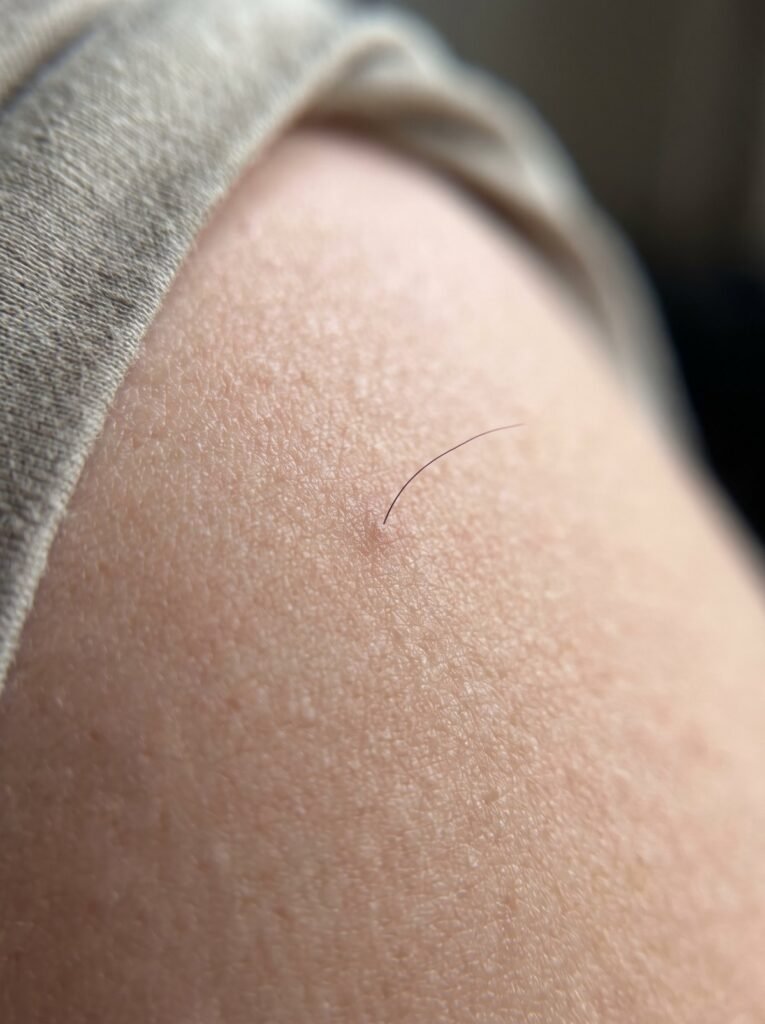
Short answer: A few random long, dark hairs on your arms, chest, stomach or face are very common and usually harmless. They are terminal hairs: thick, pigmented hairs that grow from a follicle that has switched over from making fine “peach fuzz,” often under the influence of androgens (hormones such as testosterone).[1][2] If you only have a handful, your periods are regular and nothing is changing fast, you can simply remove them. Many new hairs, or hairs with other symptoms, are worth a doctor’s check.
You look down and there it is: one long, black hair sprouting from your shoulder, breast, neck or forearm, much longer and darker than everything around it. It can feel strange, and it is easy to worry that something is wrong. In most cases nothing is. This article explains why these hairs appear, when they might point to hirsutism, and the easiest ways to deal with them.
Are random long black hairs normal for women?
Yes, a few are. Most of a woman’s body is covered in vellus hair, which is short, fine and light. Some follicles, especially in “sexual hair” areas such as the face, chest, breasts, stomach and back, are more sensitive to androgens. Under their influence, a vellus follicle can enlarge and start producing terminal hair, which is longer, thicker and darker.[1][2] This can happen to one follicle on its own, which is why a single dark hair can appear among fine ones.
Women’s hair also changes with age. Remaining facial hair often becomes coarser in later life, most often on the chin and around the lips.[3] Read more in dark hairs on your chin.
Why is one hair so much longer than the others?
We couldn’t find any studies that look specifically at single, unusually long body hairs. The most likely explanation is the one above: that follicle has become a terminal hair follicle, so it grows longer and darker than the vellus hairs around it. The old idea that a single long hair is caused by a “mutation” in the follicle is not backed by research we could find.
Hairs growing from a mole
Moles sometimes have hair growing from them, and this is normal.[4] Some birthmarks, such as congenital moles, are naturally hairy.[5] What matters is whether the mole itself changes. See a doctor if a mole changes size, shape or color, becomes painful or itchy, or is inflamed, bleeding or crusty.[4]
A single patch of thick hair
Sometimes several dark hairs grow close together in one well-defined patch. This can be nevoid hypertrichosis, a localized patch of terminal hair that is usually harmless.[5] Learn the difference in hirsutism or hypertrichosis?
Could random dark hairs be a sign of hirsutism?
A few stray hairs are not hirsutism. Hirsutism means excess terminal hair in a male pattern in women.[2] Doctors measure it across several body areas with the Ferriman-Gallwey score. The Endocrine Society advises against testing hormone levels in women with regular periods who only have unwanted hair in one area, because the tests rarely change what happens next.[2]
It is more likely to be hirsutism if the dark hairs keep spreading to areas such as the upper lip, chin, chest, stomach or back, especially if you also have irregular periods.[6] The most common cause of hirsutism is PMOS, previously called polycystic ovary syndrome (PCOS).[6] PCOS was officially renamed polyendocrine metabolic ovarian syndrome (PMOS) in 2026.[7] Our hirsutism self-check can help you see where you fall.
How to remove random long hairs
There is no medical need to remove them. If you want to, the best method depends on how many there are and where they grow.
Tweezing
For one or a few hairs, tweezers are the obvious choice. Dermatology sources describe hand-held tweezers as suited to “the occasional coarse hair or a small group of hairs.”[8] Plucking can cause pain, inflamed follicles (folliculitis), ingrown hairs and dark marks.[8] To make it easier:
- Tweeze after a warm shower, when the hair and skin are softer.
- Use clean, sharp, slanted tweezers and good light.
- Hold the skin taut and pull in the direction the hair grows.
- Grip the hair close to the skin so it doesn’t snap.
The hair will grow back, and plucking does not stop it for good. See how many times you have to pluck a hair before it stops growing.
Trimming
Small, rounded scissors let you cut a single hair at skin level without irritating the skin. This is a good option for a hair growing from a mole, because it avoids pulling on the mole.
Shaving and hair removal creams
If there are several hairs in one area, shaving is quick and painless. Use a sharp blade and shave in the direction of growth to lower the risk of razor burn and ingrown hairs.[9] Shaving does not make hair grow back thicker.[9] Hair removal creams dissolve hair at the surface. Do a patch test first, and use a product made for the face if you are treating facial hair.
Epilators and waxing
These remove hair from the root, so results last longer than shaving, but they share the same risks as plucking, including pain and ingrown hairs.[8] They make more sense for a cluster of hairs than for one.
Electrolysis and laser
Evidence: Strong If the same hairs keep coming back and bother you, longer-lasting options are available. The Endocrine Society suggests laser-based hair removal for brown or black hair and electrolysis for white or blonde hair.[2] Results aren’t the same for everyone, the treatments carry some risks, and they can be expensive.[6] Because electrolysis treats one follicle at a time, it can suit a small number of stubborn hairs. Read our guide to permanent hair removal.

When to see a doctor
- Thick, dark hairs are spreading to new areas over months
- New hair growth starts suddenly or gets worse quickly
- You also have irregular or missing periods
- Your voice is getting deeper, your muscles are getting bigger, or your clitoris has become larger (signs of virilization)
- A mole with a hair in it changes, itches or bleeds[4]
Sudden hair growth with signs of virilization can rarely point to a hormone-producing tumor, which needs prompt testing.[2] Read more about virilization.
Frequently asked questions
Why do I have one long black hair on my arm?
It is most likely a single follicle that has switched from fine vellus hair to thick terminal hair.[1] It is common and harmless on its own.
Is it OK to pluck a hair growing from a mole?
We couldn’t find good evidence either way. Trimming the hair close to the skin avoids pulling on the mole. More important is to watch the mole itself for changes.
Do random dark hairs mean I have high testosterone?
Not necessarily. Follicles differ in how sensitive they are to androgens, so some women grow terminal hairs with normal hormone levels.[1][2] Doctors don’t usually test hormones for a few stray hairs if your periods are regular.[2]
Will a random long hair come back after I pull it out?
Usually, yes. Plucking removes the hair from the root, but the follicle can grow a new one.[8]
Key takeaways
- A few random long, dark hairs are common and usually harmless.
- They are terminal hairs, often from follicles that respond to androgens.
- Tweezing or trimming is the simplest fix for one or two hairs. Electrolysis and laser last longer.
- Many spreading hairs, irregular periods or signs of virilization are reasons to see a doctor.
- A hair growing from a mole is normal, but a changing mole needs checking.

Free: The Hirsutism Action Plan
A 12-page guide: what’s causing your hair growth, which tests to ask your doctor for, and which treatments actually work, plus a printable doctor visit checklist.
You’ll also get our weekly email. Unsubscribe anytime.
Sources
- DermNet. Hirsutism. Accessed October 2026. Link
- Martin KA, Anderson RR, Chang RJ, et al. Evaluation and Treatment of Hirsutism in Premenopausal Women: An Endocrine Society Clinical Practice Guideline. J Clin Endocrinol Metab. 2018;103(4):1233-1257. PubMed 29522147
- MedlinePlus (US National Library of Medicine). Aging changes in hair and nails. Accessed October 2026. Link
- NHS. Moles. Accessed October 2026. Link
- DermNet. Hypertrichosis. Accessed October 2026. Link
- NHS. Hirsutism. Accessed October 2026. Link
- Teede HJ, et al. Polyendocrine metabolic ovarian syndrome, the new name for polycystic ovary syndrome: a multistep global consensus process. Lancet. 2026;407(10545):2329-2339. Published online May 12, 2026. PubMed 42119588
- DermNet. Epilation. Accessed October 2026. Link
- DermNet. Shaving. Accessed October 2026. Link
This article is for education and is not medical advice. Talk to a doctor about diagnosis and treatment.