
Short answer: Laser hair removal can reduce nipple hair for months to years, and it avoids the ingrown hairs and irritation that plucking and shaving can cause. It works best on dark hair. Because the areola is darker than the skin around it, the risk of burns and skin color changes is higher, so choose a dermatologist or a very experienced provider. We found no studies on laser for the nipple area specifically. Electrolysis is an alternative, especially for light or blond hairs.
If you are tired of plucking the same few dark hairs around your nipples, laser can sound like the perfect fix. It can work well, but the nipple area comes with a few extra considerations. Here is what the evidence says about laser hair removal, what makes the areola different, and how to prepare so you get good results safely.
Does laser hair removal work on nipple hair?
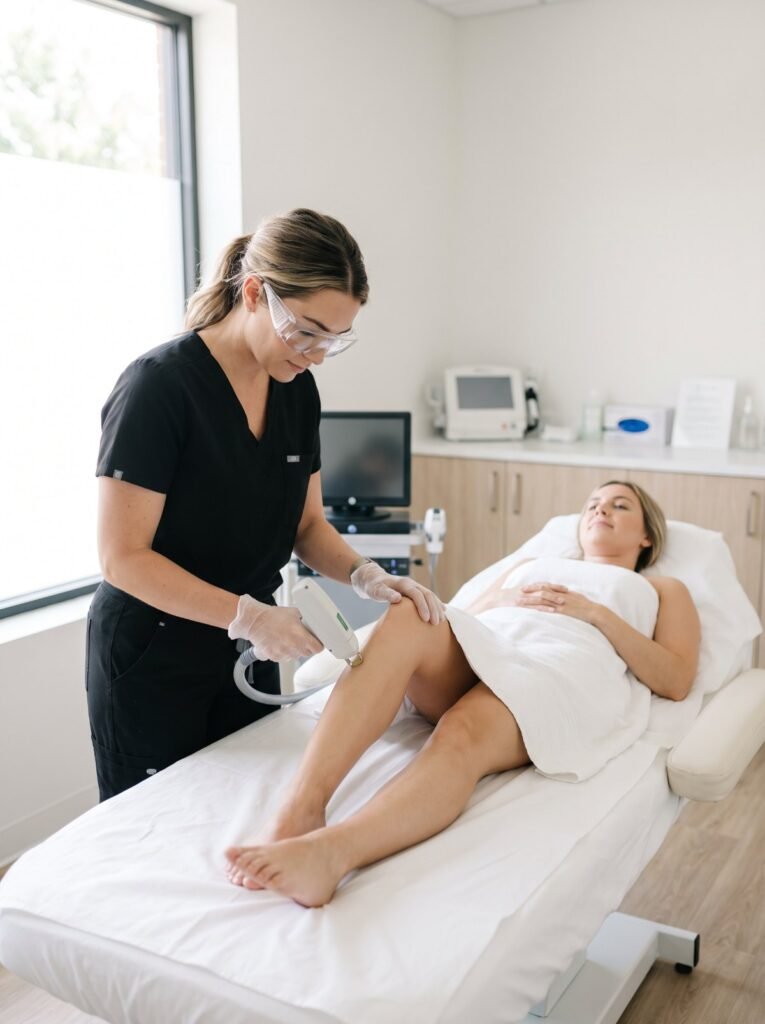
Evidence: Moderate Laser hair removal uses light that is absorbed by the pigment in the hair. The heat damages the follicle and slows regrowth. It works best when there is a clear contrast between dark hair and lighter skin, and it works less well on blond, white, gray and red hair. [1]
The evidence for laser in general is reasonable, though not perfect. A Cochrane review of 11 randomized trials with 444 people found that alexandrite and diode lasers reduced hair by about 50% for up to 6 months after the last session. None of the trials were of high quality, and long-term hair removal was not documented. [2] The Endocrine Society suggests photoepilation (laser or light-based hair removal) for women with brown or black unwanted hair. [3]
What you can realistically expect:
- Each treatment removes about 10 to 25% of the hair, and the hair that grows back tends to be finer, lighter and sparser. [4]
- Most people need between 2 and 8 sessions, spaced several weeks apart. The American Academy of Dermatology says 2 to 6 sessions, usually every 4 to 6 weeks, [4] and Mayo Clinic says 4 to 8. [1]
- Laser does not guarantee that hair will never grow back, and occasional maintenance sessions may be needed. [1], [4]
We could not find any studies that looked at laser hair removal on the nipple or areola specifically. The numbers above come from studies of other body areas.
Is laser hair removal on the nipples safe?
Laser hair removal is generally safe in experienced hands, but the AAD warns that it can be dangerous when done by someone inexperienced. [4] Common short-term side effects include discomfort, redness and swelling that looks like a mild sunburn and lasts 1 to 3 days. [4] Less common risks are blistering, crusting, scarring, infection, cold sore flare-ups and lighter or darker patches of skin. [4], [1] Rarely, hair around the treated area grows thicker instead of thinner. [1]
Why the areola needs extra care
The laser targets pigment. The areola is naturally darker than the surrounding breast skin, [5] and darker skin absorbs more of the laser’s energy. The risk of skin color changes is higher in people with black or brown skin, [1] and treating darker skin “must be performed very carefully.” [4] For darker skin, the Endocrine Society suggests a long-wavelength laser such as an Nd:YAG or diode laser with skin cooling. [3] Ask your provider which laser they plan to use on your areola and whether they will do a test spot first.
The areola also has Montgomery glands, small oil glands that look like bumps, [5] and the skin is thin and sensitive. Ask your provider how they handle the nipple area before you book.
Paradoxical hair growth
In a small number of people, laser or light treatment triggers more hair growth nearby instead of less. This is called paradoxical hypertrichosis. The Endocrine Society says women of Mediterranean and Middle Eastern descent with facial hirsutism should be warned about a higher risk. [3] It is mostly described on the face, but it is worth asking about if you are in a higher-risk group.
Is laser right for you?
Laser is usually a good fit if:
- Your nipple hairs are dark, since dark hair responds best [1]
- Plucking or shaving keeps giving you ingrown hairs or bumps. The NHS lists laser as a longer-term option for people with ingrown hairs. [6]
- You can commit to several sessions and avoid sun on the area
Laser is less likely to work if your nipple hairs are blond, white, gray or red. [1] For light hair, the Endocrine Society suggests electrolysis instead. [3]
If the hair around your nipples is part of a wider pattern, with coarse hair on your chin, belly or back or irregular periods, the cause may be hormonal. Hirsutism is most often caused by PMOS (formerly PCOS), [3], [7] and the Endocrine Society says women with high androgen levels who choose hair removal should also be offered medication to reduce regrowth. [3] Without treating the cause, new hairs may keep appearing. Try our hirsutism self-check and read why you may have hair on your breasts.
Electrolysis: the alternative for the nipple area
Evidence: Limited Electrolysis uses a fine probe placed into each follicle and a small electric current to destroy it. It can remove hair permanently and works on all hair colors, but it needs several sessions because hair grows in cycles. [8] Because it treats one hair at a time, it suits small areas with a few hairs, like the areola. Risks include infection from unsterile probes, scarring and burns when done by an inexperienced operator, and keloids (raised scars) in people with darker skin. [8] The AAD recommends a board-certified dermatologist or a board-certified electrologist. [8] We rate the evidence as limited because we did not find controlled trials of electrolysis to cite, even though the Endocrine Society suggests it for light hair. [3] Read more in electrolysis: how long it takes to see results and our guide to permanent hair removal.
How to choose a provider
- Look for a board-certified dermatologist, or a provider supervised by one. The AAD recommends this because laser can injure the skin in inexperienced hands. [4], [8]
- Ask how much experience they have with your skin tone. [8]
- Ask which laser they will use and what settings they use for darker skin. [3]
- Ask for a test spot, and ask how they protect the nipple itself.

How to prepare for laser on your nipples
- Stop plucking, waxing or electrolysis at least 4 weeks before treatment, because the laser needs the hair root to be in place. [1]
- Shave or trim the area the day before your appointment, as your provider directs. [1]
- Avoid sun, tanning beds and self-tanners before treatment, and wait for any tan to fade. [1], [8]
- Tell your provider if you have taken isotretinoin, take any other medicines (including aspirin), scar easily, get keloids or have frequent cold sores. [9]
Aftercare
- Use a cool compress to ease discomfort. [4]
- Keep the area out of direct sun and avoid tanning beds, for about 6 weeks or as your provider advises. [1], [4]
- Contact your provider if you get blisters, crusting or signs of infection. [1], [4]
When to see a doctor first
Before booking laser, see a doctor if your nipple hair appeared suddenly or is spreading fast, or if you have a deepening voice, an enlarged clitoris or missing periods. These can point to a rare androgen-producing tumor. [3] Read more about virilization. Also get any breast change checked, such as a new lump, nipple discharge that is not breast milk, a nipple that turns inward or scaly skin on the nipple. [10]
Frequently asked questions
Is laser hair removal on the nipples permanent?
Not guaranteed. Laser greatly reduces hair, and regrowth tends to be finer and lighter, but some hair may come back and maintenance sessions may be needed. [1], [4] Electrolysis is the method that can remove hair permanently. [8]
How many sessions do you need for nipple hair?
Usually somewhere between 2 and 8 sessions, spaced several weeks apart. [4], [1] We found no data specific to the nipple area.
Does laser hair removal on the nipples hurt?
Most people feel some discomfort, and the skin may be red and swollen for 1 to 3 days. Some providers use a numbing gel, which takes 30 to 60 minutes to work. [4]
Can you get laser on the areola if you have dark skin?
Yes, but it must be done carefully, ideally with a long-wavelength laser such as Nd:YAG or diode and skin cooling, because the risk of skin color changes is higher. [4], [3], [1]
Key takeaways
- Laser can reduce dark nipple hair for months or longer, but it is not guaranteed to be permanent.
- The areola is darker and more sensitive than the surrounding skin, so choose a dermatologist or a provider experienced with your skin tone.
- Electrolysis is a good alternative for a few hairs or for light-colored hair.
- If hair is spreading in several areas, ask your doctor about hormones before or alongside hair removal.

Free: The Hirsutism Action Plan
A 12-page guide: what’s causing your hair growth, which tests to ask your doctor for, and which treatments actually work, plus a printable doctor visit checklist.
You’ll also get our weekly email. Unsubscribe anytime.
Sources
- Mayo Clinic. Laser hair removal. Accessed October 2026. Link
- Haedersdal M, Gøtzsche PC. Laser and photoepilation for unwanted hair growth. Cochrane Database Syst Rev. 2006;(4):CD004684. Cochrane summary
- Martin KA, Anderson RR, Chang RJ, et al. Evaluation and Treatment of Hirsutism in Premenopausal Women: An Endocrine Society Clinical Practice Guideline. J Clin Endocrinol Metab. 2018;103(4):1233-1257. PubMed 29522147
- American Academy of Dermatology. Laser hair removal: FAQs. Accessed October 2026. Link
- Cleveland Clinic. Montgomery Glands. Accessed October 2026. Link
- NHS. Ingrown hairs. Accessed October 2026. Link
- Teede HJ, Bahri Khomami M, Morman R, Laven JSE, et al. Polyendocrine metabolic ovarian syndrome, the new name for polycystic ovary syndrome: a multistep global consensus process. Lancet. 2026;407(10545):2329-2339. PubMed 42119588
- American Academy of Dermatology. 6 ways to remove unwanted hair. Accessed October 2026. Link
- American Academy of Dermatology. Laser hair removal: Preparation. Accessed October 2026. Link
- American Cancer Society. Signs and Symptoms of Breast Cancer. Accessed October 2026. Link
This article is for education and is not medical advice. Talk to a doctor about diagnosis and treatment.