

Short answer: You can make arm hair less noticeable by lightening it with a bleaching cream, trimming it, or removing it by shaving, waxing, sugaring or a hair removal cream. For longer-lasting results, laser hair removal works well on dark hair, and electrolysis works on any hair color. Lemon juice has no evidence behind it and can burn your skin in the sun. Dark arm hair on its own is usually normal and not a sign of hirsutism.
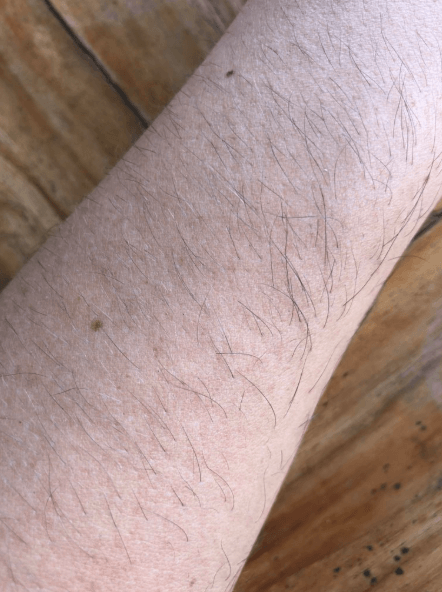
Everyone has hair on their arms, but how dark, thick and long it is varies a lot from person to person. If yours bothers you, you have plenty of options, from five-minute fixes to treatments that last for years. Removing it is a personal choice, not a necessity. This guide compares the options, explains how to do each one safely, and points out the popular tips that don’t hold up.

Is dark arm hair a sign of hirsutism?
Usually not. Hirsutism means thick, dark hair growing in a male-like pattern on areas such as the face, neck, chest, tummy, lower back, buttocks or thighs. The NHS notes that lighter, finer hair is usually not considered hirsutism.[1] Arms are not on that list, and the amount and color of arm hair varies naturally from person to person.
It’s worth thinking about hormones if your arm hair is part of a bigger picture: coarse dark hair on your face, chest or stomach, irregular periods or acne. The most common cause of hirsutism is PMOS, the condition previously called polycystic ovary syndrome (PCOS).[1] Our hirsutism self-check can help you decide whether to talk to a doctor, and our guide to hirsutism versus hypertrichosis explains the difference between hormone-driven hair and other types of excess hair.
Your options at a glance
| Method | How long it lasts | Good to know |
|---|---|---|
| Bleaching | Until new dark hair grows in | Hides hair without removing it.[3] Results vary with hair and skin color. |
| Trimming | A few days to weeks | No skin irritation. Hair stays, just shorter. |
| Shaving | One to a few days[2] | Fast and painless, but stubble can feel rough. |
| Depilatory cream | Usually longer than shaving[2] | Can irritate skin, so test first.[2], [3] |
| Waxing or sugaring | A few weeks or longer[2] | Painful at first. Avoid with some acne medicines.[2] |
| Laser hair removal | Long term after several sessions[2], [9] | Works best on dark hair. Doesn’t work on blonde, red, gray or white hair.[2] |
| Electrolysis | Permanent after several sessions[2] | Works on all hair colors. Slow and costly for large areas.[2], [3] |
Bleaching arm hair
Bleaching makes dark hair less obvious without removing it.[3] Because the hair stays, there’s no stubble or regrowth line, which makes it a good option if your arm hair is fine but dark. The NHS lists lightening alongside shaving and waxing as a home option for unwanted hair.[1]
Tips for bleaching safely:
- Use a cream bleach made for body or facial hair, not a hair dye or bleach meant for your scalp.
- Do the patch test in the instructions, usually on a small area of skin 24 hours before, and don’t continue if you get burning, redness or itching.
- Don’t bleach right after shaving, waxing or exfoliating, or on sunburned or broken skin.
- Keep to the timing on the pack. Leaving bleach on longer doesn’t make it work better and increases irritation.
- Very dark, coarse hair can turn orange or yellow, and light hair can stand out against darker skin tones. Try a small area first and see how it looks.
If your hair is already fairly light and you’re wondering how this fits with hirsutism, see can hirsutism be blonde?.
Trimming arm hair
If your arm hair is long rather than dark, trimming it with an electric body trimmer and a guard can make a big difference. It doesn’t touch the skin, so there’s no risk of razor bumps or ingrown hairs, and hair grows back soft rather than as stubble. Try a longer guard setting first and go shorter if needed.
Shaving arm hair
Shaving removes hair at the skin’s surface, so results last only a day to a few days. It’s painless if you don’t nick yourself, but frequent shaving can irritate skin and cause ingrown hairs in some people.[2] Dermatologists recommend:[4]
- Shaving after a shower, when skin and hair are soft
- Using a shaving cream or gel, labeled for sensitive skin if your skin is dry or sensitive
- Shaving in the direction the hair grows
- Rinsing the blade after each stroke and replacing blades or disposable razors after 5 to 7 shaves
- Storing your razor somewhere dry
Moisturize afterward if your skin feels dry. If you get bumps, see our guide to razor bumps and ingrown hairs.
Does shaving make arm hair grow back thicker?
No. Shaving doesn’t change the thickness, color or growth rate of hair.[3], [5] Regrowth can look darker or feel coarser because shaving leaves a blunt tip instead of the hair’s natural tapered end.[5] The thing that does change is the feel: Stubble on arms can be noticeable to touch, which is why some people prefer bleaching or waxing for this area.
Waxing and sugaring arm hair
Waxing pulls hair out from the root, so results can last a few weeks or longer, though it takes practice and can hurt.[2] A salon visit can be a good way to learn how it should be done before trying a home kit.
The American Academy of Dermatology (AAD) recommends:[6]
- Letting hair grow to about ¼ to ¾ inch first
- Washing and fully drying the skin so the wax sticks
- Testing the wax temperature on the inside of your wrist. It should feel warm, not painful
- Applying wax in the direction of hair growth and pulling the strip off quickly against it while holding the skin taut
- Not waxing sunburned or very sensitive skin
- Seeing a dermatologist if redness or swelling lasts more than two days
Don’t wax if you are taking isotretinoin or took it in the last 6 months, or if you use tretinoin or are taking an antibiotic. These medicines can make skin fragile enough to tear.[2] At a salon, check that the staff use a fresh stick each time and never double-dip, because heated wax isn’t hot enough to kill germs.[2]
Sugaring works in a similar way, using a paste of sugar, water and lemon juice instead of wax. Homemade sugar paste has to be boiled to a very high temperature, so the main risk is burns: Let it cool and test it on your wrist the same way you would test wax.[6] Rinse the area well afterward so no lemon residue stays on your skin in the sun.[7]
Wondering whether waxing eventually stops hair from growing back? Read how many times you have to wax before the hair stops growing.
Hair removal creams
Depilatory creams dissolve hair at the surface and often last a bit longer than shaving. They can irritate skin and cause dermatitis, so dermatologists recommend testing first: Apply a small amount, rinse it off at the time on the label or as soon as it burns, and wait 24 hours to see whether you react.[2], [3] Never leave a cream on longer than the instructions say.
Does lemon juice lighten arm hair?
Evidence: None We couldn’t find any studies showing that lemon juice lightens body hair. It is, however, a well-documented skin hazard. Lemon and lime juice contain furocoumarins, chemicals that react with sunlight and can cause phytophotodermatitis, a burn-like, often blistering rash.[7], [8] The dark marks it leaves can last weeks, months or, in some cases, years.[7], [8]
You may see advice to put lemon juice on your arms and sit in the sun. We don’t recommend this. If you want lighter arm hair, a cream bleach is more predictable and safer when used as directed.
Laser hair removal for arms
Evidence: Moderate Laser hair removal uses light that targets the pigment in hair. The AAD says it usually takes about six or more sessions and that the results are permanent on most areas of the body, though not on a woman’s face.[2], [9] A Cochrane review of 11 randomized trials found that alexandrite and diode lasers reduced hair by roughly 50% for up to six months, but none of the trials were high quality and none documented long-term results. Evidence for intense pulsed light (IPL) devices was weaker.[10]
Things to know before you book:
- It works on all skin tones when the operator has experience with yours, but you should wait until a tan fades.[2]
- It doesn’t work well on blonde, red, gray or white hair, because there’s not enough pigment to target.[2]
- An inexperienced provider can cause burns, blisters, infection or dark spots, so choose carefully.[2]
Our guide to permanent hair removal compares laser, IPL and electrolysis in more detail.
Electrolysis for arms
Evidence: Limited Electrolysis uses a fine probe and an electrical current to damage each hair follicle. The AAD says it can permanently remove unwanted hair and, unlike laser, works on light-colored hair.[2] DermNet also describes it as able to cause permanent hair loss but notes that it takes time.[3] The supporting evidence we found comes mainly from expert guidance rather than large trials.
Because each follicle is treated one at a time, arms take many sessions, which makes it slow and expensive for large areas. Choose a board-certified dermatologist or certified electrologist who uses sterile probes. Unskilled treatment can cause scarring, and people with darker skin tones can develop raised keloid scars.[2], [3] See how long electrolysis takes to show results.
When to see a doctor
Dark arm hair by itself rarely needs a medical check. Talk to a doctor if:
- You also have thick, dark hair on your face, chest, stomach or back
- Your periods are irregular or have stopped
- Hair growth started suddenly or is getting worse quickly
- Your voice is getting deeper, your muscles are getting bigger, or your clitoris has enlarged
The NHS advises an urgent appointment for sudden new hair growth on the face and body, a deepening voice or increased muscle bulk.[1] These can be signs of virilization, which needs prompt investigation. Our article on what causes hirsutism explains the possible causes.
Frequently asked questions
Is it normal for girls to have dark arm hair?
Yes. Arm hair is normal, and how dark and thick it is varies naturally between people. On its own, arm hair isn’t counted as hirsutism, which affects areas such as the face, chest, stomach, back and thighs.[1]
Is it OK for women to shave their arms?
Yes. It’s a personal choice. Shaving doesn’t make hair grow back thicker or darker.[5] The main downside is that stubble comes back within a day or two, and it can feel rough.
What’s the fastest way to make arm hair less noticeable?
Shaving or trimming takes a few minutes. A bleaching cream takes a little longer but avoids stubble. Waxing lasts longest of the at-home options.[2]
Is bleaching arm hair safe?
For most people it is when you follow the instructions and do the patch test first. Stop if your skin burns, itches or turns red, and don’t bleach broken, sunburned or freshly shaved skin.
Is laser hair removal on the arms permanent?
The AAD describes laser results as permanent on most body areas after about six or more sessions.[9] Trial evidence is less certain about long-term results.[10] If hair grows back, treatment can be repeated.[9]
Key takeaways
- Dark arm hair is common and usually not a sign of hirsutism.
- Bleaching hides dark hair without stubble. Trimming, shaving, creams and waxing remove it for days to weeks.
- Shaving doesn’t make hair grow back thicker or darker.
- Skip lemon juice: There’s no evidence it lightens hair, and it can burn your skin in the sun.
- For long-term results, laser works on dark hair and electrolysis works on any hair color.

Free: The Hirsutism Action Plan
A 12-page guide: what’s causing your hair growth, which tests to ask your doctor for, and which treatments actually work, plus a printable doctor visit checklist.
You’ll also get our weekly email. Unsubscribe anytime.
Sources
- NHS. Excessive hair growth (hirsutism). Accessed October 2026. Link
- American Academy of Dermatology. 6 ways to remove unwanted hair. Accessed October 2026. Link
- DermNet. Hirsutism. Accessed October 2026. Link
- American Academy of Dermatology. Hair removal: How to shave. Accessed October 2026. Link
- Mayo Clinic. Shaving hair: Does shaved hair grow back thicker?. Accessed October 2026. Link
- American Academy of Dermatology. Hair removal: How to wax. Accessed October 2026. Link
- Mioduszewski M, Beecker J. Phytophotodermatitis from making sangria: a phototoxic reaction to lime and lemon juice. CMAJ. 2015;187(10):756. doi:10.1503/cmaj.140942
- DermNet. Phytophotodermatitis. Accessed October 2026. Link
- American Academy of Dermatology. Laser hair removal: Overview. Accessed October 2026. Link
- Haedersdal M, Gøtzsche PC. Laser and photoepilation for unwanted hair growth. Cochrane Database Syst Rev. 2006;(4):CD004684. Link
This article is for education and is not medical advice. Talk to a doctor about diagnosis and treatment.