
Short answer: Facial hair in PMOS (the condition that was called PCOS until 2026) is driven by androgens, hormones such as testosterone, acting on hair follicles on the chin, upper lip, jawline and neck. Insulin resistance, which is common in PMOS, makes this worse. What helps most is treating the hormones and the hair at the same time: the pill and, if needed, an anti-androgen to slow new growth, plus laser or electrolysis for the hair that is already there. Expect to wait at least six months to judge any medical treatment.
If you have PMOS and you are plucking chin hairs in the car mirror, you are in very large company. Excess facial and body hair is one of the most common signs of the condition, alongside irregular periods, acne and thinning hair on the scalp.[6] This guide explains why PMOS causes facial hair, which treatments the evidence supports, and how to combine them so the results last.
Why PMOS causes facial hair
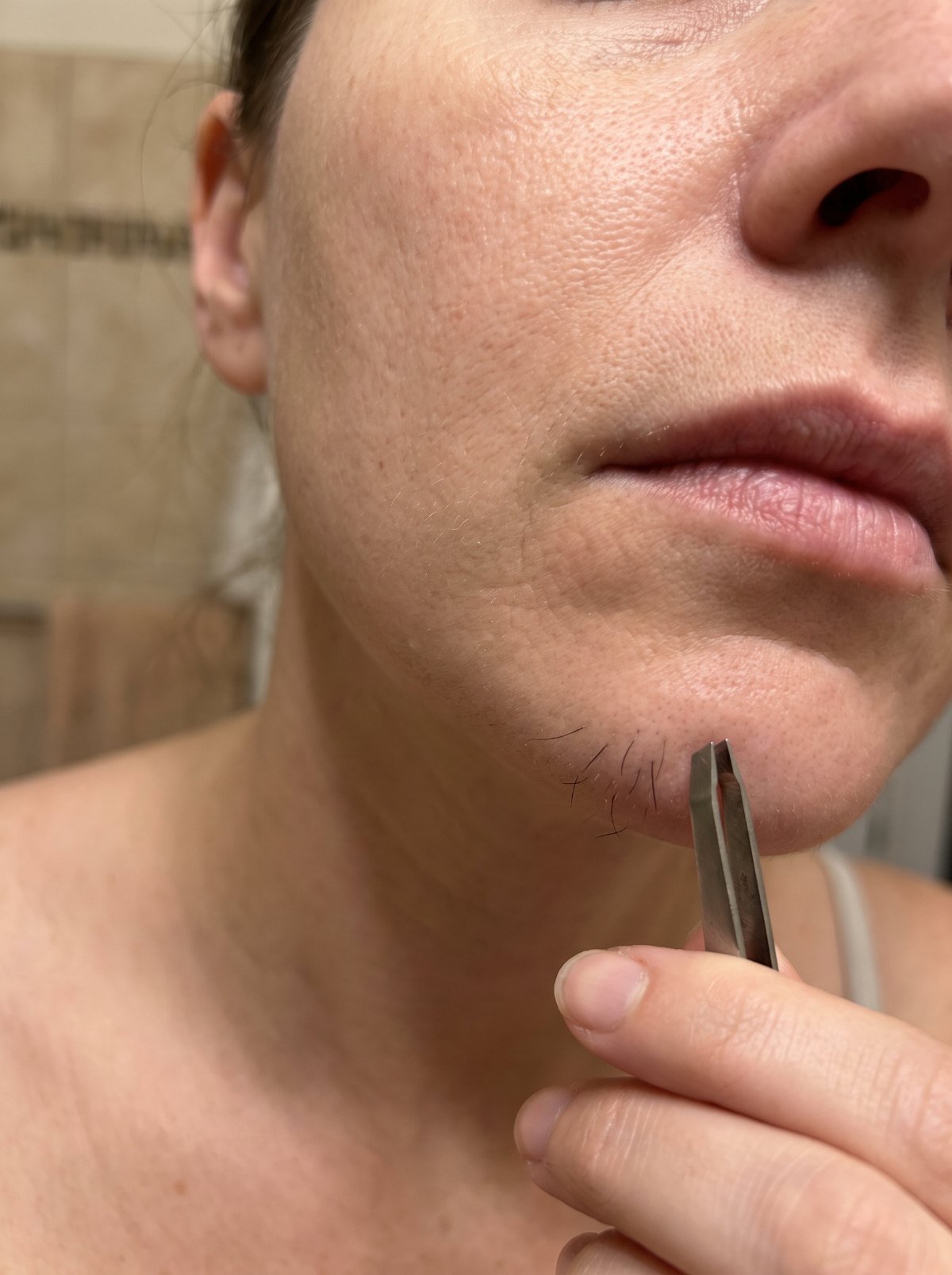
Hair follicles on the face respond to androgens. In women with higher androgen levels, or with follicles that are extra sensitive to them, fine, light “peach fuzz” hairs turn into coarse, dark terminal hairs over time.[3] That is why PMOS facial hair often starts as a few stubborn chin hairs and spreads slowly to the upper lip, jawline, sideburns and neck.
PMOS raises androgen activity in two main ways:
- The ovaries make more androgens. This is part of the “polyendocrine” in the new name: several hormone systems are involved.[1]
- Insulin pushes androgens up. Insulin resistance affects up to 85% of women with PMOS, including many at a lower weight.[5] High insulin levels boost androgen production and lower a protein called SHBG, which normally binds testosterone. Less SHBG means more free testosterone reaching the hair follicles.[10]
About 70-80% of women who see a doctor for hirsutism turn out to have PMOS.[4] But not every woman with PMOS gets facial hair, and how much hair you grow does not tell you how severe your PMOS is.
Is your facial hair a sign of PMOS?
Facial hair alone is not enough for a diagnosis. Doctors diagnose PMOS when at least two of three signs are present, after other causes have been ruled out: signs of high androgens (such as hirsutism or acne, or high levels in a blood test), irregular or missing ovulation, and polycystic ovaries on ultrasound or a high AMH level.[2]
To judge the hair itself, doctors use the modified Ferriman-Gallwey scale, which scores nine body areas. The 2023 international guideline treats a score of 4 to 6 or higher as hirsutism, with the exact cutoff depending on ethnicity.[2] You can do the same check at home in two minutes with our hirsutism self-check and bring the result to your appointment.
Some facial hair needs a quicker look. See a doctor soon if hair growth started suddenly or is getting worse fast, or if you notice a deeper voice, more muscle bulk, a receding hairline or an enlarged clitoris. These can point to a rare hormone-producing tumor rather than PMOS.[3]
What treatment does: slowing new growth
Medical treatment does not remove hair you already have. It slows down new growth and makes regrowing hairs finer, which also makes hair removal last longer. Because facial hair grows in cycles, it takes at least six months before you can tell whether a treatment works.[3]
| Treatment | What it does | Evidence |
|---|---|---|
| Combined birth control pill | Lowers androgen production and raises SHBG. First-line treatment for hirsutism in PMOS.[2] | Good |
| Anti-androgen, such as spironolactone | Blocks androgens at the follicle. Added if the pill alone is not enough after six months. Needs reliable contraception, because it can harm a developing baby.[2] | Good |
| Eflornithine cream | Slows facial hair growth while you use it. Works better combined with laser.[8] Not available in every country. | Moderate |
| Metformin | Mainly helps insulin resistance and metabolic health. On its own, it has little effect on hair.[2], [7] | Weak for hair |
The pill
The 2023 international PCOS (now PMOS) guideline recommends a combined birth control pill as the first medical treatment for hirsutism.[2] It reduces the amount of androgens your ovaries make and increases SHBG, so less free testosterone reaches your follicles. A Cochrane review found that the pill reduces hair scores, and that combining it with an anti-androgen works better than either alone.[7]
Anti-androgens
If your hair has not improved enough after six months on the pill, the guideline suggests adding an anti-androgen such as spironolactone.[2] Anti-androgens block androgens where they act. They should not be taken during pregnancy, so reliable contraception is essential.
Eflornithine cream
Eflornithine is a prescription cream for facial hair in women. It slows hair growth while you use it, and the effect wears off within weeks of stopping. In a randomized study, women who used eflornithine alongside laser had faster and better results than with laser alone.[8] It has been discontinued or is hard to get in some countries, so ask your doctor or pharmacist what is available where you live.
What about weight, diet and supplements?
If you have a higher weight, losing a modest amount can lower insulin and androgen levels and improve PMOS symptoms over time.[2] It is not a fast fix for facial hair, and many women with PMOS have facial hair at any weight. Supplements and herbal remedies have much weaker evidence. We cover the studies in supplements for hirsutism and spearmint tea.
What hair removal does: clearing the hair you have
Hair removal deals with the hair that is already there, while treatment slows the hair that is coming. In PMOS, you usually need both. In our 2019 survey of 269 women with hirsutism, 97% removed facial hair, most often by plucking, shaving or waxing.[11]
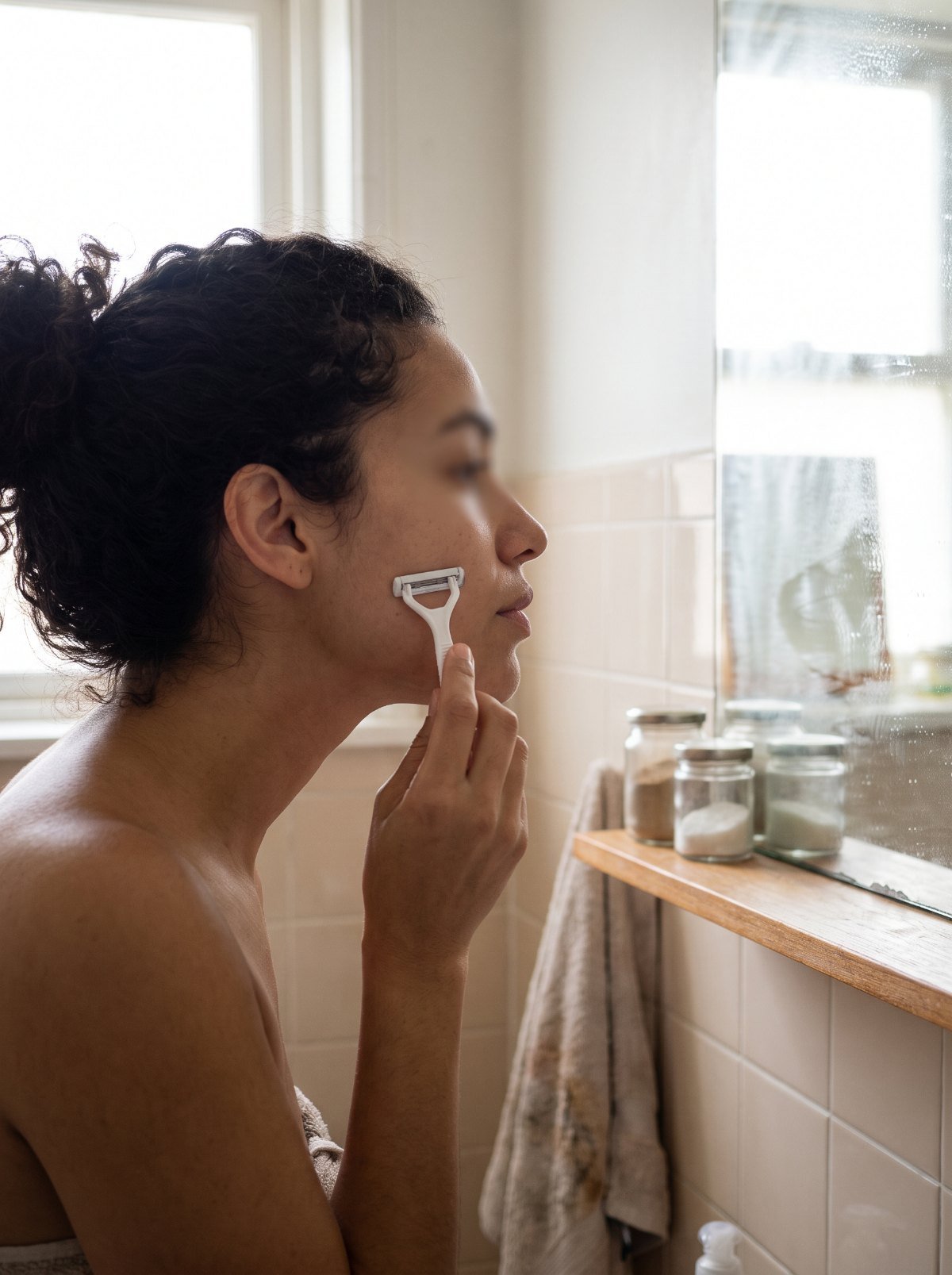
- Shaving is quick, painless and does not make hair grow back thicker. The regrowth just feels blunt. Many women with PMOS shave their face daily. Read our guide to shaving your face as a woman.
- Plucking and threading are fine for a few hairs, but frequent plucking can cause ingrown hairs and dark marks on the chin. See tweezing pros and cons.
- Laser gives long-lasting reduction of dark hair. With PMOS, hormones keep pushing new hairs into growth, so plan for top-up sessions.
- Electrolysis is the only method considered permanent, and it works on every hair color, including the gray and blond hairs laser cannot see.
Our PMOS hair removal guide compares the methods for hormone-driven hair in detail, and the laser vs electrolysis calculator estimates the sessions, time and cost for your face.
A plan that tends to work
- Get a diagnosis. Ask your doctor for an exam and blood tests, so you know whether PMOS or something else is behind the hair.[9] Not sure who to see? Use our which doctor should I see tool.
- Start treatment for new growth. Usually the pill, with an anti-androgen added after six months if needed.[2]
- Remove what is there. Shave or use eflornithine in the meantime, then start laser or electrolysis once you know what you can afford.
- Review at six months. Compare photos taken before hair removal, and ask your doctor whether to adjust treatment.
- Keep it going. If you stop hormonal treatment, facial hair usually returns gradually, because the underlying cause has not gone away.[3]
Frequently asked questions
Does PMOS facial hair ever go away on its own?
Rarely. Androgen-sensitive follicles keep producing coarse hair as long as androgen levels stay high. Treatment and hair removal can reduce it a lot, but most women need some form of ongoing management.[3]
Why do I have PMOS facial hair even though my blood tests are normal?
Some women’s follicles are more sensitive to androgens, so normal levels in the blood can still cause hair growth. Clinical signs, such as hair and acne, count as evidence of high androgens for a PMOS diagnosis even when blood tests look normal.[2]
Does birth control help PMOS facial hair?
Yes. A combined pill is the first-line treatment in the international guideline, and it usually reduces new growth within six to twelve months. It works best alongside hair removal.[2], [7]
Is it OK to shave my face with PMOS?
Yes. Shaving does not make hair thicker or darker, and it does not cause more hair to grow. It is a safe, cheap way to manage facial hair while treatment takes effect.
Key takeaways
- PMOS facial hair is caused by androgens, and insulin resistance makes it worse.
- About 70-80% of women seeing a doctor for hirsutism have PMOS, but facial hair alone does not mean you have it.
- Medical treatment slows new growth, and hair removal deals with existing hair. Most women need both.
- The pill is the first-line treatment, with an anti-androgen added if needed. Give each step at least six months.
- See a doctor quickly if hair growth is sudden or comes with a deeper voice or other signs of virilization.

Free: The Hirsutism Action Plan
A 12-page guide: what’s causing your hair growth, which tests to ask your doctor for, and which treatments actually work, plus a printable doctor visit checklist.
You’ll also get our weekly email. Unsubscribe anytime.
Sources
- Teede HJ, Bahri Khomami M, Morman R, et al. Polyendocrine metabolic ovarian syndrome, the new name for polycystic ovary syndrome: a multistep global consensus process. Lancet. 2026;407(10545):2329-2339. PubMed 42119588
- Teede HJ, Tay CT, Laven JJE, et al. Recommendations From the 2023 International Evidence-based Guideline for the Assessment and Management of Polycystic Ovary Syndrome. J Clin Endocrinol Metab. 2023;108(10):2447-2469. PubMed 37580314
- Martin KA, Anderson RR, Chang RJ, et al. Evaluation and Treatment of Hirsutism in Premenopausal Women: An Endocrine Society Clinical Practice Guideline. J Clin Endocrinol Metab. 2018;103(4):1233-1257. PubMed 29522147
- Escobar-Morreale HF, Carmina E, Dewailly D, et al. Epidemiology, diagnosis and management of hirsutism: a consensus statement by the Androgen Excess and Polycystic Ovary Syndrome Society. Hum Reprod Update. 2012;18(2):146-170. PubMed 22064667
- White L. PCOS Gets a New Name: Polyendocrine Metabolic Ovarian Syndrome (PMOS). AFP Community Blog, American Academy of Family Physicians. June 1, 2026. Link
- Better Health Channel (Victoria State Government). Polyendocrine metabolic ovarian syndrome (PMOS). Accessed October 2026. Link
- van Zuuren EJ, Fedorowicz Z, Carter B, Pandis N. Interventions for hirsutism (excluding laser and photoepilation therapy alone). Cochrane Database Syst Rev. 2015;(4):CD010334. Link
- Hamzavi I, Tan E, Shapiro J, Lui H. A randomized bilateral vehicle-controlled study of eflornithine cream combined with laser treatment versus laser treatment alone for facial hirsutism in women. J Am Acad Dermatol. 2007;57(1):54-59. doi:10.1016/j.jaad.2006.09.025
- NHS. Excessive hair growth (hirsutism). Accessed October 2026. Link
- Azziz R, Amiri M, Bril F, et al. Approach to the Patient: Hirsutism. J Clin Endocrinol Metab. 2025;110(10):e3503-e3519. PubMed 40200552
- myHirsutism. Hirsutism Survey 2019: responses from 269 women with hirsutism, collected January-February 2019 (83% also reported PCOS). Unpublished summary.